
UNITED STATES
SECURITIES AND EXCHANGE COMMISSION
Washington, D.C. 20549
_____________________
FORM 10-K
_____________________
(Mark One)
| ANNUAL REPORT PURSUANT TO SECTION 13 OR 15(d) OF THE SECURITIES EXCHANGE ACT OF 1934 | |||||
For the fiscal year ended December 31 , 2025
or
| TRANSITION REPORT PURSUANT TO SECTION 13 OR 15(d) OF THE SECURITIES EXCHANGE ACT OF 1934 | |||||
For the transition period from to
Commission File Number 1-12981
_____________________
(Exact name of registrant as specified in its charter)
_____________________
(State or other jurisdiction of
incorporation or organization)
(Address of principal executive offices)
(I.R.S. Employer
Identification No.)
(Zip Code)
Registrant’s telephone number, including area code: (610 ) 647-2121
Securities registered pursuant to Section 12(b) of the Act:
| Title of each class | Trading symbol(s) | Name of each exchange on which registered | ||||||
| (voting) | ||||||||
Securities registered pursuant to Section 12(g) of the Act: None
_____________________
Indicate by check mark if the registrant is a well-known seasoned issuer, as defined in Rule 405 of the Securities Act. Yes ☒ No ☐
Indicate by check mark if the registrant is not required to file reports pursuant to Section 13 or Section 15(d) of the Act. Yes ☐ No ☒
Indicate by check mark whether the registrant (1) has filed all reports required to be filed by Section 13 or 15(d) of the Securities Exchange Act of 1934 during the preceding 12 months (or for such shorter period that the registrant was required to file such reports), and (2) has been subject to such filing requirements for the past 90 days. Yes ☒ No ☐
Indicate by check mark whether the registrant has submitted electronically every Interactive Data File required to be submitted pursuant to Rule 405 of Regulation S-T (§232.405 of this chapter) during the preceding 12 months (or for such shorter period that the registrant was required to submit such files). Yes ☒ No ☐
Indicate by check mark whether the registrant is a large accelerated filer, an accelerated filer, a non-accelerated filer, a smaller reporting company, or an emerging growth company. See the definitions of “large accelerated filer,” “accelerated filer,” “smaller reporting company,” and “emerging growth company” in Rule 12b-2 of the Exchange Act.
☒ | Accelerated filer | ☐ | ||||||||||||
Non-accelerated filer | ☐ | Smaller reporting company | ||||||||||||
| Emerging growth company | ||||||||||||||
If an emerging growth company, indicate by check mark if the registrant has elected not to use the extended transition period for complying with any new or revised financial accounting standards provided pursuant to Section 13(a) of the Exchange Act. ☐
Indicate by check mark whether the registrant has filed a report on and attestation to its management's assessment of the effectiveness of its internal control over financial reporting under Section 404(b) of the Sarbanes-Oxley Act (15 U.S.C. 7262(b)) by the registered public accounting firm that prepared or issued its audit report. ☒
If securities are registered pursuant to Section 12(b) of the Act, indicate by check mark whether the financial statements of the registrant included in the filing reflect the correction of an error to previously issued financial statements. ☐
Indicate by check mark whether any of those error corrections are restatements that required a recovery analysis of incentive-based compensation received by any of the registrant's executive officers during the relevant recovery period pursuant to §240.10D-1(b). ☐
Indicate by check mark whether the registrant is a shell company (as defined in Rule 12b-2 of the Act). Yes ☐ No ☒
The aggregate market value of the voting stock held by non-affiliates of the registrant was approximately $41.8 billion as of June 30, 2025, the last business day of the registrant’s most recently completed second fiscal quarter.
The number of shares of the registrant’s Common Stock outstanding as of January 30, 2026 was 228,977,202 .
Documents Incorporated by Reference
AMETEK, Inc.
2025 Form 10-K Annual Report
Table of Contents
| Page | ||||||||
1
PART I
Item 1. Business
General Development of Business
AMETEK, Inc. (“AMETEK” or the “Company”) is incorporated in Delaware. Its predecessor was originally incorporated in Delaware in 1930 under the name American Machine and Metals, Inc. AMETEK is a leading global manufacturer of electronic instruments and electromechanical devices with operations in North America, Europe, Asia and South America. AMETEK maintains its principal executive offices at 1100 Cassatt Road, Berwyn, Pennsylvania, 19312. Listed on the New York Stock Exchange (symbol: AME), the common stock of AMETEK is a component of the Standard and Poor’s 500 and the Russell 1000 Indices.
Products and Services
AMETEK’s products are marketed and sold worldwide through two operating groups: Electronic Instruments (“EIG”) and Electromechanical (“EMG”). Electronic Instruments is a leader in the design and manufacture of advanced instruments for the process, power and industrial, and aerospace markets. Electromechanical is a differentiated supplier of precision motion control solutions, highly engineered medical components and devices, thermal management systems, specialty metals and electrical interconnects. Its end markets include aerospace and defense, medical, automation and other industrial markets.
Competitive Strengths
Management believes AMETEK has significant competitive advantages that help strengthen and sustain its market positions. Those advantages include:
Strong Market Share. AMETEK maintains strong market share in a number of targeted niche markets through its ability to produce and deliver high-quality, differentiated products at competitive prices. EIG has strong market positions in niche segments of the process, power and industrial, and aerospace markets. EMG holds strong positions in niche segments of the aerospace and defense, automation and medical markets.
Technological and Development Capabilities. AMETEK believes it has certain technological advantages over its competitors that allow it to maintain its leading market positions. Historically, the Company has demonstrated an ability to develop innovative new products and solutions that support customer needs. AMETEK has consistently added to its investment in research, development and engineering, and improved its new product development efforts with the adoption of Design for Six Sigma and Value Analysis/Value Engineering methodologies along with artificial intelligence tools. These have improved the pace and quality of product innovation and resulted in the introduction of a steady stream of new products across all of AMETEK’s businesses and aligned with attractive secular growth markets.
Efficient and Flexible Manufacturing Operations. Through its Operational Excellence initiatives, AMETEK has established a lean and flexible manufacturing platform for its businesses. In its effort to achieve best-cost manufacturing, AMETEK has operating facilities, as of December 31, 2025, in China, Czechia, Malaysia, Mexico, and Serbia. These facilities offer proximity to customers and provide opportunities for increasing international sales. Acquisitions also have allowed AMETEK to achieve operating synergies by consolidating operations, product lines and distribution channels, benefiting both of AMETEK’s operating groups.
Experienced Management Team. Another component of AMETEK’s success is the strength of its management team and that team’s commitment to improving Company performance. AMETEK senior management has extensive industry experience and an average of approximately 24 years of AMETEK service. The management team is focused on delivering strong, consistent and profitable growth, growing
2
shareholder value, and creating a sustainable future for all stakeholders. Individual performance is tied to financial results through Company-established stock ownership guidelines and equity incentive programs.
Business Strategy
AMETEK is committed to achieving earnings growth through the successful implementation of the AMETEK Growth Model. The goal of the Growth Model is high single digit annual percentage growth in sales and double digit annual percentage growth in earnings per share over the business cycle, strong cash flow generation, and a superior return on total capital. Other financial initiatives have been or may be undertaken, including public and private debt or equity issuance, bank debt refinancing, local financing in certain foreign countries and share repurchases.
AMETEK’s Growth Model integrates the four growth strategies of Operational Excellence, Strategic Acquisitions, Global and Market Expansion, and New Product Development with a focus on cash generation and capital deployment.
Operational Excellence. Operational Excellence is AMETEK’s cornerstone strategy for accelerating growth, improving profit margins and strengthening its competitive position across its businesses. Operational Excellence focuses on initiatives to drive increased organic sales growth, improvements in operating efficiencies and sustainable practices. It emphasizes team building and a participative management culture. AMETEK’s Operational Excellence strategies include lean manufacturing, global sourcing, Design for Six Sigma, Value Engineering/Value Analysis, growth kaizens, digitalization and use of artificial intelligence technology. Each plays an important role in improving efficiency, enhancing the pace and quality of innovation and driving profitable sales growth. Operational Excellence initiatives have yielded lower operating and administrative costs, shortened manufacturing cycle times, resulted in higher cash flow from operations and increased customer satisfaction. They also have played a key role in achieving synergies with newly acquired companies.
Strategic Acquisitions. Acquisitions are a key to achieving the goals of the AMETEK Growth Model. Since the beginning of 2021 through December 31, 2025, AMETEK has completed 15 acquisitions with annualized sales totaling approximately $1.8 billion. AMETEK targets companies that offer a compelling strategic, technical and cultural fit. It seeks to acquire businesses in adjacent markets with complementary products and technologies. It also looks for businesses that provide attractive growth opportunities aligned with strong secular growth themes, often in new and emerging markets. AMETEK’s management team has developed considerable skill in identifying, acquiring and integrating new businesses. As it has executed its acquisition strategy, AMETEK’s mix of businesses has shifted toward those that are more highly differentiated and, therefore, offer better opportunities for growth and profitability.
Global & Market Expansion. AMETEK has experienced significant growth outside the United States, reflecting an expanding international customer base, investments in its global infrastructure and the attractive growth potential of its businesses in overseas markets. While Europe remains its largest overseas market, AMETEK has pursued growth opportunities worldwide, especially in key emerging markets. It has grown sales in Latin America, Middle East and Asia by driving its global and market expansion strategy and initiatives. AMETEK also has expanded its sales, service, and engineering capabilities globally. Recently acquired businesses have further added to AMETEK’s international presence.
New Product Development. New products are essential to AMETEK’s long-term growth. As a result, AMETEK has maintained a consistent investment in new product development and engineering. AMETEK's businesses help solve our customers' most complex challenges with differentiated technology solutions. In 2025, AMETEK added to its highly differentiated product portfolio with a range of new products across many of its businesses.
AMETEK focuses on cash generation and capital deployment. AMETEK generates strong cash flow given its asset-light business model and strong operational execution. This cash flow supports AMETEK’s capital
3
deployment strategy with its primary focus on strategic, value-enhancing acquisitions. AMETEK is also committed to paying a consistently increasing cash dividend.
Attracting, retaining, and developing talent is critical to the success and sustainability of the AMETEK Growth Model as our employees are responsible for successfully driving these strategies.
2025 Overview
Operating Performance
In 2025, the Company posted record sales, operating income, net income, diluted earnings per share, orders, and backlog, as well as strong operating cash flow. The Company achieved these results from organic sales growth, contributions from recent acquisitions, as well as the Company's Operational Excellence initiatives. See "Results of Operations" in Part II, Item 7 Management's Discussion and Analysis of Financial Condition and Results of Operations for further details.
In 2025, the Company achieved sales of $7,401.1 million, an increase of 6.6% from 2024. Diluted earnings per share for 2025 were $6.40, an increase of $0.47 or 7.9%, compared with $5.93 per diluted share in 2024.
Recent Acquisitions
AMETEK spent $933.2 million in cash, net of cash acquired, to purchase two businesses:
In January 2025, AMETEK acquired Kern Microtechnik ("Kern"), a leading manufacturer of high-precision machining and optical inspection solutions.
In July 2025, AMETEK acquired FARO Technologies ("FARO"), a leading provider of 3D measurement and imaging solutions.
Financing
In the second quarter of 2025, the Company paid in full, at maturity, a $50.0 million in aggregate principal amount of 3.91% senior notes. In the third quarter of 2025, the Company paid in full, at maturity, a $100.0 million in aggregate principal amount of 3.96% senior notes. In the fourth quarter of 2025, the Company paid in full, at maturity, a $275.0 million in aggregate principal amount of 4.18% senior notes. See Note 10 to the Consolidated Financial Statements included in Part II, Item 8 of this Annual Report on Form 10-K for further details.
Recently Adopted Accounting Pronouncement
In December 2023, the FASB issued ASU No. 2023-09, Income Taxes (Topic 740): Improvements to Income Tax Disclosures ("ASU 2023-09"), which improves income tax disclosures on an annual basis. The Company retrospectively adopted ASU 2023-09, effective December 31, 2025, and the adoption resulted in additional disclosures in the Income Taxes footnote. See Note 2 to the Consolidated Financial Statements included in Part II, Item 8 of this Annual Report on Form 10-K for further details.
Description of Business
Described below are the products and markets of each reportable segment:
EIG
EIG is a leader in the design and manufacture of advanced analytical, test and measurement instruments for the process, aerospace, medical, research, power and industrial markets.
4
EIG is a leader in many of the specialized markets it serves. Products supplied to these markets include process, test, measurement and analytical instruments for the life sciences, pharmaceutical, semiconductor, automation, power, food and beverage, oil and gas, and petrochemical industries. It provides a growing range of instruments to the research and laboratory equipment, ultra-precision manufacturing and metrology, optics, medical, and test and measurement markets. It is a leader in power quality monitoring and metering, uninterruptible power systems, programmable power equipment, electromagnetic compatibility test equipment, sensors for gas turbines, dashboard instruments for heavy trucks, and instrumentation and controls for the food and beverage industries. EIG supplies the aerospace industry with aircraft and engine sensors, monitoring systems, embedded computing systems, power supplies, fuel and fluid measurement systems, and data acquisition systems.
In many instances, EIG's products differ from or are technologically superior to its competitors’ products. EIG has achieved competitive advantage through continued investment in research, development and engineering to develop market-leading products and solutions that serve niche markets.
In 2025, 52% of EIG’s net sales were to customers outside the United States. At December 31, 2025, EIG employed approximately 12,800 people, of whom approximately 900 were covered by collective bargaining agreements. At December 31, 2025, EIG had operating facilities in the United States, the United Kingdom, Germany, Canada, Denmark, Finland, France, Switzerland, Argentina, Austria, Serbia, and Mexico. EIG also shares operating facilities with EMG in China, Serbia, and Mexico.
Process and Analytical Instrumentation Markets and Products
Process and analytical instrumentation sales represented 70% of EIG’s 2025 net sales. These businesses include process analyzers, emission monitors and spectrometers; elemental and surface analysis instruments; level, pressure and temperature sensors and transmitters; radiation measurement devices; level measurement devices; precision manufacturing systems; materials- and force-testing instruments; contact and non-contact metrology products; and clinical and educational communication solutions. Among the industries it serves are power generation, pharmaceutical manufacturing, medical and healthcare, research and development, water and waste treatment, renewable energy production, semiconductor manufacturing, natural gas distribution, emissions monitoring, and oil, gas, and petrochemical refining. I
ts instruments are used for precision measurement in a number of applications, including radiation detection, trace element and materials analysis, nanotechnology research, ultraprecise manufacturing, advanced optical metrology, and test and measurement.
Acquired in July 2025, FARO is a leading provider of 3D measurement and imaging solutions, including portable measurement arms, laser scanners and trackers, software solutions, and comprehensive service offerings. FARO's 3D metrology and digital reality solutions expand and enhance the Company's existing ultra precision technologies business.
Acquired in January 2025, Kern is a leading manufacturer of high-precision machining and optical inspection solutions. Kern's design and engineering capabilities complement the Company's existing ultra precision technologies business.
Acquired in October 2024, Virtek is a leading provider of advanced laser-based projection and inspection systems. Virtek's advanced 3D laser projectors, smart cameras, and quality control inspection systems complement the Company's existing Creaform business capabilities.
Aerospace and Power Instrumentation Markets and Products
Aerospace and Power Instrumentation sales represented 30% of EIG’s 2025 net sales. These businesses produce a wide array of instrumentation, systems and sensors for applications in the aerospace, power and industrial markets.
5
These businesses produce power monitoring and metering instruments, uninterruptible power supply systems and programmable power supplies used in a wide range of industrial settings. It is a leader in the design and manufacture of power measurement, quality monitoring and event recorders for use in power generation, transmission and distribution. These businesses provide uninterruptible power supply systems, multifunction electric meters, and highly specialized communications equipment for smart grid applications, renewable energy applications and data centers. It also offers precision power supplies and power conditioning products, and electrical immunity and EMC test equipment, sensors for electric vehicle testing, gas turbines, dashboard instruments for heavy trucks and other vehicles, and instrumentation and controls for the food and beverage industries.
AMETEK’s aerospace products are designed to customer specifications and manufactured to stringent operational and reliability requirements. These products include airborne data systems, turbine engine temperature measurement products, vibration-monitoring systems, cockpit instruments and displays, fuel and fluid measurement products, embedded computing systems, and sensors and switches. AMETEK serves all segments of the commercial and military aerospace market, including commercial aircraft, business jets, regional aircraft and helicopters.
AMETEK operates in highly specialized aerospace market segments in which it has proven technological or manufacturing advantages versus its competition. Among its more significant competitive advantages is its 70-year-plus reputation as an established aerospace supplier. AMETEK has long-standing relationships with the world’s leading commercial and military aircraft, jet engine and original equipment manufacturers and aerospace system integrators. AMETEK also is a leading provider of spare part sales, repairs and overhaul services to commercial aerospace.
Customers
EIG is not dependent on any single customer such that the loss of that customer would have a material adverse effect on EIG’s operations. Approximately 4% of EIG’s 2025 net sales were made to its five largest customers. No single customer comprises more than 2% of net sales.
EMG
EMG is a leader in the design and manufacture of highly engineered medical components and devices, automation solutions, thermal management systems, specialty metals and electrical interconnects. EMG is a leader in many of the niche markets in which it competes. Products supplied to these markets include single-use and consumable surgical instruments, implantable components, and drug delivery systems used across a wide range of medical applications, advanced precision motion control solutions, which are used in a wide range of automation applications across the medical, semiconductor, aerospace, defense, and food and beverage industries, as well as highly engineered electrical connectors and electronics packaging used in aerospace and defense, medical, and industrial applications.
EMG supplies high-purity powdered metals, strip and foil, specialty clad metals and metal matrix composites. EMG's heat exchangers provide electronic cooling and environmental control for the aerospace and defense and semiconductor industries. EMG's motors are widely used in commercial appliances, food and beverage machines, hydraulic pumps and industrial blowers. Additionally, EMG operates a global network of aviation maintenance, repair and overhaul (“MRO”) facilities.
EMG designs and manufactures products that, in many instances, are significantly different from or technologically superior to competitors’ products. It has achieved competitive advantage through continued investment in research, development and engineering, efficiency improvements from operational excellence, acquisition synergies and improved supply chain management.
In 2025, 42% of EMG’s net sales were to customers outside the United States. At December 31, 2025, EMG employed approximately 9,400 people, of whom approximately 2,300 were covered by collective bargaining agreements. At December 31, 2025, EMG had operating facilities in the United States, the United Kingdom, China,
6
Germany, France, Italy, Poland, Mexico, Serbia, Czechia, Malaysia, and Taiwan. EMG also shares operating facilities with EIG in China, Serbia, and Mexico.
Automation and Engineered Solutions Markets and Products
Automation and Engineered Solution sales represented 70% of EMG’s 2025 net sales. These businesses produce precision motion control solutions, brushless motors, blowers and pumps, heat exchangers and other electromechanical systems. These products are used in a wide variety of high-precision discrete automation applications, including semiconductor, laboratory and medical equipment.
AMETEK is a leader in highly engineered single-use and consumable surgical instruments, implantable components and drug delivery systems. Its electrical connectors and electronics packaging are designed specifically for harsh environments and highly customized applications, and are used to protect sensitive devices and mission-critical electronics. In addition, AMETEK is an innovator and market leader in specialized metal powder, strip, wire and bonded products used in medical, aerospace and defense, telecommunications, automotive and general industrial applications.
Aerospace Markets and Products
Aerospace sales represented 30% of EMG’s 2025 net sales. These businesses produce motor-blower systems and heat exchangers used in thermal management and other applications on a variety of military and commercial aircraft and military ground vehicles. In addition, these businesses provide the commercial and military aerospace industry with third-party MRO services on a global basis with facilities in the United States, Europe and Asia.
Customers
EMG is not dependent on any single customer such that the loss of that customer would have a material adverse effect on EMG’s operations. Approximately 15% of EMG’s 2025 net sales were made to its five largest customers. No single customer comprises greater than 5% of net sales.
Marketing
AMETEK’s marketing efforts generally are organized and carried out at the business level. EIG makes use of specialized distributors and sales representatives to market its products along with a direct sales force for its technically sophisticated products. Within aerospace, the specialized customer base of aircraft and jet engine manufacturers is served primarily by direct sales engineers. Given the technical nature of its many products, as well as its strong market share, EMG conducts much of its domestic and international marketing activities through a direct sales force and makes some use of sales representatives and distributors, both in the United States and in other countries.
Competition
In general, AMETEK’s markets are highly competitive with competition based on technology, performance, quality, service and price.
In EIG’s markets, AMETEK believes it ranks as a leader in certain analytical measurement and control instruments, and power and industrial markets. It also is a major instrument and sensor supplier to commercial aviation. In process and analytical instruments, numerous companies compete in each market on the basis of product quality, performance and innovation. In power and industrial and in aerospace, AMETEK competes with a number of companies depending on the specific market segment.
EMG’s businesses compete with a number of companies in each of its markets. Competition is generally based on product innovation, performance and price. There also is competition from alternative materials and processes.
7
8
Availability of Raw Materials
AMETEK’s reportable segments obtain raw materials and supplies from a variety of sources and generally from more than one supplier. For EMG, however, certain items, including various base metals and certain steel components, are available from only a limited number of suppliers. AMETEK believes its sources and supplies of raw materials are adequate for its needs.
Environmental and Other Governmental Regulation
AMETEK's operations and properties are subject to laws and regulations relating to environmental protection, including those governing air emissions, water discharges, waste management, and workplace safety. The Company uses, generates and disposes of hazardous substances and waste in its operations and could be subject to material liabilities relating to the investigation and clean-up of contaminated properties and related claims. The Company is required to conform our operations and properties to these laws and adapt to regulatory requirements in all countries as these requirements change. The Company has a robust Environmental Health and Safety program responsible for supporting its environmental monitoring and compliance efforts. In connection with acquisitions, the Company will assess potential material environmental liabilities, and determine regulatory and fiduciary obligations during the course of the due diligence process. In addition, new laws and regulations, the discovery of previously unknown contamination or the imposition of new requirements could increase costs or subject AMETEK to new or increased liabilities.
Information with respect to environmental matters is set forth in Note 13 to the Consolidated Financial Statements included in Part II, Item 8 of this Annual Report on Form 10-K.
Patents, Licenses and Trademarks
AMETEK owns numerous unexpired U.S. and foreign patents, including counterparts of its more important U.S. patents, in the major industrial countries of the world. It is a licensor or licensee under patent agreements of various types, and its products are marketed under various registered and unregistered U.S. and foreign trademarks and trade names. AMETEK, however, does not consider any single patent or trademark, or any group of them, essential either to its business as a whole or to either one of its reportable segments. The annual royalties received or paid under license agreements are not significant to either of its reportable segments or to AMETEK’s overall operations.
Sustainability and Human Capital Management
Sustainability
AMETEK is committed to providing a consistent and excellent return to our stakeholders, all while maintaining a strong commitment to environmental stewardship, social responsibility, inclusion, and sound corporate governance. We believe that effectively prioritizing and managing our sustainability initiatives will help create long-term value and a better future for our stakeholders.
Our Sustainability Report highlights our sustainability initiatives and is available on our website at https://www.ametek.com/who-we-are/sustainability.
Key elements in the Company’s approach to sustainability include the following:
Core Values. Our core values — Ethics and Integrity, Respect for the Individual, Inclusion, Teamwork, and Social Responsibility — remain the most critical components of our sustainability efforts. Sustainability is an integral aspect of the core values that guide the way we do business.
Upholding Sound Governance. Our commitment to transparency, accountability, and ethical and responsible decision-making is demonstrated through our core values, corporate governance structure, compliance measures, and focus on sustainability oversight. Together, AMETEK’s governance structure underpins our distributed
9
operating structure and provides our colleagues with the foundation to advance sustainability initiatives across their businesses.
Protecting Our Environment. Our ongoing commitment to serve as environmental stewards and protect the environment for future generations is reflected in our proactive approach to environmental management and sustainability. From emissions reduction initiatives to optimizing resource consumption, we emphasize environmental protection in every facet of our operations. We are firmly committed to reducing our carbon footprint and have made outstanding progress toward our stated greenhouse gas emissions reduction target.
Investing in Our People. Our people are the most essential resource in driving AMETEK’s long-term success and in achieving our sustainability ambitions. AMETEK is committed to developing an inclusive culture to help power innovation, growth, and greater opportunities for all employees. Through strategic investments in talent acquisition, learning and development, and employee well-being, we foster a culture of empowerment, innovation, and inclusivity, driving our collective success and sustainable growth. We are continually expanding our employee development, engagement, and training initiatives to provide meaningful opportunities for personal and professional development.
Driving Sustainable Product Solutions. AMETEK is committed to advancing a low-carbon economy. Our growing portfolio of clean technology and sustainability-related solutions includes a wide range of products and solutions that have a positive, global environmental impact across a broad set of diverse end markets, supporting customers in achieving their sustainability goals and creating a more sustainable future. Through collaborative partnerships with our customers, we develop solutions which help reduce carbon emissions, promote renewable energy adoption, improve efficiency and productivity, and improve healthcare outcomes.
Partnering with Our Communities. We cultivate strong and lasting relationships with the communities in which we operate, actively contributing to their social and economic prosperity. Our charitable arm, the AMETEK Foundation, provides wide-ranging support to non-profit and educational organizations. Through employee volunteerism, financial support, and contributions from the AMETEK Foundation, we partner to strengthen the work of non-profit charities around the world.
Human Capital Management
As a global organization, we have seen firsthand that the innovation needed to solve our customers’ biggest challenges can only come from employees that are fully engaged and committed, and who have diverse perspectives and backgrounds. Our Board regularly receives updates and presentations on key topics, including sustainability, compliance, inclusion, and employee development and succession.
Our executive management team reviews the key talent across our company and assesses the adequacy of talent to meet business challenges and future growth needs. We have an active Inclusion Council, which drives initiatives focused on mentorship, education and career guidance.
We have created a leadership development program for employees on track to become P&L leaders in the company. This focused and intensive program involves both internal and external training on leadership effectiveness as well as specific job-related skills. In addition, participants receive hands-on experience in key AMETEK business system processes such as growth kaizens and acquisition due diligence. We have a long-standing commitment to responsible corporate conduct. Each employee is provided with annual performance goals which are reviewed in a performance review with their manager. Employee feedback is actively encouraged through an open-door policy for all managers, regular town hall/all hands meetings, executive presentations with Q&A sessions, a regular CEO podcast for all employees, and a hotline that can be used to report complaints.
Giving back to our community is an important part of our culture. Established in 1960, the AMETEK Foundation’s mission is to empower AMETEK colleagues making a positive impact in their local communities, with a focus on health and welfare, civic and social service programs, and education.
As of December 31, 2025, we have approximately 22,500 employees. Our compensation programs are designed to provide competitive salaries and benefit programs to attract, retain and motivate a world-class
10
workforce. Selected employees participate in short and long-term incentive programs that align employee and shareholder interests and promote long-term retention. Additionally, we strive to protect health and safety in every aspect of our enterprise – from the way we design, manufacture and deliver our products to the way our customers use them. We continue to drive towards our goal of zero lost-time work incidents. In 2025, we achieved a lost-time incident rate that was significantly below the industry average. We continue to enhance our safety initiatives as each facility is tasked with identifying opportunities for additional safety measures. Businesses with zero incidents share best practices and ensure ongoing training to maintain their safety excellence. In addition to our EHS facility audits, our facilities include safety committees, continual training, documented self-audits, and behavior-based safety observations and feedback.
Our U.S. Federal Employment Information Report (EEO-1) for 2024 is available at www.ametek.com.
Available Information
AMETEK’s annual report on Form 10-K, quarterly reports on Form 10-Q, current reports on Form 8-K and all amendments to those reports filed or furnished pursuant to Section 13(a) of the Securities Exchange Act of 1934 are made available free of charge on the Company’s website at www.ametek.com in the “Investors – Reporting” section as soon as reasonably practicable after such material is electronically filed with, or furnished to, the U.S. Securities and Exchange Commission. All reports filed with the Securities and Exchange Commission can also be viewed on their website at www.sec.gov. AMETEK has posted in the “Investors – Governance” section of its website its corporate governance guidelines, Board committee charters, codes of ethics, and social and environmental policies. Those documents also are available free of charge in published form to any stockholder who requests them by writing to the Investor Relations Department at AMETEK, Inc., 1100 Cassatt Road, Berwyn, Pennsylvania, 19312.
The Company has adopted a Code of Ethics for the principal executive office, principal financial office and principal accounting officer, which may be found on the Company's website at www.ametek.com. Any amendments to the Code of Ethics or any grant of a waiver from the provision of the Code of Ethics requiring disclosure under applicable U.S. Securities and Exchange Commission rules will be disclosed on the Company's website.
Item 1A. Risk Factors
You should consider carefully the following risk factors and all other information contained in this Annual Report on Form 10-K and the documents we incorporate by reference in this Annual Report on Form 10-K. Any of the following risks could materially and adversely affect our business, financial condition, results of operations and cash flows.
Risks Related to Our Operations
Our growth could suffer if the markets into which we sell our products and services decline, do not grow as anticipated, experience cyclicality, or a general downturn in the economy could adversely affect our business.
A number of the industries in which we operate are cyclical in nature and therefore are affected by factors beyond our control. A downturn in the U.S. or global economy, and, in particular, in the aerospace and defense, oil and gas, process instrumentation or power markets could have an adverse effect on our business, financial condition and results of operations.
Our growth depends in part on the growth of the markets which we serve. Visibility into the future performance of certain of our markets is limited (particularly for markets into which we sell through distribution). Our quarterly sales and profits depend substantially on the volume and timing of orders received during the fiscal quarter, which are difficult to forecast. Any decline or lower than expected growth in our served markets could diminish demand for our products and services, which would adversely affect our financial statements. A number of our businesses operate in industries that may experience periodic, cyclical downturns. In addition, in certain of our
11
businesses, demand depends on customers’ capital spending budgets, as well as government funding policies. Matters of public policy and government budget dynamics, as well as product and economic cycles, can affect the spending decisions of these customers. Demand for our products and services is also sensitive to changes in customer order patterns, which may be affected by announced price changes, changes in incentive programs, new product introductions and customer inventory levels. Any of these factors could adversely affect our growth and results of operations in any given period.
We may not properly execute, or realize anticipated cost savings or benefits from, our Operational Excellence initiatives.
Our success is partly dependent upon properly executing and realizing cost savings or other benefits from our ongoing production and procurement initiatives. These initiatives are primarily designed to make the Company more efficient, which is necessary in the Company’s highly competitive industries. These initiatives are often complex, and a failure to implement them properly may, in addition to not meeting projected cost savings or benefits, adversely affect our business and operations.
Foreign and domestic economic, political, legal, compliance and business factors could negatively affect our international sales and operations.
International sales for 2025 and 2024 represented 48.2% and 47.4% of our consolidated net sales, respectively. As a result of our growth strategy, we anticipate that the percentage of sales outside the United States will increase in the future. As of December 31, 2025, we have manufacturing operations in 22 countries outside the United States, with significant operations in Canada, China, France, Germany, Mexico, Serbia, Poland and the United Kingdom. A disruption of our ability to obtain a supply of goods from these countries or a change in the cost to purchase, manufacture, or distribute these products could have an adverse effect on our sales and operations. International sales and operations are subject to the customary risks of operating in an international environment, including:
•Imposition of trade or foreign exchange restrictions, including in the United States;
•Overlap of different tax structures, including the development of a global minimum tax;
•Unexpected changes in regulatory requirements, including in the United States;
•Trade protection measures, such as the imposition of or increase in tariffs and other trade barriers, including in the United States;
•The difficulty and/or costs of designing and implementing an effective control environment across diverse regions and employee bases;
•Restrictions on currency repatriation;
•General economic conditions;
•Unstable political situations and social unrest, both internationally and in the United States;
•Increasing trade tensions between the United States and certain countries, including China;
•Nationalization of assets; and
•Compliance with a wide variety of international and U.S. laws and regulatory requirements.
Furthermore, fluctuations in foreign currency exchange rates, including changes in the relative value of currencies in the countries where we operate, subject us to exchange rate exposure and may adversely affect our
12
financial statements. For example, increased strength in the U.S. dollar will increase the effective price of our products sold overseas, which may adversely affect sales or require us to lower our prices. In addition, our consolidated financial statements are presented in U.S. dollars, and we must translate our assets, liabilities, sales and expenses into U.S. dollars for external reporting purposes. As a result, changes in the value of the U.S. dollar due to fluctuations in currency exchange rates or currency exchange controls may materially and negatively affect the value of these items in our consolidated financial statements, even if their value has not changed in their local currency.
Our international sales and operations may be adversely impacted by compliance with export laws.
We are required to comply with various import, export, export control and economic sanctions laws, which may affect our transactions with certain customers, business partners and other persons, including in certain cases dealings with or between our employees and subsidiaries. In certain circumstances, export control and economic sanctions regulations may prohibit the export of certain products, services and technologies and in other circumstances, we may be required to obtain an export license before exporting a controlled item. In addition, failure to comply with any of these regulations could result in civil and criminal, monetary and non-monetary penalties, disruptions to our business, limitations on our ability to import and export products and services and damage to our reputation.
Our reputation, ability to do business and financial statements may be impaired by improper conduct by any of our employees, agents or business partners.
We cannot provide assurance that our internal controls and compliance systems will always protect us from acts committed by employees, agents or business partners of ours (or of businesses we acquire or partner with) that would violate U.S. and/or non-U.S. laws, including the laws governing payments to government officials, bribery, fraud, kickbacks and false claims, pricing, sales and marketing practices, conflicts of interest, competition, export and import compliance, money laundering and data privacy. In particular, the U.S. Foreign Corrupt Practices Act, the U.K. Bribery Act and similar anti-bribery laws in other jurisdictions generally prohibit companies and their intermediaries from making improper payments to government officials for the purpose of obtaining or retaining business, and we operate in many parts of the world that have experienced governmental corruption to some degree. Any such improper actions or allegations of such acts could damage our reputation and subject us to civil or criminal investigations in the U.S. and in other jurisdictions and related shareholder lawsuits could lead to substantial civil and criminal, monetary and non-monetary penalties and could cause us to incur significant legal and investigatory fees. In addition, we rely on our suppliers to adhere to our supplier standards of conduct and violations of such standards of conduct could occur that could have a material effect on our financial statements.
Any inability to hire, train and retain a sufficient number of skilled officers and other employees could impede our ability to compete successfully.
If we cannot hire, train and retain a sufficient number of qualified employees, we may not be able to effectively integrate acquired businesses and realize anticipated results from those businesses, manage our expanding international operations and otherwise profitably grow our business. Even if we do hire and retain a sufficient number of employees, the expense necessary to attract and motivate these officers and employees may adversely affect our results of operations.
If we are unable to develop new products on a timely basis, it could adversely affect our business and prospects.
We believe that our future success depends, in part, on our ability to develop, on a timely basis, technologically advanced products that meet or exceed appropriate industry standards. Maintaining our existing technological advantages will require us to continue investing in research and development and sales and marketing. There can be no assurance that we will have sufficient resources to make such investments, that we will be able to make the technological advances necessary, including through the use of artificial intelligence, to maintain such competitive advantages or that we can recover major research and development expenses. We are not currently aware of any emerging standards or new products which could render our existing products obsolete, although there can be no assurance that this will not occur or that we will be able to develop and successfully market new products.
13
Our technology is important to our success and our failure to protect this technology could put us at a competitive disadvantage.
Many of our products rely on proprietary technology; therefore, we endeavor to protect our intellectual property rights through patents, copyrights, trade secrets, trademarks, confidentiality agreements and other contractual provisions. Despite our efforts to protect proprietary rights, unauthorized parties or competitors may copy or otherwise obtain and use our products or technology. In addition, our ability to protect and enforce our intellectual property rights may be limited in certain countries outside the U.S. Actions to enforce our rights may result in substantial costs and diversion of resources and we make no assurances that any such actions will be successful.
A disruption in, shortage of, or price increases for, supply of our components and raw materials may adversely impact our operations.
While we manufacture certain parts and components used in our products, we require substantial amounts of raw materials and purchase some parts and components, including semiconductor chips and other electronic components, from suppliers. The availability and prices for raw materials, parts and components may be subject to curtailment or change due to, among other things, suppliers' allocation to other purchasers, interruptions in production by suppliers, changes in exchange rates and prevailing price levels. In addition, our facilities, supply chains, distribution systems, and products may be impacted by natural or man-made disruptions, including armed conflict, damaging weather or other acts of nature, pandemics or other public health crises. A shutdown of, or inability to utilize, one or more of our facilities, our supply chain, or our distribution system could significantly disrupt our operations, delay production and shipments, damage our relationships and reputation with customers, suppliers, employees, stockholders and others, result in lost sales, result in the misappropriation or corruption of data, or result in legal exposure and large remediation or other expenses. Furthermore, certain items, including base metals and certain steel components, are available only from a limited number of suppliers and are subject to commodity market fluctuations. Shortages in raw materials or price increases therefore could affect the prices we charge, our operating costs and our competitive position, which could adversely affect our business, financial condition, results of operations and cash flows.
We are subject to numerous governmental regulations, which may be burdensome or lead to significant costs.
Our operations are subject to numerous federal, state, local and foreign governmental laws and regulations. In addition, existing laws and regulations may be revised or reinterpreted and new laws and regulations, including with respect to privacy legislation and climate change, may be adopted or become applicable to us or customers for our products. These laws continue to develop and may be inconsistent from jurisdiction to jurisdiction. Complying with emerging and changing international requirements may cause the Company to incur substantial costs or require the Company to change its business practices. We cannot predict the form any such new laws or regulations will take or the impact any of these laws and regulations will have on our business or operations.
We operate in highly competitive industries, which may adversely affect our results of operations or ability to expand our business.
Our markets are highly competitive. We compete, domestically and internationally, with individual producers, as well as with vertically integrated manufacturers, some of which have resources greater than we do. The principal elements of competition for our products are product technology, quality, service, distribution and price. Although we believe EIG is a market leader, competition is strong and could intensify in the markets served by EIG. In the aerospace markets served by EIG, a limited number of companies compete on the basis of product quality, performance and innovation. EMG’s competition in specialty metal products stems from alternative materials and processes. Our competitors may develop new or improve existing products that are superior to our products or may adapt more readily to new technologies or changing requirements of our customers. There can be no assurance that our business will not be adversely affected by increased competition in the markets in which it operates or that our products will be able to compete successfully with those of our competitors.
14
Our business and financial performance could be adversely impacted by a significant disruption in, or breach in security of, our information technology systems.
We rely on information technology systems, some of which are managed by third-parties, to process, transmit and store electronic information (including sensitive data such as confidential business information and personally identifiable data relating to employees, customers, other business partners and patients), and to monitor, manage, and support a variety of critical business processes and activities including receiving and fulfilling orders, billing, collecting and making payments, shipping products, providing services and support to customers and fulfilling contractual obligations. Despite our implementation of certain controls to protect our systems and sensitive, confidential or personal data or information, these systems, products, data and services may be damaged, compromised, disrupted or shut down due to attacks by computer hackers, computer viruses, ransomware, misuse of artificial intelligence, human error or malfeasance, power outages, hardware failures, telecommunication or utility failures, catastrophes or other unforeseen events. In any such circumstances, our system redundancy and other disaster recovery planning may be ineffective or inadequate. Further, we also face information security risks due to our reliance on internet technology and use of hybrid work arrangements, which could strain our technology resources or create additional opportunity for cyber-attackers to exploit vulnerabilities. Moreover, the rapid evolution and adoption of artificial intelligence may increase our cybersecurity risks.
Attacks may also target hardware, software and information installed, stored or transmitted in our products after such products have been purchased and incorporated into third-party products, facilities or infrastructure. Like most multinational corporations, our information technology systems have been subject to computer viruses, malicious codes, unauthorized access and other cyber-attacks and we expect the sophistication and frequency of such attacks to continue to increase. Any of the attacks, breaches or other disruptions or damage described above could interrupt our operations or the operations of our customers and partners, delay production and shipments, result in theft of intellectual property and trade secrets, damage customer and business partner relationships and our reputation or result in defective products or services, legal claims and proceedings, liability and penalties under privacy laws and increased costs for security and remediation, each of which could adversely affect our business, reputation and financial statements. Further, given the increasing sophistication of cyber-attacks and the complexity of techniques used, any of these attacks or breaches could potentially persist for an extended period before being detected. As a result, it could take a significant time before an investigation can be completed and new disclosure regulations could result in us being required to disclose information about a material cybersecurity incident before it has been mitigated or resolved, or even fully investigated. Although we maintain cyber risk insurance, damages and claims arising from such incidents may not be covered or may exceed the amount of any insurance available.
Risks Related to Our Acquisitions
Our growth strategy includes strategic acquisitions. We may not be able to consummate future acquisitions or successfully integrate recent and future acquisitions.
A portion of our growth has been attributed to acquisitions of strategic businesses. We plan to continue making strategic acquisitions to enhance our global market position and broaden our product offerings. Although we have been successful with our acquisition strategy in the past, our ability to successfully effectuate acquisitions will be dependent upon a number of factors, including:
•Our ability to identify acceptable acquisition candidates;
•The impact of increased competition for acquisitions, which may increase acquisition costs, affect our ability to consummate acquisitions on favorable terms, and result in us assuming a greater portion of the seller’s liabilities;
•Successfully integrating acquired businesses, including integrating the management, technological and operational processes, procedures and controls of the acquired businesses with those of our existing operations;
15
•Adequate financing for acquisitions being available on terms acceptable to us;
•Unexpected losses of key employees, customers and suppliers of acquired businesses;
•Mitigating assumed, contingent and unknown liabilities; and
•Challenges in managing the increased scope, geographic diversity and complexity of our operations.
The process of integrating acquired businesses into our existing operations may result in unforeseen operating difficulties and may require additional financial resources and attention from management that would otherwise be available for the ongoing development or expansion of our existing operations. Furthermore, even if successfully integrated, the acquired business may not achieve the results we expected or produce expected benefits in the time frame planned. Failure to continue with our acquisition strategy and the successful integration of acquired businesses could have an adverse effect on our business, financial condition, results of operations and cash flows.
The indemnification provisions of acquisition agreements by which we have acquired companies may not fully protect us and as a result we may face unexpected liabilities.
Certain of the acquisition agreements by which we have acquired companies require the former owners to indemnify us against certain liabilities related to the operation of the company before we acquired it. In most of these agreements, however, the liability of the former owners is limited, and certain former owners may be unable to meet their indemnification responsibilities. We may also obtain representation and warranty insurance to address certain potential risks and liabilities. We cannot assure you that these indemnification provisions and insurance policies will protect us fully or at all, and as a result we may face unexpected liabilities that adversely affect our financial statements.
Risks Related to Our Financial Condition
Certain environmental risks may cause us to be liable for costs associated with hazardous or toxic substance clean-up which may adversely affect our financial condition.
Our businesses, operations and facilities are subject to a number of federal, state, local and foreign environmental and occupational health and safety laws and regulations concerning, among other things, air emissions, discharges to waters and the use, manufacturing, generation, handling, storage, transportation and disposal of hazardous substances and wastes. Environmental risks are inherent in many of our manufacturing operations. Certain laws provide that a current or previous owner or operator of property may be liable for the costs of investigating, removing and remediating hazardous materials at such property, regardless of whether the owner or operator knew of, or was responsible for, the presence of such hazardous materials. In addition, the Comprehensive Environmental Response, Compensation and Liability Act generally imposes joint and several liability for clean-up costs, without regard to fault, on parties contributing hazardous substances to sites designated for clean-up under the Act. We have been named a potentially responsible party at several sites, which are the subject of government-mandated clean-ups. As the result of our ownership and operation of facilities that use, manufacture, store, handle and dispose of various hazardous materials, we may incur substantial costs for investigation, removal, remediation and capital expenditures related to compliance with environmental laws. While it is not possible to precisely quantify the potential financial impact of pending environmental matters, based on our experience to date, we believe that the outcome of these matters is not likely to have a material adverse effect on our financial position or future results of operations. In addition, new laws and regulations, new classification of hazardous materials, stricter enforcement of existing laws and regulations, the discovery of previously unknown contamination or the imposition of new clean-up requirements could require us to incur costs or become the basis for new or increased liabilities that could have a material adverse effect on our business, financial condition and results of operations. There can be no assurance that future environmental liabilities will not occur or that environmental damages due to prior or present practices will not result in future liabilities.
16
We are subject to a variety of litigation and other legal and regulatory proceedings in the course of our business that could adversely affect our financial statements.
We are subject to a variety of litigation and other legal and regulatory proceedings incidental to our business (or the business operations of previously owned entities), including claims for damages arising out of the use of products or services and claims relating to intellectual property matters, employment matters, tax matters, commercial disputes, competition and sales and trading practices, environmental matters, personal injury, insurance coverage and acquisition-related matters, as well as regulatory investigations or enforcement. These lawsuits may include claims for compensatory damages, punitive and consequential damages and/or injunctive relief. The defense of these lawsuits may divert our management’s attention, we may incur significant expenses in defending these lawsuits, and we may be required to pay damage awards or settlements or become subject to equitable remedies that could adversely affect our operations and financial statements. Moreover, any insurance or indemnification rights that we may have may be insufficient or unavailable to protect us against such losses. In addition, developments in proceedings in any given period may require us to adjust the loss contingency estimates that we have recorded in our financial statements, record estimates for liabilities or assets previously not susceptible of reasonable estimates or pay cash settlements or judgments. Any of these developments could adversely affect our financial statements in any particular period. We cannot assure you that our liabilities in connection with litigation and other legal and regulatory proceedings will not exceed our estimates or adversely affect our financial statements and reputation. However, based on our experience, current information and applicable law, we do not believe that any amounts we may be required to pay in connection with litigation and other legal and regulatory proceedings in excess of our reserves will have a material effect on our financial statements.
Restrictions contained in our revolving credit facility and other debt agreements may limit our ability to incur additional indebtedness.
Our existing revolving credit facility and other debt agreements (each a “Debt Facility” and collectively, “Debt Facilities”) contain restrictive covenants, including restrictions on our ability to incur indebtedness. These restrictions could limit our ability to effectuate future acquisitions, limit our ability to pay dividends, limit our ability to make capital expenditures or restrict our financial flexibility. Our Debt Facilities contain covenants requiring us to achieve certain financial and operating results and maintain compliance with specified financial ratios. Our ability to meet the financial covenants or requirements in our Debt Facilities may be affected by events beyond our control, and we may not be able to satisfy such covenants and requirements. A breach of these covenants or our inability to comply with the financial ratios, tests or other restrictions contained in a Debt Facility could result in an event of default under one or more of our other Debt Facilities. Upon the occurrence of an event of default under a Debt Facility, and the expiration of any grace periods, the lenders could elect to declare all amounts outstanding under one or more of our other Debt Facilities, together with accrued interest, to be immediately due and payable. If this were to occur, our assets may not be sufficient to fully repay the amounts due under our Debt Facilities or our other indebtedness.
Our goodwill and other intangible assets represent a substantial proportion of our total assets and the impairment of such substantial goodwill and intangible assets could have a negative impact on our financial condition and results of operations.
Our total assets include substantial amounts of intangible assets, primarily goodwill. At December 31, 2025, goodwill and other intangible assets, net of accumulated amortization, totaled $11,299.2 million or 70% of our total assets. The goodwill results from our acquisitions, representing the excess of cost over the estimated fair value of the net tangible and other identifiable intangible assets we have acquired. If future operating performance at one or more of our reporting units were to fall significantly below current levels, we could record, under current applicable accounting rules, a non-cash charge to operating income for goodwill or other intangible asset impairment. Any determination requiring the impairment of a significant portion of goodwill or other intangible assets would negatively affect our financial condition and results of operations.
17
Item 1B. Unresolved Staff Comments
None.
Item 1C. Cybersecurity
Mandatory cybersecurity training is conducted eight times a year for all of AMETEK’s employees with email access. The training provides critical information on how employees can protect themselves and AMETEK against cybersecurity risks. AMETEK financial professionals receive additional training due to the nature of their roles.
Item 2. Properties
At December 31, 2025, the Company conducted business from office and operating facilities at owned and leased locations throughout the United States and select global markets. The Company leases a facility in Berwyn, Pennsylvania for its corporate headquarters.
The Company believes that all facilities have been adequately maintained, are in good operating condition, and are suitable for our current needs.
18
Item 3. Legal Proceedings
Please refer to Note 13 to the Consolidated Financial Statements included in Part II, Item 8 of this Annual Report on Form 10-K for information regarding certain litigation matters.
The Company is subject to a variety of litigation and other legal and regulatory proceedings incidental to its business (or the business operations of previously owned entities), including claims for damages arising out of the use of the Company’s products or services and claims relating to intellectual property matters, employment matters, tax matters, commercial disputes, competition and sales and trading practices, environmental matters, personal injury, insurance coverage and acquisition-related matters, as well as regulatory investigations or enforcement. Based upon the Company’s experience, the Company does not believe that these proceedings and claims will have a material adverse effect on its results of operations, financial position or cash flows.
Item 4. Mine Safety Disclosures
Not Applicable.
19
PART II
Item 5. Market for Registrant’s Common Equity, Related Stockholder Matters and Issuer Purchases of Equity Securities
The principal market on which the Company’s common stock is traded is the New York Stock Exchange and it is traded under the symbol “AME.” On January 30, 2026, there were approximately 1,600 holders of record of the Company’s common stock.
Market price and dividend information with respect to the Company’s common stock is set forth below. Future dividend payments by the Company will be dependent on future earnings, financial requirements, contractual provisions of debt agreements and other relevant factors.
Under its share repurchase program, the Company repurchased approximately 2,306,500 shares of its common stock for $443.0 million in 2025 and approximately 1,258,200 shares of its common stock for $223.1 million in 2024.
The objective and rationale of the share repurchases is to enhance shareholder value through the opportunistic repurchases of the Company’s common stock. The Company takes a balanced approach when determining how to deploy capital, including strategic acquisitions, dividends, and share repurchases. The factors evaluated when considering how to deploy capital include: the Company’s share price, the Company’s cash balances, balance sheet flexibility, business prospects, the leverage of the Company, and other investment opportunities.
Issuer Purchases of Equity Securities
The following table reflects purchases of AMETEK, Inc. common stock by the Company during the three months ended December 31, 2025:
| Period | Total Number of Shares Purchased (1)(2) | Average Price Paid per Share | Total Number of Shares Purchased as Part of Publicly Announced Plan (2) | Approximate Dollar Value of Shares that May Yet Be Purchased Under the Plan | |||||||||||||||||||
| October 1, 2025 to October 31, 2025 | — | $ | — | — | $ | 1,092,440,060 | |||||||||||||||||
| November 1, 2025 to November 30, 2025 | 1,079,645 | 192.95 | 1,079,645 | 884,122,636 | |||||||||||||||||||
| December 1, 2025 to December 31, 2025 | 382,726 | 201.52 | 382,726 | 806,994,962 | |||||||||||||||||||
| Total | 1,462,371 | $ | 195.19 | 1,462,371 | |||||||||||||||||||
_____________________
(1)Represents shares surrendered to the Company to satisfy tax withholding obligations in connection with employees’ share-based compensation awards.
(2)Effective February 7, 2025, the Company's Board of Directors approved a $1.25 billion share repurchase authorization. This new authorization replaces the previous $1 billion share repurchase authorization approved in May 2022. Consists of the number of shares purchased pursuant to the Company’s Board of Directors $1.25 billion authorization for the repurchase of its common stock. Such purchases may be effected from time to time in the open market or in private transactions, subject to market conditions and at management’s discretion.
20
Securities Authorized for Issuance Under Equity Compensation Plan Information
The following table sets forth information as of December 31, 2025 regarding all of the Company’s existing compensation plans pursuant to which equity securities are authorized for issuance to employees and non-employee directors:
| Plan category | Number of securities to be issued upon exercise of outstanding options, warrants and rights (a) | Weighted average exercise price of outstanding options, warrants and rights (b) | Number of securities remaining available for future issuance under equity compensation plans (excluding securities reflected in column (a)) (c) | ||||||||||||||
| Equity compensation plans approved by security holders | 1,949,695 | $ | 126.07 | 4,678,695 | |||||||||||||
| Equity compensation plans not approved by security holders | — | — | — | ||||||||||||||
| Total | 1,949,695 | $ | 126.07 | 4,678,695 | |||||||||||||
21
Stock Performance Graph
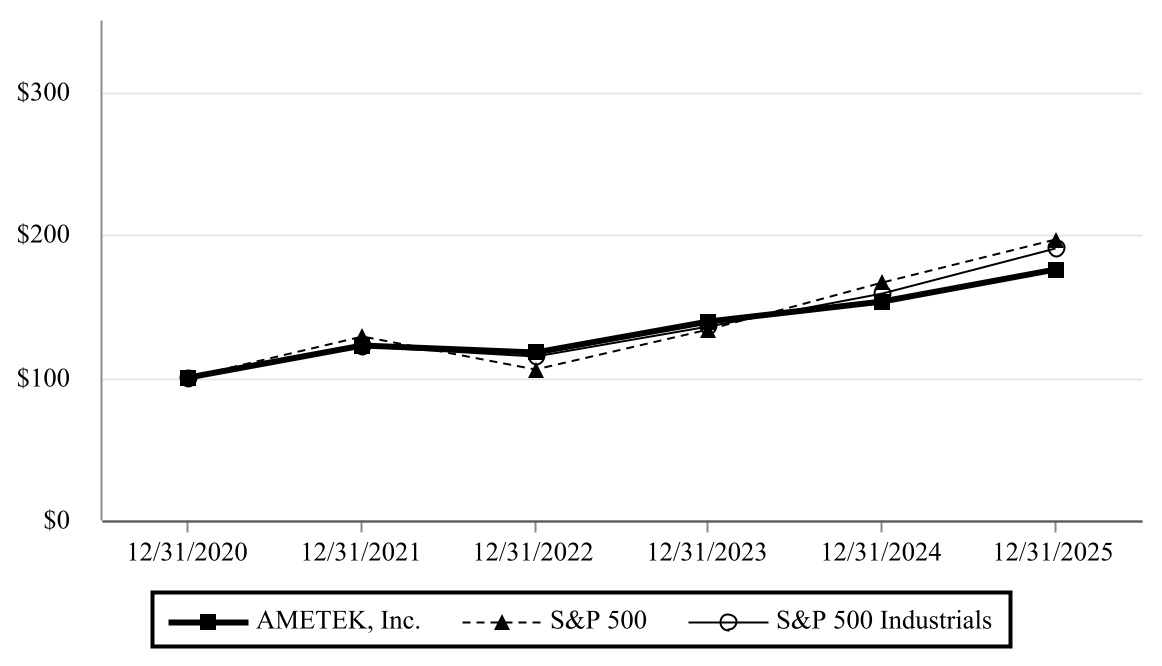
The following graph and accompanying table compare the cumulative total stockholder return for AMETEK over the last five years ended December 31, 2025 with total returns for the same period for the Standard and Poor’s (“S&P”) 500 Index and S&P 500 Industrials. AMETEK’s stock price is a component of both indices. The performance graph and table assume a $100 investment made on December 31, 2020 and reinvestment of all dividends. The stock performance shown on the graph below is based on historical data and is not necessarily indicative of future stock price performance.
COMPARISON OF FIVE-YEAR CUMULATIVE TOTAL RETURN | ||
| December 31, | |||||||||||||||||||||||||||||||||||
| 2020 | 2021 | 2022 | 2023 | 2024 | 2025 | ||||||||||||||||||||||||||||||
| AMETEK, Inc. | $ | 100.00 | $ | 122.32 | $ | 117.04 | $ | 139.05 | $ | 152.97 | $ | 175.40 | |||||||||||||||||||||||
| S&P 500 Index | 100.00 | 128.71 | 105.40 | 133.10 | 166.40 | 196.16 | |||||||||||||||||||||||||||||
| S&P 500 Industrials | 100.00 | 121.12 | 114.48 | 135.24 | 158.87 | 189.72 | |||||||||||||||||||||||||||||
Item 6. Reserved
22
Item 7. Management’s Discussion and Analysis of Financial Condition and Results of Operations
This report includes forward-looking statements based on the Company’s current assumptions, expectations and projections about future events. When used in this report, the words “believes,” “anticipates,” “may,” “expect,” “intend,” “estimate,” “project” and similar expressions are intended to identify forward-looking statements, although not all forward-looking statements contain such words. In this report, the Company discloses important factors that could cause actual results to differ materially from management’s expectations. For more information on these and other factors, see “Forward-Looking Information” herein.
The following Management’s Discussion and Analysis of Financial Condition and Results of Operations should be read in conjunction with “Item 1A. Risk Factors,” and the consolidated financial statements and related notes included elsewhere in this Annual Report on Form 10-K.
Business Overview
The Company benefits from its strategic initiatives under the AMETEK Growth Model's four key strategies: Operational Excellence, Strategic Acquisitions, Global & Market Expansion and New Products. In 2025, the Company posted record sales, operating income, net income, diluted earnings per share, orders, and backlog, as well as strong operating cash flow. Positive market trends, the Company's backlog, contributions from recent acquisitions, and benefits from the continued implementation of the AMETEK Growth Model had a positive impact on 2025 results.
Highlights in 2025 were:
•Net sales for 2025 were a record $7,401.1 million, an increase of $459.9 million or 6.6%, compared with net sales of $6,941.2 million in 2024.
•Net income for 2025 was a record $1,480.1 million, an increase of $104.0 million or 7.6%, compared with $1,376.1 million in 2024.
•Diluted earnings per share for 2025 were a record $6.40, an increase of $0.47 or 7.9%, compared with $5.93 per diluted share in 2024.
•Orders for 2025 were a record $7,579.4 million, an increase of $769.1 million or 11.3%, compared with $6,810.3 million in 2024. The Company's backlog of unfilled orders at December 31, 2025 was a record $3,581.5 million.
•Cash provided by operating activities totaled $1,801.8 million in 2025. Free cash flow (cash flow provided by operating activities less capital expenditures) was $1,671.6 million in 2025.
•During 2025, the Company spent $933.2 million in cash, net of cash acquired, to purchase two businesses:
•In January 2025, AMETEK acquired Kern Microtechnik ("Kern"), a leading manufacturer of high-precision machining and optical inspection solutions.
•In July 2025, AMETEK acquired FARO Technologies ("FARO"), a leading provider of 3D measurement and imaging solutions.
•EBITDA (earnings before interest, income taxes, depreciation, and amortization) was a record $2,296.9 million in 2025, compared with $2,151.7 million in 2024.
•In 2025, the Company repurchased approximately 2.3 million shares of its common stock for $443.0 million, compared with $212.0 million used for repurchases of approximately 1.2 million shares in 2024.
23
•The Company continued its emphasis on investment in research, development and engineering, spending $382.8 million in 2025. Approximately 27% of sales in 2025 were from products introduced in the past three years.
Recent Trends
During 2025, the United States government announced additional tariffs and trade restrictions on goods imported into the U.S. from various nations. Our businesses have been proactive in addressing the potential impacts of tariffs, including targeted pricing initiatives, strategic adjustments to our global supply chains, and leveraging our worldwide manufacturing footprint to localize production and adapt to changing demand patterns. The recent tariff modifications did not materially impact our results for 2025, however, as the situation continues to evolve, we cannot be certain of the outcome, which could adversely impact demand for our products, costs, inflation, customers, suppliers, and the overall global economy. We continue to monitor and analyze the impacts of the tariffs and will continue to implement appropriate actions as necessary to mitigate their effects.
Results of Operations
The following “Results of Operations of the year ended December 31, 2025 compared with the year ended December 31, 2024” section presents an analysis of the Company’s consolidated operating results displayed in the Consolidated Statement of Income. A discussion regarding our financial condition and results of operations for the year ended December 31, 2024 compared to the year ended December 31, 2023 can be found under Item 7 in our Annual Report on Form 10-K for the fiscal year ended December 31, 2024, filed with the Securities and Exchange Commission on February 20, 2025.
For the year ended December 31, 2025 , the Company recorded $37.3 million of pre-tax acquisition-related costs related to the FARO acquisition, which are comprised of one-time transactions costs and ongoing integration costs. Acquisition-related integration costs of $25.3 million were recorded in Cost of sales and primarily include employee severance, change in control costs, and fair-value inventory adjustments. One-time acquisition-related transaction costs of $12.0 million were recorded in Other (expense) income, net and primarily include investment banker fees and representation and warranty insurance costs.
Results of Operations for the year ended December 31, 2025 compared with the year ended December 31, 2024
Net sales for 2025 were $7,401.1 million, an increase of $459.9 million or 6.6%, compared with net sales of $6,941.2 million in 2024. The increase in net sales for 2025 was due to a 4% increase from acquisitions, a 2% organic sales increase, as well as a 1% favorable effect of foreign currency translation. EIG net sales were $4,919.1 million in 2025, an increase of 5.6%, compared with $4,659.9 million in 2024. EMG net sales were $2,482.0 million in 2025, an increase of 8.8%, compared with $2,281.3 million in 2024.
Total international sales for 2025 were $3,570.5 million or 48.2% of net sales, an increase of $278.8 million or 8.5%, compared with international sales of $3,291.7 million or 47.4% of net sales in 2024. The increase in international sales was primarily driven by contributions from recent acquisitions and increased demand in all regions. Export shipments from the United States, which are included in total international sales, were $2,041.2 million in 2025, an increase of $160.4 million or 8.5%, compared with $1,880.8 million in 2024.
Orders for 2025 were $7,579.4 million, an increase of $769.1 million or 11.3% compared with $6,810.3 million in 2024. The increase in orders was due to a 4% increase from acquisitions, a 4% organic order increase, as well as a 3% favorable effect of foreign currency translation. The Company’s backlog of unfilled orders at December 31, 2025 was a record $3,581.5 million, an increase of $178.3 million or 5.2%, compared with $3,403.2 million at December 31, 2024.
Cost of sales for 2025 was $4,733.7 million or 64.0% of net sales, an increase of $269.0 million or 6.0%, compared with $4,464.7 million or 64.3% of net sales for 2024. The cost of sales increase was primarily due to the net sales increase discussed above.
24
Segment operating income for 2025 was $2,026.0 million, an increase of $141.1 million or 7.5%, compared with segment operating income of $1,884.9 million in 2024. Segment operating income, as a percentage of net sales, increased to 27.4% in 2025, compared with 27.2% in 2024. Segment operating income and operating margins in 2025 were negatively impacted 60 basis points by the dilutive impact of recent acquisitions and 30 basis points from acquisition-related integration costs. Segment operating income and operating margins in 2024 included $29.2 million of acquisition-related integration costs related to the Paragon acquisition, which negatively impacted segment operating margins by 40 basis points. Excluding the dilutive impact of the recent acquisitions, acquisition-related integration costs, and the Paragon acquisition-related integration costs, segment operating margins increased 70 basis points compared to 2024, due to the continued benefits from the Company's Operational Excellence initiatives.
Selling, general and administrative expenses for 2025 were $757.1 million or 10.2% of net sales, an increase of $60.2 million or 8.6%, compared with $696.9 million or 10.0% of net sales in 2024. Selling expenses increased primarily due to the increase in net sales discussed above. General and administrative expenses for 2025 were $115.7 million, compared with $105.3 million in 2024.
Consolidated operating income was $1,910.3 million or 25.8% of net sales for 2025, an increase of $130.7 million or 7.3%, compared with $1,779.6 million or 25.6% of net sales in 2024.
Interest expense was $81.3 million for 2025, a decrease of $31.7 million or 28.1%, compared with $113.0 million in 2024. Higher borrowings under the revolving credit facility related to the December 2023 Paragon acquisition resulted in higher interest expense in 2024.
Other expense, net was $30.7 million for 2025, compared with $5.1 million of other expense in 2024. Other expense increased in 2025 primarily due to $12.0 million of acquisition-related transaction costs and increased environmental spend, compared to 2024.
The effective tax rate for 2025 was 17.7%, compared with 17.2% in 2024. See Note 9 to the Consolidated Financial Statements included in Part II, Item 8 of this Annual Report on Form 10-K for further details.
Net income for 2025 was $1,480.1 million, an increase of $104.0 million or 7.6%, compared with $1,376.1 million in 2024.
Diluted earnings per share for 2025 were $6.40, an increase of $0.47 or 7.9%, compared with $5.93 per diluted share in 2024.
Segment Results
EIG’s net sales totaled a record $4,919.1 million for 2025, an increase of $259.2 million or 5.6%, compared with $4,659.9 million in 2024. The net sales increase was due to a 6% increase from acquisitions and a 1% favorable effect of foreign currency translation, partially offset by a 1% organic sales decrease.
EIG’s operating income was a record $1,447.1 million for 2025, an increase of $18.7 million or 1.3%, compared with $1,428.4 million in 2024. EIG’s operating margins were 29.4% of net sales for 2025, compared with 30.7% of net sales in 2024. EIG's operating income was negatively impacted 100 basis points by the dilutive impact of recent acquisitions and 50 basis points for acquisition-related integration costs in 2025. Excluding the dilutive impact of recent acquisitions and acquisition-related integration costs, EIG's operating margins increased 20 basis points in 2025 compared to 2024 due to the sales increase discussed above, as well as continued benefits from the Company's Operational Excellence initiatives.
EMG’s net sales totaled a record $2,482.0 million for 2025, an increase of $200.7 million or 8.8%, compared with $2,281.3 million in 2024. The net sales increase was due to an 8% organic sales increase and a 1% favorable effect of foreign currency translation.
25
EMG’s operating income was a record $578.9 million for 2025, an increase of $122.4 million or 26.8%, compared with $456.5 million in 2024. EMG’s operating margins were 23.3% of net sales for 2025, compared with 20.0% of net sales in 2024. EMG's operating income and operating margins for 2024 included $29.2 million of acquisition-related integration costs related to the Paragon acquisition, which negatively impacted segment operating margins by 130 basis points. Excluding the Paragon acquisition-related integration costs, EMG operating margins increased 200 basis points compared to 2024, due to the sales increase discussed above, as well as the continued benefits from the Company's Operational Excellence initiatives.
Liquidity and Capital Resources
Cash provided by operating activities totaled $1,801.8 million in 2025, a decrease of $27.0 million or 1.5%, compared with cash provided by operating activities of $1,828.8 million in 2024. The decrease in cash provided by operating activities for 2025 was primarily due to higher working capital investments, partially offset by higher net income.
Free cash flow (cash flow provided by operating activities less capital expenditures) was $1,671.6 million in 2025, compared with $1,701.7 million in 2024. EBITDA (earnings before interest, income taxes, depreciation and amortization) was $2,296.9 million in 2025, compared with $2,151.7 million in 2024. Free cash flow and EBITDA are presented because the Company is aware that they are measures used by third parties in evaluating the Company. (See "Non-GAAP Financial Measures" for a reconciliation of U.S. GAAP measures to comparable non-GAAP measures).
Cash used by investing activities totaled $1,062.8 million in 2025, compared with cash used by investing activities of $244.8 million in 2024. In 2025, the Company paid $933.2 million, net of cash acquired, to purchase Kern Microtechnik and FARO Technologies, compared to $117.5 million, net of cash acquired, to purchase Virtek Vision International in 2024. Additions to property, plant and equipment totaled $130.2 million in 2025, compared with $127.1 million in 2024.
Cash used by financing activities totaled $686.3 million in 2025, compared with $1,602.5 million of cash used by financing activities in 2024. At December 31, 2025, total debt, net was $2,283.3 million, compared with $2,079.7 million at December 31, 2024. In 2025, total borrowings increased by $6.4 million, compared with a decrease of $1,189.7 million in 2024. At December 31, 2025, the Company had available borrowing capacity of $1,489.2 million under its revolving credit facility, excluding the $700 million accordion feature. At December 31, 2025, the Company had $18.8 million outstanding on the revolver.
On January 6, 2025, the Company established a commercial paper program under which it may issue short-term, unsecured commercial paper notes. Amounts available under the commercial paper program may be borrowed, repaid and re-borrowed, with the aggregate face or principal amount of the notes outstanding under the commercial paper program at any time not to exceed $2.3 billion. The notes have maturities of up to 364 days from the date of issue. At December 31, 2025, the Company had $740.0 million outstanding under its commercial paper program.
In the second quarter of 2025, the Company paid in full, at maturity, a $50.0 million in aggregate principal amount of 3.91% senior notes. In the third quarter of 2025, the Company paid in full, at maturity, a $100.0 million in aggregate principal amount of 3.96% senior notes. In the fourth quarter of 2025, the Company paid in full, at maturity, a $275.0 million in aggregate principal amount of 4.18% senior notes. The debt-to-capital ratio was 17.7% at December 31, 2025 and December 31, 2024. The net debt-to-capital ratio (total debt, net less cash and cash equivalents divided by the sum of net debt and stockholders’ equity) was 14.7% at December 31, 2025, compared with 15.0% at December 31, 2024. The net debt-to-capital ratio is presented because the Company is aware that this measure is used by third parties in evaluating the Company. (See "Non-GAAP Financial Measures" for a reconciliation of U.S. GAAP measures to comparable non-GAAP measures).
In 2025, the Company repurchased approximately 2.3 million shares of its common stock for $443.0 million, compared with $212.0 million used for repurchases of approximately 1.2 million shares in 2024. Effective February 7, 2025, the Company's Board of Directors approved a $1.25 billion share repurchase authorization. The new
26
authorization replaces the previous $1 billion share repurchase authorization approved in May 2022. At December 31, 2025, $807.0 million was available under the Company’s Board of Directors authorization for future share repurchases.
Additional financing activities for 2025 included cash dividends paid of $285.3 million, compared with $258.8 million in 2024. Effective February 7, 2025, the Company's Board of Directors approved an 11% increase in the quarterly cash dividend on its common stock to $0.31 per share from $0.28 per share. Proceeds from the exercise of employee stock options were $36.4 million in 2025, compared with $66.9 million in 2024.
As a result of all of the Company’s cash flow activities in 2025, cash and cash equivalents at December 31, 2025 totaled $458.0 million, compared with $374.0 million at December 31, 2024. At December 31, 2025, the Company had $374.5 million in cash outside the United States, compared with $361.5 million at December 31, 2024. The Company utilizes this cash to fund its international operations, as well as to acquire international businesses. The Company is in compliance with all covenants, including financial covenants, for all of its debt agreements. The Company believes it has sufficient cash-generating capabilities from domestic and unrestricted foreign sources, available credit facilities and access to long-term capital funds to enable it to meet its operating needs and contractual obligations for the foreseeable future.
Acquisition subsequent to December 31, 2025
In January 2026, the Company acquired LKC Technologies, a leading provider of innovative technology to enable effective diagnosis and management of ophthalmic conditions. LKC Technologies will join EIG.
Subsequent Event
Effective February 12, 2026, the Company's Board of Directors approved a 10% increase in the quarterly cash dividend on its common stock to $0.34 per share from $0.31 per share.
Contractual Obligations and Other Commitments
Material contractual obligations arising in the normal course of business primarily consist of purchase obligations, long-term debt and related interest payments, and leases. See Note 10 to the Consolidated Financial Statements included in Part II, Item 8 of this Annual Report on Form 10-K for more information on the nature and timing of debt obligations.
Leases expire over a range of years from 2026 to 2040. Most of the leases contain renewal or purchase options, subject to various terms and conditions. See Note 14 to the Consolidated Financial Statements included in Part II, Item 8 of this Annual Report on Form 10-K for more information on the nature and timing of lease obligations.
Purchase obligations primarily consist of contractual commitments to purchase certain inventories at fixed prices. At December 31, 2025, the Company had $669.0 million of purchase obligations due within one year and $46.6 million of purchase obligations due in more than one year.
The Company has standby letters of credit and surety bonds of $197.9 million related to performance and payment guarantees at December 31, 2025. Based on experience with these arrangements, the Company believes that any obligations that may arise will not be material to its financial position.
27
Non-GAAP Financial Measures
EBITDA represents earnings before interest, income taxes, depreciation and amortization. EBITDA is presented because the Company is aware that it is used by rating agencies, securities analysts, investors and other parties in evaluating the Company. It should not be considered, however, as an alternative to operating income as an indicator of the Company’s operating performance or as an alternative to cash flows as a measure of the Company’s overall liquidity as presented in the Company’s consolidated financial statements. Furthermore, EBITDA measures shown for the Company may not be comparable to similarly titled measures used by other companies. The following table presents the reconciliation of net income reported in accordance with U.S. generally accepted accounting principles (“GAAP”) to EBITDA:
| Year Ended December 31, | |||||||||||||||||
| 2025 | 2024 | 2023 | |||||||||||||||
| (In millions) | |||||||||||||||||
| Net income | $ | 1,480.1 | $ | 1,376.1 | $ | 1,313.2 | |||||||||||
| Add (deduct): | |||||||||||||||||
| Interest expense | 81.3 | 113.0 | 81.8 | ||||||||||||||
| Interest income | (5.5) | (5.8) | (11.1) | ||||||||||||||
| Income taxes | 318.2 | 285.4 | 293.2 | ||||||||||||||
| Depreciation | 145.5 | 135.3 | 122.5 | ||||||||||||||
| Amortization | 277.3 | 247.7 | 215.1 | ||||||||||||||
| Total adjustments | 816.8 | 775.6 | 701.5 | ||||||||||||||
| EBITDA | $ | 2,296.9 | $ | 2,151.7 | $ | 2,014.7 | |||||||||||
Free cash flow represents cash flow from operating activities less capital expenditures. Free cash flow is presented because the Company is aware that it is used by rating agencies, securities analysts, investors and other parties in evaluating the Company. The following table presents the reconciliation of cash flow from operating activities reported in accordance with U.S. GAAP to free cash flow:
| Year Ended December 31, | |||||||||||||||||
| 2025 | 2024 | 2023 | |||||||||||||||
| (In millions) | |||||||||||||||||
| Cash provided by operating activities | $ | 1,801.8 | $ | 1,828.8 | $ | 1,735.3 | |||||||||||
| Deduct: Capital expenditures | (130.2) | (127.1) | (136.2) | ||||||||||||||
| Free cash flow | $ | 1,671.6 | $ | 1,701.7 | $ | 1,599.1 | |||||||||||
Net debt represents total debt, net minus cash and cash equivalents. Net debt is presented because the Company is aware that it is used by rating agencies, securities analysts, investors and other parties in evaluating the Company. The following table presents the reconciliation of total debt, net reported in accordance with U.S. GAAP to net debt:
| December 31, | |||||||||||
| 2025 | 2024 | ||||||||||
| (In millions) | |||||||||||
| Total debt, net | $ | 2,283.3 | $ | 2,079.7 | |||||||
| Less: Cash and cash equivalents | (458.0) | (374.0) | |||||||||
| Net debt | 1,825.3 | 1,705.7 | |||||||||
| Stockholders’ equity | 10,628.8 | 9,655.3 | |||||||||
| Capitalization (net debt plus stockholders’ equity) | $ | 12,454.0 | $ | 11,361.0 | |||||||
| Net debt as a percentage of capitalization | 14.7 | % | 15.0 | % | |||||||
28
Internal Reinvestment
Capital Expenditures
Capital expenditures were $130.2 million or 1.8% of net sales in 2025, compared with $127.1 million or 1.8% of net sales in 2024. Capital expenditures in 2026 are expected to be approximately 2% of net sales, with a continued emphasis on spending to improve productivity.
Research, Development and Engineering
The Company is committed to, and has consistently invested in, research, development and engineering activities to design and develop new and improved products and solutions. Research, development and engineering costs were $382.8 million in 2025, $371.9 million in 2024 and $351.7 million in 2023. These amounts included research and development expenses of $236.1 million, $236.6 million and $220.8 million in 2025, 2024, and 2023, respectively. All such expenditures were directed toward the development of new products and solutions and the improvement of existing products and solutions.
Environmental Matters
Information with respect to environmental matters is set forth in Note 13 to the Consolidated Financial Statements included in Part II, Item 8 of this Annual Report on Form 10-K.
Critical Accounting Policies and Estimates
Critical accounting policies are those policies that can have a significant impact on the presentation of the Company’s financial condition and results of operations and that require the use of complex and subjective estimates based on the Company’s historical experience and management’s judgment. Because of the uncertainty inherent in such estimates, actual results may differ materially from the estimates used. Below are the policies used in preparing the Company's financial statements that management believes are the most dependent upon the application of estimates and assumptions. A complete list of the Company’s significant accounting policies is in Note 1 to the Consolidated Financial Statements included in Part II, Item 8 of this Annual Report on Form 10-K.
•Business Combinations. The Company allocates the purchase price of an acquired company, including when applicable, the acquisition date fair value of contingent consideration between tangible and intangible assets acquired and liabilities assumed from the acquired business based on their estimated fair values, with the residual of the purchase price recorded as goodwill. Third party appraisal firms and other consultants are engaged to assist management in determining the fair values of certain assets acquired and liabilities assumed. In the absence of a third party appraisal, the Company uses internal valuation estimates based on pertinent data from comparable prior acquisitions. Estimating fair values requires significant judgments, estimates and assumptions, including but not limited to: discount rates, future cash flows and the economic lives of trade names, technology, and customer relationships. These estimates are based on historical experience and information obtained from the management of the acquired companies and are inherently uncertain.
•Goodwill and Other Intangible Assets. Goodwill and other intangible assets with indefinite lives, primarily trademarks and trade names, are not amortized; rather, they are tested for impairment at least annually. The Company performs either a qualitative or quantitative analysis to determine if it is more likely than not that the fair values of its reporting units are less than the respective carrying values of those reporting units.
When testing goodwill for impairment, the Company has the option to first assess qualitative factors to determine whether the existence of events or circumstances leads to a determination that it is more likely than not the estimated fair value of a reporting unit is less than its carrying amount. If the Company performs a qualitative assessment and determines that an impairment is more likely than not, then
29
performance of a quantitative impairment test is required. In conducting a qualitative assessment, the Company analyzes actual and forecasted net sales and selling profit for each reporting unit, as well as historical performance and the results of prior quantitative tests performed. Additionally, the Company assesses critical areas that may impact its business, including macroeconomic conditions, industry and market conditions, cost factors, or any relevant events and factors that may impact projected financial results.
If performed, the quantitative goodwill impairment test uses a discounted cash flow analysis to determine the fair value of each reporting unit, which considers cash flows discounted at an appropriate discount rate. The annual goodwill impairment test requires the Company to make a number of assumptions and estimates concerning future levels of revenue growth, operating margins, depreciation, amortization and working capital requirements, which are based on the Company’s long-range plan and are considered level 3 inputs. The discount rate is an estimate of the overall after-tax rate of return required by a market participant whose weighted average cost of capital includes both equity and debt, including a risk premium. While the Company uses the best available information to prepare its cash flow and discount rate assumptions, actual future cash flows or market conditions could differ significantly resulting in future impairment charges related to recorded goodwill balances.
The impairment test for indefinite-lived intangibles other than goodwill (primarily trademarks and trade names) consists of a comparison of the estimated fair value of the indefinite-lived intangible asset to the carrying value of the asset as of the impairment testing date. The Company can elect to perform a qualitative analysis to determine if it is more likely than not that the fair values of its indefinite-lived intangible assets are less than the respective carrying values of those assets. The Company elected to bypass the performing the qualitative screen. The Company may elect to perform the qualitative analysis in future periods. The Company estimates the fair value of its indefinite-lived intangibles using the relief from royalty method using level 3 inputs, which is a widely used valuation technique for such assets. The fair value derived from the relief from royalty method is determined by applying a royalty rate to a projection of net revenues discounted using an appropriate discount rate. Each royalty rate is determined based on the profitability of the trade name to which it relates and observed market royalty rates. Certain impairment models have discount rates calculated based on a debt/equity cost of capital. While the Company uses the best available information to prepare its cash flow and discount rate assumptions, actual future cash flows or market conditions could differ significantly resulting in future impairment charges related to recorded intangible balances. While there are always changes in assumptions to reflect changing business and market conditions, the Company’s overall methodology and the population of assumptions used have remained unchanged.
The Company’s acquisitions have generally included a significant goodwill component and the Company expects to continue to make acquisitions. At December 31, 2025, goodwill and other indefinite-lived intangible assets totaled $8,274.1 million or 51.5% of the Company’s total assets. The Company completed its required annual impairment tests in the fourth quarter of 2025 and determined that the carrying values of the Company’s goodwill and indefinite-lived intangibles were not impaired. There can be no assurance that goodwill or indefinite-lived intangibles impairment will not occur in the future.
•Income Taxes. The process of providing for income taxes and determining the related balance sheet accounts requires management to assess uncertainties, make judgments regarding outcomes and utilize estimates. The Company conducts a broad range of operations around the world and is therefore subject to complex tax regulations in numerous international taxing jurisdictions, resulting at times in tax audits, disputes and potential litigation, the outcome of which is uncertain. Management must make judgments currently about such uncertainties and determine estimates of the Company’s tax assets and liabilities. To the extent the final outcome differs, future adjustments to the Company’s tax assets and liabilities may be necessary.
The Company assesses the realizability of its deferred tax assets, taking into consideration the Company’s forecast of future taxable income, available net operating loss carryforwards and available tax planning
30
strategies that could be implemented to realize the deferred tax assets. Based on this assessment, management must evaluate the need for, and the amount of, valuation allowances against the Company’s deferred tax assets. To the extent facts and circumstances change in the future, adjustments to the valuation allowances may be required.
The Company assesses the uncertainty in its tax positions by applying a minimum recognition threshold which a tax position is required to meet before a tax benefit is recognized in the financial statements. Once the minimum threshold is met, using a more likely than not standard, a series of probability estimates is made for each item to properly measure and record a tax benefit. The tax benefit recorded is generally equal to the highest probable outcome that is more than 50% likely to be realized after full disclosure and resolution of a tax examination. The underlying probabilities are determined based on the best available objective evidence such as recent tax audit outcomes, published guidance, external expert opinion, or by analogy to the outcome of similar issues in the past. There can be no assurance that these estimates will ultimately be realized given continuous changes in tax policy, legislation and audit practice. The Company recognizes interest and penalties accrued related to uncertain tax positions in income tax expense.
Recent Accounting Pronouncements
See Note 2, Recent Accounting Pronouncements, to the Company’s Consolidated Financial Statements included in Part II, Item 8 of this Annual Report on Form 10-K for information regarding recently issued accounting pronouncements.
Forward-Looking Information
Certain matters discussed in this Form 10-K are “forward-looking statements” as defined in the Private Securities Litigation Reform Act of 1995 (“PSLRA”), which involve risk and uncertainties that exist in the Company’s operations and business environment and can be affected by inaccurate assumptions, or by known or unknown risks and uncertainties. Many such factors will be important in determining the Company’s actual future results. The Company wishes to take advantage of the “safe harbor” provisions of the PSLRA by cautioning readers that numerous important factors in some cases have caused, and in the future could cause, the Company’s actual results to differ materially from those expressed in any forward-looking statements made by, or on behalf of, the Company. Some, but not all, of the factors or uncertainties that could cause actual results to differ from present expectations are set forth above and under Item 1A. Risk Factors. The Company undertakes no obligation to publicly update any forward-looking statements, whether as a result of new information, subsequent events or otherwise, unless required by the securities laws to do so.
31
Item 7A. Quantitative and Qualitative Disclosures About Market Risk
The Company’s primary exposures to market risk are fluctuations in interest rates and foreign currency exchange rates, which could impact its financial condition and results of operations. The Company addresses its exposure to these risks through its normal operating and financing activities. The Company’s differentiated and global business activities help to reduce the impact that any particular market risk may have on its operating income as a whole.
The Company’s short-term debt carries variable interest rates and generally its long-term debt carries fixed rates. These financial instruments are more fully described in the Notes to the Consolidated Financial Statements included in Part II, Item 8 of this Annual Report on Form 10-K.
The foreign currencies to which the Company has the most significant exchange rate exposure are the Euro, the British pound, the Japanese yen, the Chinese renminbi, the Canadian dollar, and the Mexican peso. The Company evaluates foreign currency exposures on a centralized basis and aims to balance, where possible, non-functional currency denominated assets to non-functional currency denominated liabilities to have a natural hedge and minimize foreign exchange impacts. In the event a natural hedge is not available, the Company takes steps to mitigate foreign currency risk through the use of local borrowings and occasional derivative financial instruments in the currency affected. The effect of translating foreign subsidiaries’ balance sheets into U.S. dollars is included in other comprehensive income within stockholders’ equity. Foreign currency transactions have not had a significant effect on the operating results reported by the Company because revenues and costs associated with the revenues are generally transacted in the same foreign currencies.
Based on a hypothetical ten percent adverse movement in interest rates or foreign currency exchange rates, the Company’s best estimate is that the potential losses in future earnings, fair value of risk-sensitive financial instruments and cash flows are not material, although the actual effects may differ materially from the hypothetical analysis.
32
Item 8. Financial Statements and Supplementary Data
| Page | ||||||||
| Index to Financial Statements (Item 15(a)(1)) | ||||||||
Reports of Independent Registered Public Accounting Firm Ernst & Young LLP, Philadelphia, Auditor Firm ID: | ||||||||
Financial Statement Schedules (Item 15(a)(2))
Financial statement schedules have been omitted because either they are not applicable, or the required information is included in the financial statements or the notes thereto.
33
Management’s Responsibility for Financial Statements
Management has prepared and is responsible for the integrity of the consolidated financial statements and related information. The statements are prepared in conformity with U.S. generally accepted accounting principles consistently applied and include certain amounts based on management’s best estimates and judgments. Historical financial information elsewhere in this report is consistent with that in the financial statements.
In meeting its responsibility for the reliability of the financial information, management maintains a system of internal accounting and disclosure controls, including an internal audit program. The system of controls provides for appropriate division of responsibility and the application of written policies and procedures. That system, which undergoes continual reevaluation, is designed to provide reasonable assurance that assets are safeguarded, and records are adequate for the preparation of reliable financial data.
Management is responsible for establishing and maintaining adequate internal control over financial reporting. AMETEK, Inc. maintains a system of internal controls that is designed to provide reasonable assurance as to the fair and reliable preparation and presentation of the consolidated financial statements; however, there are inherent limitations in the effectiveness of any system of internal controls.
Management recognizes its responsibility for conducting the Company’s activities according to the highest standards of personal and corporate conduct. That responsibility is characterized and reflected in a code of business conduct for all employees and in a financial code of ethics for the Chief Executive Officer and Senior Financial Officers, as well as in other key policy statements publicized throughout the Company.
The Audit Committee of the Board of Directors, which is composed solely of independent directors who are not employees of the Company, meets with the independent registered public accounting firm, the internal auditors and management to satisfy itself that each is properly discharging its responsibilities. The report of the Audit Committee is included in the Company’s Proxy Statement for the 2026 Annual Meeting of Stockholders. Both the independent registered public accounting firm and the internal auditors have direct access to the Audit Committee.
The Company’s independent registered public accounting firm, Ernst & Young LLP, is engaged to render an opinion as to whether management’s financial statements present fairly, in all material respects, the Company’s financial position and operating results. This report is included herein.
Management’s Report on Internal Control over Financial Reporting
Management of the Company is responsible for establishing and maintaining adequate internal control over financial reporting, as such term is defined in the Exchange Act Rules 13a-15(f) and 15d-15(f). Under the supervision and with the participation of our management, including our Chief Executive Officer and Chief Financial Officer, AMETEK, Inc. conducted an evaluation of the effectiveness of the Company’s internal control over financial reporting as of December 31, 2025 based on criteria established in Internal Control – Integrated Framework issued by the Committee of Sponsoring Organizations of the Treadway Commission (2013 framework). Based on that evaluation, our management concluded that the Company’s internal control over financial reporting was effective as of December 31, 2025.
The Company acquired Kern Microtechnik ("Kern") in January 2025 and FARO Technologies ("FARO") in July 2025. As permitted by the U.S. Securities and Exchange Commission staff interpretative guidance for newly acquired businesses, the Company excluded Kern and FARO from management’s assessment of the effectiveness of the Company’s internal control over financial reporting as of December 31, 2025. Kern and FARO constituted 8.4% of total assets as of December 31, 2025 and 3.2% of net sales for the year then ended.
The Company’s internal control over financial reporting as of December 31, 2025 has been audited by Ernst & Young LLP, an independent registered public accounting firm, as stated in their report, which is included herein.
/s/ DAVID A. ZAPICO | /s/ DALIP M. PURI | |||||||
| Chairman of the Board and Chief Executive Officer | Executive Vice President – Chief Financial Officer | |||||||
| February 17, 2026 | ||||||||
34
REPORT OF INDEPENDENT REGISTERED PUBLIC ACCOUNTING FIRM
ON INTERNAL CONTROL OVER FINANCIAL REPORTING
To the Shareholders and the Board of Directors of AMETEK, Inc.
Opinion on Internal Control over Financial Reporting
We have audited AMETEK, Inc.’s internal control over financial reporting as of December 31, 2025, based on criteria established in Internal Control—Integrated Framework issued by the Committee of Sponsoring Organizations of the Treadway Commission (2013 framework) (the COSO criteria). In our opinion, AMETEK, Inc. (the Company) maintained, in all material respects, effective internal control over financial reporting as of December 31, 2025, based on the COSO criteria.
As indicated in the accompanying Management’s Report on Internal Control over Financial Reporting, management’s assessment of and conclusion on the effectiveness of internal control over financial reporting did not include the internal controls of Kern Microtechnik ("Kern") and FARO Technologies ("FARO"), which are included in the 2025 consolidated financial statements of the Company and constituted 8.4% of total assets as of December 31, 2025 and 3.2% of net sales for the year then ended. Our audit of internal control over financial reporting of the Company also did not include an evaluation of the internal control over financial reporting of Kern and FARO.
We also have audited, in accordance with the standards of the Public Company Accounting Oversight Board (United States) (PCAOB), the consolidated balance sheets of AMETEK, Inc. as of December 31, 2025 and 2024, the related consolidated statements of income, comprehensive income, stockholders’ equity and cash flows for each of the three years in the period ended December 31, 2025, and the related notes and our report dated February 17, 2026 expressed an unqualified opinion thereon.
Basis for Opinion
The Company’s management is responsible for maintaining effective internal control over financial reporting and for its assessment of the effectiveness of internal control over financial reporting included in the accompanying Management’s Report on Internal Control over Financial Reporting. Our responsibility is to express an opinion on the Company’s internal control over financial reporting based on our audit. We are a public accounting firm registered with the PCAOB and are required to be independent with respect to the Company in accordance with the U.S. federal securities laws and the applicable rules and regulations of the Securities and Exchange Commission and the PCAOB.
We conducted our audit in accordance with the standards of the PCAOB. Those standards require that we plan and perform the audit to obtain reasonable assurance about whether effective internal control over financial reporting was maintained in all material respects.
Our audit included obtaining an understanding of internal control over financial reporting, assessing the risk that a material weakness exists, testing and evaluating the design and operating effectiveness of internal control based on the assessed risk, and performing such other procedures as we considered necessary in the circumstances. We believe that our audit provides a reasonable basis for our opinion.
Definition and Limitations of Internal Control Over Financial Reporting
A company’s internal control over financial reporting is a process designed to provide reasonable assurance regarding the reliability of financial reporting and the preparation of financial statements for external purposes in accordance with generally accepted accounting principles. A company’s internal control over financial reporting includes those policies and procedures that (1) pertain to the maintenance of records that, in reasonable detail, accurately and fairly reflect the transactions and dispositions of the assets of the company; (2) provide reasonable assurance that transactions are recorded as necessary to permit preparation of financial statements in accordance with generally accepted accounting principles, and that receipts and expenditures of the company are being made only in accordance with authorizations of management and directors of the company; and (3) provide reasonable assurance regarding prevention or timely detection of unauthorized acquisition, use, or disposition of the company’s assets that could have a material effect on the financial statements.
Because of its inherent limitations, internal control over financial reporting may not prevent or detect misstatements. Also, projections of any evaluation of effectiveness to future periods are subject to the risk that controls may become inadequate because of changes in conditions, or that the degree of compliance with the policies or procedures may deteriorate.
| /s/ | ||||||||
| February 17, 2026 | ||||||||
35
REPORT OF INDEPENDENT REGISTERED PUBLIC ACCOUNTING FIRM
To the Shareholders and the Board of Directors of AMETEK, Inc.:
Opinion on the Financial Statements
We have audited the accompanying consolidated balance sheets of AMETEK, Inc. (the Company) as of December 31, 2025 and 2024, the related consolidated statements of income, comprehensive income, stockholders’ equity and cash flows for each of the three years in the period ended December 31, 2025, and the related notes (collectively referred to as the “consolidated financial statements”). In our opinion, the consolidated financial statements present fairly, in all material respects, the financial position of the Company at December 31, 2025 and 2024, and the results of its operations and its cash flows for each of the three years in the period ended December 31, 2025, in conformity with U.S. generally accepted accounting principles.
We also have audited, in accordance with the standards of the Public Company Accounting Oversight Board (United States) (PCAOB), the Company’s internal control over financial reporting as of December 31, 2025, based on criteria established in Internal Control–Integrated Framework issued by the Committee of Sponsoring Organizations of the Treadway Commission (2013 framework), and our report dated February 17, 2026 expressed an unqualified opinion thereon.
Basis for Opinion
These financial statements are the responsibility of the Company’s management. Our responsibility is to express an opinion on the Company’s financial statements based on our audits. We are a public accounting firm registered with the PCAOB and are required to be independent with respect to the Company in accordance with the U.S. federal securities laws and the applicable rules and regulations of the Securities and Exchange Commission and the PCAOB.
We conducted our audits in accordance with the standards of the PCAOB. Those standards require that we plan and perform the audit to obtain reasonable assurance about whether the financial statements are free of material misstatement, whether due to error or fraud. Our audits included performing procedures to assess the risks of material misstatement of the financial statements, whether due to error or fraud, and performing procedures that respond to those risks. Such procedures included examining, on a test basis, evidence regarding the amounts and disclosures in the financial statements. Our audits also included evaluating the accounting principles used and significant estimates made by management, as well as evaluating the overall presentation of the financial statements. We believe that our audits provide a reasonable basis for our opinion.
Critical Audit Matters
The critical audit matters communicated below are matters arising from the current period audit of the financial statements that were communicated or required to be communicated to the audit committee and that: (1) relate to accounts or disclosures that are material to the financial statements and (2) involved especially challenging, subjective or complex judgments. The communication of critical audit matters does not alter in any way our opinion on the consolidated financial statements, taken as a whole, and we are not, by communicating the critical audit matters below, providing separate opinions on the critical audit matters or on the accounts or disclosures to which they relate.
36
| Impairment Assessment of Indefinite-Lived Intangible Assets (other than Goodwill) | ||||||||
| Description of the Matter | At December 31, 2025, the Company’s indefinite-lived intangible assets (other than goodwill) totaled $1,103.3 million, consisting of trademarks and trade names. As described in Note 1 to the consolidated financial statements, indefinite-lived intangible assets are not amortized but are tested for impairment at least annually in the Company’s fourth quarter. Auditing management’s indefinite-lived intangible asset impairment tests was complex and highly judgmental due to the significant measurement uncertainty in estimating the fair value of the trademarks and trade names. In particular, the fair value estimates were sensitive to significant assumptions such as discount rate, forecasted revenues and royalty rates, which are affected by expectations about future market or economic conditions. | |||||||
| How We Addressed the Matter in Our Audit | We obtained an understanding, evaluated the design and tested the operating effectiveness of controls over the Company’s indefinite-lived intangible asset impairment process. For example, we tested controls over management’s review of the valuation models and significant assumptions, including forecasted financial information, as well as management’s controls to validate that the data used in the valuations was complete and accurate. To test the estimated fair value of the Company’s indefinite-lived intangible assets, we performed audit procedures that included, among others, assessing the fair value methodologies utilized by management and the significant assumptions discussed above, including the underlying data used in the analyses. For example, when evaluating the significant assumptions, we compared them to current financial and operating plans, market and industry studies, historical trends, and royalty rates used in prior periods. We also assessed the historical accuracy of management’s forecasts and performed sensitivity analyses of significant assumptions to evaluate the changes in the fair value estimates of the trademarks and trade names that would result from changes in the assumptions. We involved our valuation specialists to assist in evaluating the discount rate, royalty rate and valuation methodologies used by the Company. | |||||||
| Accounting for the fair value of the customer relationship intangible asset from the acquisition of FARO Technologies, Inc. | ||||||||
| Description of the Matter | As described in Note 6 to the consolidated financial statements, during the year ended December 31, 2025, the Company completed the acquisition of FARO Technologies, Inc. ("FARO") for consideration of $ 1,023.7 million, of which approximately $250.7 million was allocated to the customer relationship intangible asset. Auditing the Company’s accounting for its acquisition of FARO was complex due to the significant estimation uncertainty, particularly in estimating the fair value of the customer relationship intangible asset. The significant assumptions used to estimate the fair value of customer relationships included the forecasted EBITDA margin and customer attrition rate. All of these significant assumptions are affected by expectations about future market or economic conditions. | |||||||
37
| How We Addressed the Matter in Our Audit | We obtained an understanding, evaluated the design and tested the operating effectiveness of controls over the Company’s estimation of the fair value of the customer relationship intangible asset. For example, we tested controls over the valuation of the customer relationship intangible asset, including controls over management’s review of the valuation model and the significant assumptions described above, review of forecasted financial information, as well as verification of underlying data used in the analysis. To test the estimated fair value of the customer relationship intangible asset for FARO, we performed audit procedures that included, among others, assessing the fair value methodology utilized by management and the significant assumptions discussed above, including the accuracy of the underlying data used in the analysis. For example, when evaluating the significant assumptions, we compared them to current financial and operating plans, market and industry studies, and historical trends. We also performed sensitivity analyses to evaluate the changes in the fair value of the customer relationship intangible asset that would result from changes in the significant assumptions. We involved our valuation specialists to assist in evaluating the attrition rate, royalty rate and valuation methodology used by the Company. | |||||||
/s/ ERNST & YOUNG LLP | ||||||||
We have served as the Company’s auditor since 1930. | ||||||||
Philadelphia, Pennsylvania | ||||||||
February 17, 2026 | ||||||||
38
AMETEK, Inc.
Consolidated Statement of Income
(In thousands, except per share amounts)
| Year Ended December 31, | |||||||||||||||||
| 2025 | 2024 | 2023 | |||||||||||||||
| Net sales | $ | $ | $ | ||||||||||||||
| Cost of sales | |||||||||||||||||
| Selling, general and administrative | |||||||||||||||||
| Total operating expenses | |||||||||||||||||
| Operating income | |||||||||||||||||
| Interest expense | ( | ( | ( | ||||||||||||||
| Other (expense) income, net | ( | ( | ( | ||||||||||||||
| Income before income taxes | |||||||||||||||||
| Provision for income taxes | |||||||||||||||||
| Net income | $ | $ | $ | ||||||||||||||
| Basic earnings per share | $ | $ | $ | ||||||||||||||
| Diluted earnings per share | $ | $ | $ | ||||||||||||||
| Weighted average common shares outstanding: | |||||||||||||||||
| Basic shares | |||||||||||||||||
| Diluted shares | |||||||||||||||||
See accompanying notes.
39
AMETEK, Inc.
Consolidated Statement of Comprehensive Income
(In thousands)
| Year Ended December 31, | |||||||||||||||||
| 2025 | 2024 | 2023 | |||||||||||||||
| Net income | $ | $ | $ | ||||||||||||||
| Other comprehensive income (loss): | |||||||||||||||||
| Amounts arising during the period – gains (losses), net of tax (expense) benefit: | |||||||||||||||||
| Foreign currency translation: | |||||||||||||||||
| Translation adjustments | ( | ||||||||||||||||
| Change in long-term intercompany notes | ( | ( | |||||||||||||||
Net investment hedge instruments (loss) gain, net of tax of $ | ( | ( | |||||||||||||||
| Defined benefit pension plans: | |||||||||||||||||
Net actuarial gain (loss), net of tax of $( | |||||||||||||||||
Amortization of net actuarial loss, net of tax of ($ | |||||||||||||||||
Amortization of prior service costs, net of tax of $( | |||||||||||||||||
| Other comprehensive income (loss) | ( | ||||||||||||||||
| Total comprehensive income | $ | $ | $ | ||||||||||||||
See accompanying notes.
40
AMETEK, Inc.
Consolidated Balance Sheet
(In thousands, except share amounts)
| December 31, | |||||||||||
| 2025 | 2024 | ||||||||||
| ASSETS | |||||||||||
| Current assets: | |||||||||||
| Cash and cash equivalents | $ | $ | |||||||||
| Receivables | |||||||||||
| Inventories, net | |||||||||||
| Other current assets | |||||||||||
| Total current assets | |||||||||||
| Property, plant and equipment, net | |||||||||||
| Right of use assets, net | |||||||||||
| Goodwill | |||||||||||
| Other intangibles, net | |||||||||||
| Investments and other assets | |||||||||||
| Total assets | $ | $ | |||||||||
| LIABILITIES AND STOCKHOLDERS’ EQUITY | |||||||||||
| Current liabilities: | |||||||||||
| Short-term borrowings and current portion of long-term debt, net | $ | $ | |||||||||
| Accounts payable | |||||||||||
| Customer advanced payments | |||||||||||
| Income taxes payable | |||||||||||
| Accrued liabilities and other | |||||||||||
| Total current liabilities | |||||||||||
| Long-term debt, net | |||||||||||
| Deferred income taxes | |||||||||||
| Other long-term liabilities | |||||||||||
| Total liabilities | |||||||||||
| Stockholders’ equity: | |||||||||||
Preferred stock, $ | |||||||||||
Common stock, $ | |||||||||||
| Capital in excess of par value | |||||||||||
| Retained earnings | |||||||||||
| Accumulated other comprehensive loss | ( | ( | |||||||||
Treasury stock: 2025 – | ( | ( | |||||||||
| Total stockholders’ equity | |||||||||||
| Total liabilities and stockholders’ equity | $ | $ | |||||||||
See accompanying notes.
41
AMETEK, Inc.
Consolidated Statement of Stockholders’ Equity
(In thousands)
| Year Ended December 31, | |||||||||||||||||
| 2025 | 2024 | 2023 | |||||||||||||||
| Capital stock | |||||||||||||||||
Preferred stock, $ | $ | — | $ | — | $ | — | |||||||||||
Common stock, $ | |||||||||||||||||
| Balance at the beginning of the year | |||||||||||||||||
| Shares issued | |||||||||||||||||
| Balance at the end of the year | |||||||||||||||||
| Capital in excess of par value | |||||||||||||||||
| Balance at the beginning of the year | |||||||||||||||||
| Issuance of common stock under employee stock plans | |||||||||||||||||
| Share-based compensation costs | |||||||||||||||||
| Balance at the end of the year | |||||||||||||||||
| Retained earnings | |||||||||||||||||
| Balance at the beginning of the year | |||||||||||||||||
| Net income | |||||||||||||||||
| Cash dividends paid | ( | ( | ( | ||||||||||||||
| Other | ( | ( | ( | ||||||||||||||
| Balance at the end of the year | |||||||||||||||||
| Accumulated other comprehensive (loss) income | |||||||||||||||||
| Foreign currency translation: | |||||||||||||||||
| Balance at the beginning of the year | ( | ( | ( | ||||||||||||||
| Translation adjustments | ( | ||||||||||||||||
| Change in long-term intercompany notes | ( | ( | |||||||||||||||
Net investment hedge instruments (loss) gain, net of tax of $ | ( | ( | |||||||||||||||
| Balance at the end of the year | ( | ( | ( | ||||||||||||||
| Defined benefit pension plans: | |||||||||||||||||
| Balance at the beginning of the year | ( | ( | ( | ||||||||||||||
Net actuarial gain (loss), net of tax of $( | |||||||||||||||||
Amortization of net actuarial loss, net of tax of ($ | |||||||||||||||||
Amortization of prior service costs, net of tax of $( | |||||||||||||||||
| Balance at the end of the year | ( | ( | ( | ||||||||||||||
| Accumulated other comprehensive loss at the end of the year | ( | ( | ( | ||||||||||||||
| Treasury stock | |||||||||||||||||
| Balance at the beginning of the year | ( | ( | ( | ||||||||||||||
| Issuance of common stock under employee stock plans | |||||||||||||||||
| Purchase of treasury stock | ( | ( | ( | ||||||||||||||
| Balance at the end of the year | ( | ( | ( | ||||||||||||||
| Total stockholders’ equity | $ | $ | $ | ||||||||||||||
See accompanying notes.
42
AMETEK, Inc.
Consolidated Statement of Cash Flows
(In thousands)
| Year Ended December 31, | |||||||||||||||||
| 2025 | 2024 | 2023 | |||||||||||||||
| Cash provided by (used for): | |||||||||||||||||
| Operating activities: | |||||||||||||||||
| Net income | $ | $ | $ | ||||||||||||||
| Adjustments to reconcile net income to total operating activities: | |||||||||||||||||
| Depreciation and amortization | |||||||||||||||||
| Deferred income taxes | ( | ( | ( | ||||||||||||||
| Share-based compensation expense | |||||||||||||||||
| Gain on sale of facilities | ( | ( | ( | ||||||||||||||
| Changes in assets and liabilities, net of acquisitions: | |||||||||||||||||
| (Increase) decrease in receivables | ( | ||||||||||||||||
| (Increase) decrease in inventories and other current assets | ( | ||||||||||||||||
| (Decrease) increase in payables, accruals and income taxes | ( | ( | |||||||||||||||
| Increase (decrease) in other long-term liabilities | ( | ||||||||||||||||
| Pension contributions | ( | ( | ( | ||||||||||||||
| Other, net | ( | ( | ( | ||||||||||||||
| Total operating activities | |||||||||||||||||
| Investing activities: | |||||||||||||||||
| Additions to property, plant and equipment | ( | ( | ( | ||||||||||||||
| Purchases of businesses, net of cash acquired | ( | ( | ( | ||||||||||||||
| Proceeds from sale of facilities | |||||||||||||||||
| Other, net | ( | ( | |||||||||||||||
| Total investing activities | ( | ( | ( | ||||||||||||||
| Financing activities: | |||||||||||||||||
| Net change in short-term borrowings | ( | ||||||||||||||||
| Repayments of long-term borrowings | ( | ( | |||||||||||||||
| Repurchases of common stock | ( | ( | ( | ||||||||||||||
| Cash dividends paid | ( | ( | ( | ||||||||||||||
| Proceeds from stock option exercises | |||||||||||||||||
| Other, net | ( | ( | ( | ||||||||||||||
| Total financing activities | ( | ( | |||||||||||||||
| Effect of exchange rate changes on cash and cash equivalents | ( | ||||||||||||||||
| Increase (decrease) in cash and cash equivalents | ( | ||||||||||||||||
| Cash and cash equivalents: | |||||||||||||||||
| Beginning of year | |||||||||||||||||
| End of year | $ | $ | $ | ||||||||||||||
See accompanying notes.
43
AMETEK, Inc.
NOTES TO CONSOLIDATED FINANCIAL STATEMENTS
1. Significant Accounting Policies
Basis of Consolidation
Use of Estimates
Cash Equivalents, Securities and Other Investments
Accounts Receivable
| 2025 | 2024 | |||||||||||||
| (in thousands) | ||||||||||||||
| Balance at January 1 | $ | $ | ||||||||||||
| Bad debt expense | ||||||||||||||
| Amounts written off charged against allowance | ( | ( | ||||||||||||
| Foreign currency translation and other | ( | |||||||||||||
| Balance at December 31 | $ | $ | ||||||||||||
Inventories
The Company predominantly uses the first-in, first-out (“FIFO”) method of inventory accounting, which approximates current replacement cost, at December 31, 2025. The last-in, first-out (“LIFO”) method of accounting is used to determine cost for 11 % of the Company’s inventory at December 31, 2025. For inventories where cost is determined by the LIFO method, the FIFO value would have been $45.2 million and $40.8 million higher than the LIFO value reported in the consolidated balance sheet at December 31, 2025 and 2024, respectively. The Company provides estimated inventory reserves for slow-moving and obsolete inventory based on current assessments about future demand, market conditions, customers who may be experiencing financial difficulties and related management initiatives.
Business Combinations
The Company allocates the purchase price of an acquired company, including when applicable, the acquisition date fair value of contingent consideration between tangible and intangible assets acquired and liabilities assumed from the acquired business based on their estimated fair values, with the residual of the purchase price
44
Property, Plant and Equipment
Goodwill and Other Intangible Assets
Goodwill and other intangible assets with indefinite lives, primarily trademarks and trade names, are not amortized; rather, they are tested for impairment at least annually.
The Company identifies its reporting units at the component level, which is one level below its operating segments. Generally, goodwill arises from acquisitions of specific operating companies and is assigned to the reporting unit in which the operating company resides. The Company’s reporting units are divisions that are one level below its operating segments and for which discrete financial information is prepared and regularly reviewed by segment management.
When testing goodwill for impairment, the Company has the option to first assess qualitative factors to determine whether the existence of events or circumstances leads to a determination that it is more likely than not the estimated fair value of a reporting unit is less than its carrying amount. If the Company performs a qualitative assessment and determines that an impairment is more likely than not, then performance of a quantitative impairment test is required. In conducting a qualitative assessment, the Company analyzes actual and forecasted net sales and selling profit for each reporting unit, as well as historical performance and the results of prior quantitative tests performed. Additionally, the Company assesses critical areas that may impact its business, including macroeconomic conditions, industry and market conditions, cost factors, or any relevant events and factors that may impact projected financial results.
If performed, the quantitative goodwill impairment test uses a discounted cash flow analysis to determine the fair value of each reporting unit, which considers cash flows discounted at an appropriate discount rate. The annual goodwill impairment test requires the Company to make a number of assumptions and estimates concerning future levels of revenue growth, operating margins, depreciation, amortization and working capital requirements, which are based on the Company’s long-range plan and are considered level 3 inputs. The discount rate is an estimate of the overall after-tax rate of return required by a market participant whose weighted average cost of capital includes both equity and debt, including a risk premium. While the Company uses the best available information to prepare its cash flow and discount rate assumptions, actual future cash flows or market conditions could differ significantly resulting in future impairment charges related to recorded goodwill balances.
During the fourth quarter of 2025, the Company completed its annual goodwill impairment tests and elected to perform a qualitative assessment.
The impairment test for indefinite-lived intangibles other than goodwill (primarily trademarks and trade names) consists of a comparison of the estimated fair value of the indefinite-lived intangible asset to the carrying value of the asset as of the impairment testing date. The Company estimates the fair value of its indefinite-lived intangibles using the relief from royalty method using level 3 inputs for revenue growth rates and royalty rates. The fair value derived from the relief from royalty method is measured as the discounted cash flow savings realized from owing such trademarks and trade names and not having to pay a royalty for their use.
45
The Company completed its required annual impairment tests as of October 1, 2025, 2024, and 2023 and determined that the carrying values of the Company's goodwill were not impaired. The Company completed its required annual indefinite-lived intangibles impairment tests as of October 1, 2025 and 2024 and determined that the carrying values of the Company's trademarks and trade names with indefinite lives were not impaired. The Company completed its required annual impairment test in the fourth quarter of 2023 and determined that the carrying values of certain of the Company's trademarks and trade names with indefinite lives were impaired and as a result, during the fourth quarter of 2023, the Company recorded an immaterial non-cash impairment charge related to certain of the Company's trade names.
Other intangible assets with finite lives are evaluated for impairment when events or changes in circumstances indicate the carrying value may not be recoverable. The carrying value of other intangible assets with finite lives is considered impaired when the total projected undiscounted cash flows from the asset group are less than the carrying value. In that event, a loss is recognized based on the amount by which the carrying value exceeds the fair value of those assets. Fair value is determined primarily using present value techniques based on projected cash flows from the asset group.
Financial Instruments and Foreign Currency Translation
Assets and liabilities of foreign operations are translated using exchange rates in effect at the balance sheet date and their results of operations are translated using average exchange rates for the year. Certain transactions of the Company and its subsidiaries are denominated in currencies other than their functional currency. Exchange gains and losses from those transactions are included in operating results for the year.
The Company makes infrequent use of derivative financial instruments. Forward contracts are primarily entered into from time to time to hedge debt or foreign currency transactions, thereby minimizing the Company’s exposure to foreign currency fluctuation.
Leases
The Company determines if an arrangement is a lease at inception. This determination generally depends on whether the arrangement conveys to the Company the right to control the use of an explicitly or implicitly identified fixed asset for a period of time in exchange for consideration. The Company has lease agreements which include lease and non-lease components, which the Company has elected to account for as a single lease component for all classes of underlying assets.
Operating leases are included in right-of-use ("ROU") assets, accrued liabilities and other, and other long-term liabilities on our consolidated balance sheets. Operating lease ROU assets and liabilities are recognized at commencement date based on the present value of lease payments over the lease term. Operating lease payments are recognized as lease expense on a straight-line basis over the lease term. The Company primarily leases buildings (real estate) and automobiles which are classified as operating leases.
The lease term for all of the Company’s leases includes the non-cancellable period of the lease plus any additional periods covered by either a Company option to extend (or not to terminate) the lease that the Company is reasonably certain to exercise, or an option to extend (or not to terminate) the lease controlled by the lessor. Options
46
for lease renewals have been excluded from the lease term (and lease liability) for the majority of the Company’s leases as the reasonably certain threshold is not met.
Lease payments included in the measurement of the lease liability are comprised of fixed and variable payments that depend on an index or rate.
Revenue Recognition
Revenue is derived from sales of products and services. The Company’s products and services are marketed and sold worldwide through two operating groups: EIG and EMG. See Note 15 Descriptive Information about Reportable Segments.
The majority of the Company’s revenues on product sales were recognized at a point in time when the customer obtains control of the product. The transfer of control of the product to the customer was typically evidenced by one or more of the following: the customer having legal title to the product, the Company’s present right to payment, the customer’s physical possession of the product, the customer accepting the product, or the customer having the benefits of ownership or risk of loss. For a small percentage of sales where title and risk of loss transfers at the point of delivery, the Company recognized revenue upon delivery to the customer, which is the point that control transferred, assuming all other criteria for revenue recognition were met.
The Company determined that revenues from certain of its customer contracts met the criteria of satisfying its performance obligations over time, primarily in the areas of the manufacture of custom-made equipment and for service repairs of customer-owned equipment. Recognizing revenue over time for custom-manufactured equipment is based on the Company’s judgment that, in certain contracts, the product does not have an alternative use and the Company has an enforceable right to payment for performance completed to date.
The Company recognizes incremental cost of obtaining contracts as an expense when incurred if the amortization period of the contract cost assets that the Company would have otherwise recognized is one year or less. These costs are included in Selling, general and administrative expenses in the consolidated statement of income.
The determination of the revenue to be recognized in each period for performance obligations satisfied over time is based on the input method. The Company recognizes revenue over time as it performs on these contracts because the transfer of control to the customer occurs over time. Revenue is recognized based on the extent of progress towards completion of the performance obligation. The Company generally uses the total cost-to-cost input method of progress because it best depicts the transfer of control to the customer that occurs as costs are incurred. Under the cost-to-cost method, the extent of progress towards completion is measured based on the proportion of costs incurred to date to the total estimated costs at completion of the performance obligation. On certain contracts, labor hours are used as the measure of progress when it is determined to be a better depiction of the transfer of control to the customer due to the timing and pattern of labor hours incurred.
Distinct performance obligations can also include post-delivery service, installation and training. Post-delivery service revenues are recognized over the contract term. Installation and training revenues are recognized over the period the service is provided. Warranty terms in customer contracts can also be considered separate performance obligations if the warranty provides services beyond assurance that a product complies with agreed-upon specification or if a warranty can be purchased separately. The Company does not incur significant obligations for customer returns and refunds.
47
The Company has certain contracts with variable consideration in the form of volume discounts, rebates and early payment options, which may affect the transaction price used as the basis for revenue recognition.
Research and Development
Research and development costs are included in Cost of sales as incurred and were $236.1 million in 2025, $236.6 million in 2024 and $220.8 million in 2023.
Shipping and Handling Costs
Advertising Costs
Share-Based Compensation
Income Taxes
The Company conducts a broad range of operations around the world and is therefore subject to complex tax regulations in numerous international taxing jurisdictions, resulting at times in tax audits, disputes and potential litigation, the outcome of which is uncertain. Management must make judgments currently about such uncertainties and determine estimates of the Company’s tax assets and liabilities. To the extent the final outcome differs, future adjustments to the Company’s tax assets and liabilities may be necessary.
The Company assesses the realizability of its deferred tax assets, taking into consideration the Company’s forecast of future taxable income, available net operating loss carryforwards and available tax planning strategies that could be implemented to realize the deferred tax assets. Based on this assessment, management must evaluate the need for, and amount of, valuation allowances against the Company’s deferred tax assets.
The Company assesses the uncertainty in its tax positions, by applying a minimum recognition threshold which a tax position is required to meet before a tax benefit is recognized in the financial statements. Once the minimum threshold is met, using a more likely than not standard, a series of probability estimates is made for each item to properly measure and record a tax benefit. The tax benefit recorded is generally equal to the highest probable outcome that is more than 50% likely to be realized after full disclosure and resolution of a tax examination. The underlying probabilities are determined based on the best available objective evidence such as recent tax audit outcomes, published guidance, external expert opinion, or by analogy to the outcome of similar issues in the past. There can be no assurance that these estimates will ultimately be realized given continuous changes in tax policy,
48
legislation and audit practice. The Company recognizes interest and penalties accrued related to uncertain tax positions in income tax expense.
Pensions
Earnings Per Share
| 2025 | 2024 | 2023 | |||||||||||||||
| (In thousands) | |||||||||||||||||
| Weighted average shares: | |||||||||||||||||
| Basic shares | |||||||||||||||||
| Equity-based compensation plans | |||||||||||||||||
| Diluted shares | |||||||||||||||||
2. Recent Accounting Pronouncements
Recently Adopted Accounting Pronouncement
In December 2023, the FASB issued ASU No. 2023-09, Income Taxes (Topic 740): Improvements to Income Tax Disclosures ("ASU 2023-09"), which improves income tax disclosures by requiring (1) consistent categories and greater disaggregation of information in the rate reconciliation and (2) income taxes paid disaggregated by jurisdiction. It also includes certain other amendments to improve the effectiveness of income tax disclosures. The Company retrospectively adopted ASU 2023-09, effective December 31, 2025, and the adoption resulted in additional disclosures in the Income Taxes footnote.
Recent Accounting Pronouncements
In November 2025, the FASB issued ASU 2025-09, Derivatives and Hedging (Topic 815) - Hedge Accounting Improvements (“ASU 2025-09”). The amendments in this update aim to better align financial reporting with an entity's risk management strategies. It makes improvements in five key areas to help entities achieve and maintain hedge accounting for highly effective economic hedges. Improvements include changes to similar risk assessment for cash flow hedges, a new model for Choose-Your-Rate debt instruments, a principles-based approach for nonfinancial forecasted transactions, clarification on net written options, and addressing the mismatch in dual-hedge accounting ASU 2025-09 is effective for annual periods beginning after December 15, 2026, and interim reporting periods within those annual reporting periods. The Company has not determined the impact ASU 2025-09 may have on the Company’s financial statement disclosures.
49
In September 2025, the FASB issued ASU 2025-06, Intangibles - Goodwill and Other - Internal-Use Software (Subtopic 350-40): Targeted Improvements to the Accounting for Internal-Use Software (ASU 2025-06) updating guidance on accounting for internal-use software. The amendments modernize guidance to consider different methods of software development, updating the requirements for capitalization of software costs. ASU 2025-06 is effective for annual and interim reporting periods beginning after December 15, 2027. Prospective, modified prospective, or retrospective application is allowed and early adoption is permitted. The Company has not determined the impact ASU 2025-06 may have on the Company's consolidated financial statements.
In November 2024, the FASB issued ASU 2024-03, Income Statement—Reporting Comprehensive Income—Expense Disaggregation Disclosures (Subtopic 220-40): Disaggregation of Income Statement Expenses, which requires additional disclosures about significant expenses included in certain expense captions presented on the face of the income statement. ASU 2024-03 is effective for annual periods beginning after December 15, 2026, and interim reporting periods beginning after December 15, 2027. Prospective or retrospective application is allowed and early adoption is permitted. The Company has not determined the impact ASU 2024-03 may have on the Company’s financial statement disclosures.
3. Revenues
The outstanding contract asset and liability accounts were as follows:
| 2025 | 2024 | ||||||||||
| (In thousands) | |||||||||||
| Contract assets – January 1 | $ | $ | |||||||||
| Contract assets – December 31 | |||||||||||
| Change in contract assets – (decrease) increase | ( | ||||||||||
| Contract liabilities – January 1 | |||||||||||
| Contract liabilities – December 31 | |||||||||||
| Change in contract liabilities – decrease (increase) | ( | ||||||||||
| Net change | $ | ( | $ | ||||||||
The net change in 2025 was primarily driven by customer advance payments from acquired businesses. The net change in 2024 was primarily driven by lower advance payments from customers on long term contracts. For the years ended December 31, 2025 and 2024, the Company recognized revenue of $328 million and $359 million, respectively, that was previously included in the beginning balance of contract liabilities.
Contract assets are reported as a component of Other current assets in the consolidated balance sheet. At December 31, 2025 and 2024, $52.7 million and $37.1 million, respectively, of Customer advanced payments (contract liabilities) were recorded in Other long-term liabilities in the consolidated balance sheet.
The remaining performance obligations exceeding one year as of December 31, 2025 and 2024 were $627.4 million and $541.8 million, respectively. Remaining performance obligations represent the transaction price of firm, non-cancelable orders, with expected delivery dates to customers greater than one year from the balance sheet date, for which the performance obligation is unsatisfied or partially unsatisfied. These performance obligations will be substantially satisfied within to three years .
50
Geographic Areas
Net sales were attributed to geographic areas based on the location of the customer. Information about the Company’s operations in different geographic areas was as follows for the year ended December 31:
| 2025 | |||||||||||||||||
| EIG | EMG | Total | |||||||||||||||
| (In thousands) | |||||||||||||||||
| United States | $ | $ | $ | ||||||||||||||
International(1): | |||||||||||||||||
| United Kingdom | |||||||||||||||||
| European Union countries | |||||||||||||||||
| Asia | |||||||||||||||||
| Other foreign countries | |||||||||||||||||
| Total international | |||||||||||||||||
| Consolidated net sales | $ | $ | $ | ||||||||||||||
_________________
(1)Includes U.S. export sales of $2,041.2 million.
| 2024 | |||||||||||||||||
| EIG | EMG | Total | |||||||||||||||
| (In thousands) | |||||||||||||||||
| United States | $ | $ | $ | ||||||||||||||
International(1): | |||||||||||||||||
| United Kingdom | |||||||||||||||||
| European Union countries | |||||||||||||||||
| Asia | |||||||||||||||||
| Other foreign countries | |||||||||||||||||
| Total international | |||||||||||||||||
| Consolidated net sales | $ | $ | $ | ||||||||||||||
_________________
(1)Includes U.S. export sales of $1,880.8 million.
| 2023 | |||||||||||||||||
| EIG | EMG | Total | |||||||||||||||
| (In thousands) | |||||||||||||||||
| United States | $ | $ | $ | ||||||||||||||
International(1): | |||||||||||||||||
| United Kingdom | |||||||||||||||||
| European Union countries | |||||||||||||||||
| Asia | |||||||||||||||||
| Other foreign countries | |||||||||||||||||
| Total international | |||||||||||||||||
| Consolidated net sales | $ | $ | $ | ||||||||||||||
_________________
51
Major Products and Services
The Company’s major products and services in the reportable segments were as follows for the year ended December 31:
| 2025 | |||||||||||||||||
| EIG | EMG | Total | |||||||||||||||
| (In thousands) | |||||||||||||||||
| Process and analytical instrumentation | $ | $ | $ | ||||||||||||||
| Aerospace and power | |||||||||||||||||
| Automation and engineered solutions | |||||||||||||||||
| Consolidated net sales | $ | $ | $ | ||||||||||||||
| 2024 | |||||||||||||||||
| EIG | EMG | Total | |||||||||||||||
| (In thousands) | |||||||||||||||||
| Process and analytical instrumentation | $ | $ | $ | ||||||||||||||
| Aerospace and power | |||||||||||||||||
| Automation and engineered solutions | |||||||||||||||||
| Consolidated net sales | $ | $ | $ | ||||||||||||||
| 2023 | |||||||||||||||||
| EIG | EMG | Total | |||||||||||||||
| (In thousands) | |||||||||||||||||
| Process and analytical instrumentation | $ | $ | $ | ||||||||||||||
| Aerospace and power | |||||||||||||||||
| Automation and engineered solutions | |||||||||||||||||
| Consolidated net sales | $ | $ | $ | ||||||||||||||
Timing of Revenue Recognition
The Company’s timing of revenue recognition was as follows for the year ended December 31:
| 2025 | |||||||||||||||||
| EIG | EMG | Total | |||||||||||||||
| (In thousands) | |||||||||||||||||
| Products transferred at a point in time | $ | $ | $ | ||||||||||||||
| Products and services transferred over time | |||||||||||||||||
| Consolidated net sales | $ | $ | $ | ||||||||||||||
| 2024 | |||||||||||||||||
| EIG | EMG | Total | |||||||||||||||
| (In thousands) | |||||||||||||||||
| Products transferred at a point in time | $ | $ | $ | ||||||||||||||
| Products and services transferred over time | |||||||||||||||||
| Consolidated net sales | $ | $ | $ | ||||||||||||||
52
| 2023 | |||||||||||||||||
| EIG | EMG | Total | |||||||||||||||
| (In thousands) | |||||||||||||||||
| Products transferred at a point in time | $ | $ | $ | ||||||||||||||
| Products and services transferred over time | |||||||||||||||||
| Consolidated net sales | $ | $ | $ | ||||||||||||||
Product Warranties
The Company provides limited warranties in connection with the sale of its products. The warranty periods for products sold vary among the Company’s operations, but the majority do not exceed one year. The Company calculates its warranty expense provision based on its historical warranty experience and adjustments are made periodically to reflect actual warranty expenses. Product warranty obligations are reported as a component of Accrued liabilities and other in the consolidated balance sheet.
Changes in the accrued product warranty obligation were as follows:
| 2025 | 2024 | 2023 | |||||||||||||||
| (In thousands) | |||||||||||||||||
| Balance at the beginning of the year | $ | $ | $ | ||||||||||||||
| Accruals for warranties issued during the year | |||||||||||||||||
| Settlements made during the year | ( | ( | ( | ||||||||||||||
| Warranty accruals related to acquired businesses and other during the year | ( | ||||||||||||||||
| Balance at the end of the year | $ | $ | $ | ||||||||||||||
4. Fair Value Measurements
Fair value is defined as the exchange price that would be received for an asset or paid to transfer a liability in an orderly transaction between market participants on the measurement date. The Company utilizes a hierarchy for disclosure of the inputs to the valuations used to measure fair value. The hierarchy prioritizes the inputs into three broad levels as follows:
Level 1 - quoted prices (unadjusted) in active markets for identical assets or liabilities
Level 2 - quoted prices for similar assets and liabilities in active markets or inputs that are observable for the asset or liability, either directly or indirectly through market corroboration, for substantially the full term of the financial instrument
Level 3 - unobservable inputs based on the Company’s own assumptions used to measure assets and liabilities at fair value
A financial asset or liability’s classification within the hierarchy is determined based on the lowest level input that is significant to the fair value measurement.
53
The following tables provide the Company’s assets and liabilities that are measured at fair value on a recurring basis at December 31:
| 2025 | |||||||||||||||||||||||
| Total | Level 1 | Level 2 | Level 3 | ||||||||||||||||||||
| (In thousands) | |||||||||||||||||||||||
| Mutual fund investments | $ | $ | $ | $ | |||||||||||||||||||
| 2024 | |||||||||||||||||||||||
| Total | Level 1 | Level 2 | Level 3 | ||||||||||||||||||||
| (In thousands) | |||||||||||||||||||||||
| Mutual fund investments | $ | $ | $ | $ | |||||||||||||||||||
The fair value of mutual fund investments is based on quoted market prices. The mutual fund investments are shown as a component of long-term assets in the consolidated balance sheet. For the years ended December 31, 2025 and 2024, gains and losses on the investments were not material.
Financial Instruments
Cash, cash equivalents and mutual fund investments are recorded at fair value at December 31, 2025 and 2024 in the consolidated balance sheet.
The fair value of short-term borrowings, net approximates the carrying value. The Company’s long-term debt, net is all privately held with no public market for this debt, therefore, the fair value of long-term debt, net was computed based on comparable current market data for similar debt instruments and is considered to be a level 3 liability. At December 31, 2025 and 2024, the fair value of long-term debt (including current portion) was $1,488.0 million and $1,778.7 million and the recorded amount of long-term debt (including current portion) was $1,527.2 million and $1,851.9 million, respectively. See Note 10 for long-term debt principal amounts, interest rates and maturities.
5. Hedging Activities
The Company has designated certain foreign-currency-denominated long-term borrowings as hedges of the net investment in certain foreign operations. As of December 31, 2025, and 2024, these net investment hedges included British-pound and Euro-denominated long-term debt. These borrowings were designed to create net investment hedges in each of the designated foreign subsidiaries. The Company designated the British-pound and Euro-denominated loans referred to above as hedging instruments to offset translation gains or losses on the net investment due to changes in the British pound and Euro exchange rates. These net investment hedges are evidenced by management’s contemporaneous documentation supporting the hedge designation. Any gain or loss on the hedging instruments (the debt) following hedge designation is reported in accumulated other comprehensive income in the same manner as the translation adjustment on the hedged investment based on changes in the spot rate, which is used to measure hedge effectiveness.
At December 31, 2025 and 2024, the Company had $302.5 million million and $281.7 million, respectively, of British-pound denominated loans, and $674.7 million and $595.2 million, respectively, in Euro-denominated loans, which were designated as a hedge against the net investment in Euro and British pound functional currency foreign subsidiaries. As a result of the British-pound and Euro-denominated loans being designated and 100 % effective as net investment hedges, $100.3 million of pre-tax currency remeasurement losses and $45.6 million of pre-tax currency remeasurement gains have been included in the foreign currency translation component of other comprehensive income for the years ended December 31, 2025 and 2024, respectively.
54
6. Acquisitions
The Company spent $933.2 million in cash, net of cash acquired, to acquire Kern Microtechnik ("Kern") in January 2025 and to acquire all outstanding shares of FARO Technologies ("FARO") common stock in July 2025. Kern is a leading manufacturer of high-precision machining and optical inspection solutions supporting a wide range of applications within the medical, semiconductor, research, and space markets. Kern has annual sales of approximately 50 million Euros. Kern is part of EIG. FARO is a leading provider of 3D measurement and imaging solutions, including portable measurement arms, laser scanners and trackers, software solutions, and comprehensive service offerings. FARO has annual sales of approximately $340 million. The transactions was completed following the approval of FARO's stockholders and receipt of all regulatory approvals. FARO is part of EIG.
The following table represents the allocation of the purchase price for the net assets of the FARO and Kern acquisitions based on the estimated fair values at acquisition (in millions):
| FARO | Kern | Total | |||||||||||||||
| Property, plant and equipment | $ | $ | $ | ||||||||||||||
| Goodwill | $ | ||||||||||||||||
| Other intangible assets | |||||||||||||||||
Convertible debt(1) | ( | ( | |||||||||||||||
| Deferred income taxes | ( | ( | |||||||||||||||
Net working capital and other(2) | |||||||||||||||||
| Total purchase price | $ | $ | $ | ||||||||||||||
| Less: Acquisition date fair value of cash acquired and convertible debt assumed | ( | ( | |||||||||||||||
| Less: Acquisition date fair value of contingent consideration liability | ( | ( | |||||||||||||||
| Total cash paid | $ | $ | $ | ||||||||||||||
______________________
(1)Acquired $90.0 million of convertible debt, which was converted and paid in the third quarter of 2025.
(2)Includes $93.0 million in accounts receivable, whose fair value, contractual cash flows and expected cash flows are approximately equal.
The amount allocated to goodwill is reflective of the benefits the Company expects to realize from the acquisitions. Kern's design and engineering capabilities complement the company's existing ultra precision technologies business. FARO's 3D metrology and digital reality solutions expand and enhance the Company's existing ultra precision technologies business.
At December 31, 2025, the purchase price allocated to other intangible assets of $448.5 million consists of $63.3 million of indefinite-lived intangible trade names, which are not subject to amortization. The remaining $385.2 million of other intangible assets consists of $250.7 million of customer relationships related to FARO, amortized over amortized over 17 years and $32.6 million of customer relationships related to Kern, amortized over 20 years and $101.9 million of purchased technology, which is being amortized over a period of 15 years. Amortization expense for each of the next five years for the acquisitions is expected to be $23.2
The Kern acquisition includes an $8.9 million estimated fair value contingent payment due upon Kern achieving certain cumulative revenue and EBITDA targets over the period January 1, 2025 to January 1, 2027. The contingent liability was based on a probabilistic approach using level 3 inputs. At December 31, 2025, there was no change to the estimated fair value of the contingent payment liability.
The Kern and FARO acquisitions had an immaterial impact on reported net sales, net income, and diluted earnings per share for the year ended December 31, 2025. Had the acquisitions been made at the beginning of 2025 or 2024, unaudited pro forma net sales, net income and diluted earnings per share for the year ended December 31, 2025 and 2024, would not have been materially different than the amounts reported.
55
The Company finalized its measurements of certain tangible and intangible assets and liabilities, as well as the associated income tax considerations, for its October 2024 acquisition of Virtek Vision International and its January 2025 acquisition of Kern, which had no material impact to the consolidated statement of income and balance sheet. The Company is in the process of finalizing the measurement of certain tangible assets and liabilities, as well as the associated income tax considerations, for its July 2025 acquisition of FARO.
In 2024, the Company spent $117.5 million in cash, net of cash acquired, to acquire Virtek Vision International ("Virtek") in October 2024. Virtek is a leading provider of advanced laser-based projection and inspection systems. Virtek is part of EIG.
In 2023, the Company spent $2,237.9 million in cash, net of cash acquired, to acquire Paragon Medical ("Paragon") in December 2023, Amplifier Research Corp. ("Amplifier Research") in October 2023, United Electronic Industries ("UEI") in August 2023, and Bison Gear & Engineering Corp. ("Bison") in March 2023. Paragon is a leading provider of highly engineered medical components and instruments. Amplifier Research is a leading manufacturer of radio frequency and microwave amplifiers and electromagnetic compatibility testing equipment. Bison is a leading manufacturer of highly engineered motion control solutions serving diverse markets and applications. UEI is a leading provider of data acquisition and control solutions for the aerospace, defense, energy and semiconductor industries. UEI and Amplifier Research are part of EIG. Paragon and Bison are part of EMG.
Acquisition subsequent to December 31, 2025
In January 2026, the Company acquired LKC Technologies, a leading provider of innovative technology to enable effective diagnosis and management of ophthalmic conditions. LKC Technologies will join EIG.
7. Goodwill and Other Intangible Assets
The changes in the carrying amounts of goodwill by segment were as follows:
| EIG | EMG | Total | |||||||||||||||
| (In millions) | |||||||||||||||||
| Balance at December 31, 2023 | $ | $ | $ | ||||||||||||||
| Goodwill acquired | |||||||||||||||||
| Purchase price allocation adjustments and other | |||||||||||||||||
| Foreign currency translation adjustments | ( | ( | ( | ||||||||||||||
| Balance at December 31, 2024 | |||||||||||||||||
| Goodwill acquired | |||||||||||||||||
| Purchase price allocation adjustments and other | |||||||||||||||||
| Foreign currency translation adjustments | |||||||||||||||||
| Balance at December 31, 2025 | $ | $ | $ | ||||||||||||||
56
Other intangible assets were as follows at December 31:
| 2025 | 2024 | ||||||||||
| (In thousands) | |||||||||||
| Definite-lived intangible assets (subject to amortization): | |||||||||||
| Patents | $ | $ | |||||||||
| Purchased technology | |||||||||||
| Customer lists | |||||||||||
| Accumulated amortization: | |||||||||||
| Patents | ( | ( | |||||||||
| Purchased technology | ( | ( | |||||||||
| Customer lists | ( | ( | |||||||||
| ( | ( | ||||||||||
| Net intangible assets subject to amortization | |||||||||||
| Indefinite-lived intangible assets (not subject to amortization): | |||||||||||
| Trademarks and trade names | |||||||||||
| $ | $ | ||||||||||
Amortization expense was $277.3 million, $247.7 million, and $215.1 million for the years ended December 31, 2025, 2024 and 2023, respectively. Amortization expense for each of the next five years is expected to approximate $277
57
8. Other Consolidated Balance Sheet Information
| December 31, | |||||||||||
| 2025 | 2024 | ||||||||||
| (In thousands) | |||||||||||
| INVENTORIES, NET | |||||||||||
| Finished goods and parts | $ | $ | |||||||||
| Work in process | |||||||||||
| Raw materials and purchased parts | |||||||||||
| $ | $ | ||||||||||
| PROPERTY, PLANT AND EQUIPMENT, NET | |||||||||||
| Land | $ | $ | |||||||||
| Buildings | |||||||||||
| Machinery and equipment | |||||||||||
| Less: Accumulated depreciation | ( | ( | |||||||||
| $ | $ | ||||||||||
| ACCRUED LIABILITIES AND OTHER | |||||||||||
| Employee compensation and benefits | $ | $ | |||||||||
| Product warranty obligation | |||||||||||
| Realignment | |||||||||||
| Short term lease liability | |||||||||||
| Other | |||||||||||
| $ | $ | ||||||||||
58
9. Income Taxes
The components of income before income taxes and the details of the provision for income taxes were as follows for the years ended December 31:
| 2025 | 2024 | 2023 | |||||||||||||||
| (In thousands) | |||||||||||||||||
| Income before income taxes: | |||||||||||||||||
| Domestic | $ | $ | $ | ||||||||||||||
| Foreign | |||||||||||||||||
| Total | $ | $ | $ | ||||||||||||||
| Provision for income taxes: | |||||||||||||||||
| Current: | |||||||||||||||||
| Federal | $ | $ | $ | ||||||||||||||
| Foreign | |||||||||||||||||
| State | |||||||||||||||||
| Total current | |||||||||||||||||
| Deferred: | |||||||||||||||||
| Federal | ( | ( | ( | ||||||||||||||
| Foreign | ( | ( | ( | ||||||||||||||
| State | ( | ( | |||||||||||||||
| Total deferred | ( | ( | ( | ||||||||||||||
| Total provision | $ | $ | $ | ||||||||||||||
Significant components of the deferred tax (asset) liability were as follows at December 31:
| 2025 | 2024 | ||||||||||
| (In thousands) | |||||||||||
| Non-current deferred tax (asset) liability: | |||||||||||
Differences in basis of property and accelerated depreciation (1) | $ | $ | |||||||||
| Reserves not currently deductible | ( | ( | |||||||||
| Pensions | |||||||||||
| Differences in basis of intangible assets and accelerated amortization | |||||||||||
| Net operating loss carryforwards | ( | ( | |||||||||
| Share-based compensation | ( | ( | |||||||||
| Foreign Tax Credit Carryforwards | ( | ( | |||||||||
| Unremitted earnings | |||||||||||
| Other | ( | ( | |||||||||
| Less: Valuation allowance | |||||||||||
| Portion included in non-current assets | |||||||||||
| Gross non-current deferred tax liability | $ | $ | |||||||||
______________________
(1)Presented net of deferred tax assets of approximately $59.5 million and $48.8 million at December 31, 2025 and 2024, respectively, resulting from lease obligations.
59
The Company’s effective tax rate reconciles to the U.S. Federal statutory rate as follows for the years ended December 31 (amounts in thousands):
| 2025 | 2024 | 2023 | |||||||||||||||||||||||||||||||||
| Amount | Percent | Amount | Percent | Amount | Percent | ||||||||||||||||||||||||||||||
| U.S. Federal statutory tax rate | $ | % | $ | % | $ | % | |||||||||||||||||||||||||||||
State and local income taxes, net of federal income tax effects(1) | |||||||||||||||||||||||||||||||||||
| Foreign Tax Effects | |||||||||||||||||||||||||||||||||||
| Luxembourg | |||||||||||||||||||||||||||||||||||
| Nontaxable or Nondeductible items | |||||||||||||||||||||||||||||||||||
| Treaty Exempt Earnings | ( | ( | ( | ( | ( | ( | |||||||||||||||||||||||||||||
| Other Adjustments | |||||||||||||||||||||||||||||||||||
| Pillar Two Min. Tax | |||||||||||||||||||||||||||||||||||
| Other | — | — | |||||||||||||||||||||||||||||||||
| Other foreign jurisdictions | |||||||||||||||||||||||||||||||||||
| Effect of changes in tax laws or rates enacted in the current period | |||||||||||||||||||||||||||||||||||
| Effect of Cross-Border tax laws | |||||||||||||||||||||||||||||||||||
| Global intangible low-taxed income / Subpart F | |||||||||||||||||||||||||||||||||||
| Foreign-derived intangible income | ( | ( | ( | ( | ( | ( | |||||||||||||||||||||||||||||
| Cross-border financing | ( | ( | ( | ( | ( | ( | |||||||||||||||||||||||||||||
| Platform Contribution Transaction | |||||||||||||||||||||||||||||||||||
| Tax Credits | |||||||||||||||||||||||||||||||||||
| Research and development tax credits | ( | ( | ( | ( | ( | ( | |||||||||||||||||||||||||||||
| Changes in valuation allowances | |||||||||||||||||||||||||||||||||||
| Nontaxable or Nondeductible items | |||||||||||||||||||||||||||||||||||
| Other | ( | ( | ( | ( | |||||||||||||||||||||||||||||||
| Changes in Unrecognized Tax Benefits | ( | ( | |||||||||||||||||||||||||||||||||
| Other Adjustments | |||||||||||||||||||||||||||||||||||
| Other | ( | ( | ( | ( | |||||||||||||||||||||||||||||||
| Effective Tax Rate | $ | % | $ | % | $ | % | |||||||||||||||||||||||||||||
_________________
(1)State taxes in California, Illinois, New Jersey, New Hampshire, Massachusetts, and Minnesota make up the majority (greater than 50 percent) of the tax effect in this category.
60
Cash paid for income taxes (net of refunds) are as follows for the years ended December 31:
| 2025 | 2024 | 2023 | ||||||||||||||||||
| (in thousands) | ||||||||||||||||||||
| US Federal | $ | $ | $ | |||||||||||||||||
| US State and Local | ||||||||||||||||||||
Other (1) | ||||||||||||||||||||
| Foreign | ||||||||||||||||||||
| United Kingdom | ||||||||||||||||||||
| Germany | ||||||||||||||||||||
| Canada | ||||||||||||||||||||
| Other | ||||||||||||||||||||
| Total | $ | $ | $ | |||||||||||||||||
_________________
(1)No individual state meets the 5% disaggregation threshold
The Company elected to pay the cash tax cost of the one-time mandatory tax on previously deferred earnings of non-U.S. subsidiaries over an eight-year period. As of December 31, 2025, the Company has a remaining cash tax obligation of $15.2 million, all of which is classified as current.
The Company has evaluated the impact of the global intangible low-taxed income (“GILTI”) section of the Tax Act and has made a tax accounting policy election to record the annual tax cost of GILTI as a current period expense when incurred and, as such, will not be measuring an impact of GILTI in its determination of deferred taxes.
The Company intends to reinvest its earnings indefinitely in operations outside the United States except to the extent of the previously taxed earnings and profits ("PTEP") . There has been no provision for U.S. deferred income taxes for the undistributed earnings over PTEP at December 31, 2025 and 2024. The determination of this unrecognized deferred tax liability at each balance sheet date is not practicable.
As of December 31, 2025, and 2024, the Company recorded deferred income taxes totaling $20.1 million and $13.9 million respectively in state income and foreign withholding taxes expected to be incurred when the cash amounts related to the previously taxed income are ultimately repatriated to the U.S.
The Company is acquisitive and at times acquires entities with tax attributes (net operating losses or tax credits) that carry over to post-acquisition tax periods of the Company. At December 31, 2025, the Company had tax effected benefits, net of uncertain tax positions of $159.0 million related to net operating loss carryforwards, which will be available to offset future income taxes payable, subject to certain annual or other limitations based on foreign and U.S. tax laws. This amount includes net operating loss carryforwards of $5.8 million for federal income tax purposes with no valuation allowance; $17.5 million for state income tax purposes with a valuation allowance of $4.1 million, and $135.7 million for foreign income tax purposes with a valuation allowance of $14.9 million. The state net operating loss carryforwards, if not used, will expire between 2026 and 2045. The majority of the federal and foreign net operating loss carryforwards can be carried forward indefinitely with the remaining portion set to expire between 2031 and 2045, if not used.
At December 31, 2025, the Company had tax effected benefits of $30.5 million related to tax credit carryforwards, which will be available to offset future income taxes payable, subject to certain annual or other limitations based on foreign and U.S. tax laws. This includes federal tax credit carryforwards of $16.5 million with no valuation allowance, $11.7 million for state income tax purposes with a valuation allowance of $8.5 million, and
61
$2.3 million for foreign income tax purposes with a valuation allowance of $0.6 million. These tax credit carryforwards, if not used, will expire between 2026 and 2045.
The Company maintains a valuation allowance to reduce certain deferred tax assets to amounts that are more likely than not to be realized. This allowance relates to deferred tax assets established for federal, state, and foreign net operating losses, credit carryforwards, and other miscellaneous timing items. In 2025, the Company recorded a net increase of $12.2 million in the valuation allowance.
The increase in the valuation allowance primarily relates to $9.3 million recorded against foreign NOL which have been deemed more likely than not to go unused.
At December 31, 2025, the Company had gross unrecognized tax benefits of $229.3 million, of which $186.5 million, if recognized, would impact the effective tax rate. At December 31, 2024, the Company had gross unrecognized tax benefits of $201.6 million, of which $158.2 million, if recognized, would impact the effective tax rate.
At December 31, 2025 and 2024, the Company reported $23.2 million and $15.3 million, respectively, related to interest and penalty exposure as accrued income tax expense in the consolidated balance sheet. During 2025, the Company recognized a net expense of $7.9 million, and in 2024 a net benefit of $3.0 million, for interest and penalties related to uncertain tax positions in the consolidated statement of income as a component of income tax expense.
Approximately 46% of the Company’s overall tax liability is incurred in the United States. The Company files income tax returns in various other state and foreign tax jurisdictions, in some cases for multiple legal entities per jurisdiction. Generally, the Company has open tax years subject to tax audit on average of between three and six years in these jurisdictions. The Company has not materially extended any other statutes of limitation for any significant location and has reviewed and accrued for, where necessary, tax liabilities for open periods including state and foreign jurisdictions that remain subject to examination. There have been no penalties asserted or imposed by the IRS related to substantial understatement of income, gross valuation misstatement or failure to disclose a listed or reportable transaction.
During 2025, the Company added $65.4 million of tax, interest and penalties related to identified uncertain tax positions and reversed $29.9 million of tax and interest related to statute expirations and settlement of prior uncertain positions. During 2024, the Company added $65.5 million of tax, interest and penalties related to identified uncertain tax positions and reversed $100.5 million of tax and interest related to statute expirations and settlement of prior uncertain positions.
The following is a reconciliation of the liability for uncertain tax positions at December 31:
| 2025 | 2024 | 2023 | |||||||||||||||
| (In millions) | |||||||||||||||||
| Balance at the beginning of the year | $ | $ | $ | ||||||||||||||
| Additions for tax positions related to the current year | |||||||||||||||||
| Additions for tax positions of prior years | |||||||||||||||||
| Reductions for tax positions of prior years | ( | ( | ( | ||||||||||||||
| Reductions related to settlements with taxing authorities | ( | ( | ( | ||||||||||||||
| Reductions due to statute expirations | ( | ( | ( | ||||||||||||||
| Balance at the end of the year | $ | $ | $ | ||||||||||||||
In 2025, the additions above primarily reflect the increase in tax liabilities for uncertain tax positions related to higher transfer pricing risks, and incentives for R&D related activities. The reductions above primarily relate to statute expirations. The net increase of $27.7 million in uncertain tax positions resulted in an increase of
62
10. Debt
Long-term debt, net consisted of the following at December 31:
| 2025 | 2024 | ||||||||||
| (In thousands) | |||||||||||
U.S. dollar | $ | $ | |||||||||
U.S. dollar | |||||||||||
U.S. dollar | |||||||||||
U.S. dollar | |||||||||||
U.S. dollar | |||||||||||
U.S. dollar | |||||||||||
U.S. dollar | |||||||||||
U.S. dollar | |||||||||||
British pound | |||||||||||
British pound | |||||||||||
Euro | |||||||||||
Euro | |||||||||||
Euro | |||||||||||
| Revolving credit facility borrowings | |||||||||||
| Commercial paper borrowings | |||||||||||
| Other, principally foreign | |||||||||||
| Less: Debt issuance costs | ( | ( | |||||||||
| Total debt, net | |||||||||||
| Less: Current portion, net | ( | ( | |||||||||
| Total long-term debt, net | $ | $ | |||||||||
Maturities of long-term debt borrowings outstanding at December 31, 2025 were as follows: $338.0 million in 2027; $486.4 million in 2028; $100.0 million in 2029; none in 2030; $100.8 million in 2031; and $49.1 million in 2032 and thereafter.
The weighted average interest rate on total debt borrowings outstanding at December 31, 2025 and 2024 was 3.2 % and 3.4 %, respectively.
Senior Note Repayments
In the fourth quarter of 2025, the Company paid in full, at maturity, a $275.0 million in aggregate principal amount of 4.18 % senior notes. In the third quarter of 2025, the Company paid in full, at maturity, a $100.0 million in aggregate principal amount of 3.96 % senior notes. In the second quarter of 2025, the Company paid in full, at maturity, a $50.0 million in aggregate principal amount of 3.91 % senior notes. In the third quarter of 2024, the Company paid in full, at maturity, a $300.0 million in aggregate principal amount of 3.73 % senior notes.
63
Senior Notes
In December 2018, the Company completed a private placement agreement to sell $575 million and 75 million Euros in senior notes to a group of institutional investors (the “2018 Private Placement”) utilizing two funding dates. The first funding occurred in December 2018 for $475 million and 75 million Euros ($88.0 million at December 31, 2025). The second funding was in January 2019 for $100 million. The 2018 Private Placement senior notes carry a weighted average interest rate of 3.93 % and are subject to certain customary covenants, including financial covenants that, among other things, require the Company to maintain certain debt-to-EBITDA (earnings before interest, income taxes, depreciation and amortization) and interest coverage ratios.
In September 2014, the Company issued $300 million in aggregate principal amount of 3.73 % senior notes due September 2024 (paid in full, at maturity, as previously noted), $100 million in aggregate principal amount of 3.83 % senior notes due September 2026 and $100 million in aggregate principal amount of 3.98 % senior notes due September 2029. In June 2015, the Company issued $50 million in aggregate principal amount of 3.91 % senior notes due June 2025 (paid in full, at maturity, as previously noted). In August 2015, the Company issued $100 million in aggregate principal amount of 3.96 % senior notes due August 2025 (paid in full, at maturity, as previously noted) and $50 million in aggregate principal amount of 4.45 % senior notes due August 2035.
In October 2016, the Company issued 300 million Euros ($352.0 million at December 31, 2025) in aggregate principal amount of 1.34 % senior notes due October 2026 and 200 million Euros ($234.7 million at December 31, 2025) in aggregate principal amount of 1.53 % senior notes due October 2028. In November 2016, the Company issued 150 million British pounds ($201.7 million at December 31, 2025) in aggregate principal amount of 2.59 % senior notes due November 2028 and 75 million British pounds ($100.8 million at December 31, 2025) in aggregate principal amount of 2.70 % senior notes due November 2031.
Short-Term borrowings
On May 12, 2022, the Company entered into a $2.3 billion, five-year revolving credit facility with a final maturity date in May 2027. The revolving credit facility total borrowing capacity excludes an accordion feature that permits the Company to request up to an additional $700 million in revolving credit commitments at any time during the life of the Credit Agreement under certain conditions. The credit agreement places certain restrictions on allowable additional indebtedness.
On January 6, 2025, the Company established a commercial paper program under which it may issue short-term, unsecured commercial paper notes. Amounts available under the commercial paper program may be borrowed, repaid and re-borrowed, with the aggregate face or principal amount of the notes outstanding under the commercial paper program at any time not to exceed $2.3 billion. The notes have maturities of up to 364 days from the date of issue. The Company intends the commercial paper program to provide additional financing flexibility for various purposes including acquisitions. The outstanding indebtedness of the Company under both the revolving credit facility and the commercial paper program will not exceed $2.3 billion at any time.
At December 31, 2025 and 2024, the Company had $18.8 million and $230.0 million of borrowings outstanding under the revolving credit facility, respectively. At December 31, 2025, the Company had $740.0 million of borrowings outstanding under the commercial paper program. At December 31, 2025, the Company had available borrowing capacity of $1,489.2 million under its revolving credit facility, excluding the $700 million accordion feature.
Interest rates on outstanding borrowings under the revolving credit facility are at the applicable benchmark rate plus a negotiated spread or at the U.S. prime rate. Outstanding borrowings under the commercial paper program are subject to floating interest rates. The weighted average interest rate on short-term borrowings for the years ended December 31, 2025 and 2024 was 4.45 % and 6.31 %, respectively. The Company had outstanding letters of credit primarily under the revolving credit facility totaling $52.0 million and $49.7 million at December 31, 2025 and 2024, respectively.
64
Foreign subsidiaries of the Company had available credit facilities with local foreign lenders of $99.6 million and $75.6 million at December 31, 2025 and 2024, respectively. At December 31, 2025, foreign subsidiaries had no debt borrowings outstanding. At December 31, 2024, foreign subsidiaries had $1.9 million of debt borrowings outstanding, which was reported in short-term borrowings.
Debt Covenants
The private placements, the senior notes and the revolving credit facility are subject to certain customary covenants, including financial covenants that, among other things, require the Company to maintain certain debt-to-EBITDA and interest coverage ratios. The Company was in compliance with all provisions of the debt arrangements at December 31, 2025.
11. Share-Based Compensation
Under the terms of the Company’s stockholder-approved share-based plans, performance restricted stock units (“PRSUs”), incentive and non-qualified stock options and restricted stock have been, and may be, issued to the Company’s officers, management-level employees and members of its Board of Directors. Stock options granted generally vest at a rate of one-third on each of the first three anniversaries of the grant date and have a maximum contractual term of ten years . Restricted stock granted to employees generally vests one-third on each of the first three anniversaries of the grant date. Restricted stock granted to non-employee directors generally vests two years after the grant date (cliff vesting) and is subject to accelerated vesting due to certain events, including doubling of the grant price of the Company’s common stock as of the close of business during any five consecutive trading days.
Share Based Compensation Expense
The Company measures and records compensation expense related to all stock awards by recognizing the grant date fair value of the awards over their requisite service periods in the financial statements. For grants under any of the Company’s plans that are subject to graded vesting based on a service condition, the Company recognizes expense on a straight-line basis over the requisite service period for the entire award.
Total share-based compensation expense was as follows for the years ended December 31:
| 2025 | 2024 | 2023 | |||||||||||||||
| (In thousands) | |||||||||||||||||
| Stock option expense | $ | $ | $ | ||||||||||||||
| Restricted stock expense | |||||||||||||||||
| PRSU expense | |||||||||||||||||
| Total pre-tax expense | $ | $ | $ | ||||||||||||||
Pre-tax share-based compensation expense is included in the consolidated statement of income in either Cost of sales or Selling, general and administrative expenses, depending on where the recipient’s cash compensation is reported.
65
Stock Options
The fair value of each stock option grant is estimated on the date of grant using a Black-Scholes-Merton option pricing model. The following weighted average assumptions were used in the Black-Scholes-Merton model to estimate the fair values of stock options granted during the years indicated:
| 2025 | 2024 | 2023 | |||||||||||||||
| Expected volatility | % | % | % | ||||||||||||||
| Expected term (years) | |||||||||||||||||
| Risk-free interest rate | % | % | % | ||||||||||||||
| Expected dividend yield | % | % | % | ||||||||||||||
| Black-Scholes-Merton fair value per stock option granted | $ | $ | $ | ||||||||||||||
Expected volatility is based on the historical volatility of the Company’s stock over the stock options’ expected term. The Company used historical exercise data to estimate the stock options’ expected term, which represents the period of time that the stock options granted are expected to be outstanding. Management anticipates that the future stock option holding periods will be similar to the historical stock option holding periods. The risk-free interest rate for periods within the expected term of the stock option is based on the U.S. Treasury yield curve at the time of grant. The expected dividend yield is calculated by dividing the Company’s annual dividend, based on the most recent quarterly dividend rate, by the Company’s closing common stock price on the grant date. Compensation expense recognized for all share-based awards is net of estimated forfeitures. The Company’s estimated forfeiture rates are based on its historical experience.
The following is a summary of the Company’s stock option activity and related information for the year ended December 31, 2025:
| Shares | Weighted Average Exercise Price | Weighted Average Remaining Contractual Life | Aggregate Intrinsic Value | ||||||||||||||||||||
| (In thousands) | (Years) | (In millions) | |||||||||||||||||||||
| Outstanding at the beginning of the year | $ | ||||||||||||||||||||||
| Granted | |||||||||||||||||||||||
| Exercised | ( | ||||||||||||||||||||||
| Forfeited | ( | ||||||||||||||||||||||
| Expired | ( | ||||||||||||||||||||||
| Outstanding at the end of the year | $ | $ | |||||||||||||||||||||
| Exercisable at the end of the year | $ | $ | |||||||||||||||||||||
The aggregate intrinsic value of stock options exercised during 2025, 2024 and 2023 was $39.4 million, $73.5 million and $54.9 million, respectively. The total fair value of stock options vested during 2025, 2024 and 2023 was $13.7 million, $14.9 million and $12.8 million, respectively.
66
The following is a summary of the Company’s non-vested stock option activity and related information for the year ended December 31, 2025:
| Shares | Weighted Average Grant Date Fair Value | ||||||||||
| (In thousands) | |||||||||||
| Non-vested stock options outstanding at the beginning of the year | $ | ||||||||||
| Granted | |||||||||||
| Vested | ( | ||||||||||
| Forfeited | ( | ||||||||||
| Non-vested stock options outstanding at the end of the year | $ | ||||||||||
As of December 31, 2025, there was approximately $13.8 million of expected future pre-tax compensation expense related to the 0.5 million non-vested stock options outstanding, which is expected to be recognized over a weighted average period of less than two years .
Restricted Stock
The fair value of restricted shares under the Company’s restricted stock arrangement is determined by the product of the number of shares granted and the Company’s closing common stock price on the grant date. Upon the grant of restricted stock, the fair value of the restricted shares (unearned compensation) at the grant date is charged as a reduction of capital in excess of par value in the Company’s consolidated balance sheet and is amortized to expense on a straight-line basis over the vesting period, which is the same as the calculated derived service period as determined on the grant date.
The following is a summary of the Company’s non-vested restricted stock activity and related information for the year ended December 31, 2025:
| Shares | Weighted Average Grant Date Fair Value | ||||||||||
| (In thousands) | |||||||||||
| Non-vested restricted stock outstanding at the beginning of the year | $ | ||||||||||
| Granted | |||||||||||
| Vested | ( | ||||||||||
| Forfeited | ( | ||||||||||
| Non-vested restricted stock outstanding at the end of the year | $ | ||||||||||
The total fair value of restricted stock vested during 2025, 2024 and 2023 was $20.5 million, $20.0 million and $20.5 million, respectively. The weighted average fair value of restricted stock granted per share during 2025 and 2024 was $176.92 and $181.74 , respectively. As of December 31, 2025, there was approximately $30.4 million of expected future pre-tax compensation expense related to the 0.2 million non-vested restricted shares outstanding, which is expected to be recognized over a weighted average period of less than two years .
Performance Restricted Stock Units
The PRSUs vest over a period up to three years from the grant date based on continuous service, with the number of shares earned (0 % to 200 % of the target award) depending upon the extent to which the Company achieves certain financial and market performance targets measured over the period from January 1 of the year of grant through December 31 of the third year. Half of the PRSUs are valued in a manner similar to restricted stock as the financial targets are based on the Company’s operating results. The grant date fair value of these PRSUs are
67
recognized as compensation expense over the vesting period based on the number of awards expected to vest at each reporting date. The other half of the PRSUs were valued using a Monte Carlo model as the performance target is related to the Company’s total shareholder return compared to a group of peer companies, which represents a market condition. The Company recognizes the grant date fair value of these awards as compensation expense ratably over the vesting period.
The following is a summary of the Company’s non-vested performance restricted stock activity and related information for the year ended December 31, 2025:
| Shares | Weighted Average Grant Date Fair Value | ||||||||||
| (In thousands) | |||||||||||
| Non-vested performance restricted stock outstanding at the beginning of the year | $ | ||||||||||
| Granted | |||||||||||
Performance assumption change 1 | |||||||||||
| Vested | ( | ||||||||||
| Forfeited | ( | ||||||||||
| Non-vested performance restricted stock outstanding at the end of the year | $ | ||||||||||
_________________________________________
1 Reflects the number of PRSUs above target levels based on performance metrics.
As of December 31, 2025, there was approximately $6.3 million of expected future pre-tax compensation expense related to the 0.2 million non-vested performance restricted shares outstanding, which is expected to be recognized over a weighted average period of less than one year .
The Company issues previously unissued shares when stock units are exercised, and shares are issued from treasury stock upon the award of restricted stock.
12. Retirement Plans and Other Postretirement Benefits
Retirement and Pension Plans
The Company sponsors several retirement and pension plans covering eligible salaried and hourly employees. The plans generally provide benefits based on participants’ years of service and/or compensation. The following is a brief description of the Company’s retirement and pension plans.
The Company maintains contributory and non-contributory defined benefit pension plans. Benefits for eligible salaried and hourly employees under all defined benefit plans are funded through trusts established in conjunction with the plans. The Company’s funding policy with respect to its defined benefit plans is to contribute amounts that provide for benefits based on actuarial calculations and the applicable requirements of U.S. federal and local foreign laws. The Company estimates that it will make both required and discretionary cash contributions of approximately $6.5 million to $8.5 million to its worldwide defined benefit pension plans in 2026.
The Company uses a measurement date of December 31 (its fiscal year end) for its U.S. and foreign defined benefit pension plans.
The Company sponsors a 401(k) retirement and savings plan for eligible U.S. employees. Participants in the retirement and savings plan may contribute a specified portion of their compensation on a pre-tax basis, Roth basis, or after-tax basis, which varies by location. The Company matches employee contributions ranging from 33 % to 100 %, up to a maximum percentage ranging from 1 % to 8 % of eligible compensation or up to a maximum of $1,200 per participant in some locations.
68
The Company’s retirement and savings plan has an annual discretionary, non-elective Company contribution feature which varies by location. Under this feature, the Company decides annually whether to make contributions for eligible employees based on a percentage of the covered employee’s salary subject to pre-established vesting, employment, and hours requirements. Employees of certain of the Company’s foreign operations participate in various local defined contribution plans.
The Company has non-qualified unfunded retirement plans for certain Directors and retired employees. It also provides supplemental retirement benefits, through contractual arrangements and/or a Supplemental Executive Retirement Plan (“SERP”) covering certain current and former executives of the Company. These supplemental benefits are designed to compensate the executive for retirement benefits that would have been provided under the Company’s primary retirement plan, except for statutory limitations on compensation that must be taken into account under those plans. The plan permits deferred amounts to be deemed invested in either, or a combination of, an interest-bearing account, phantom mutual fund or collective investment trust accounts or the equivalent of a fund which invests in shares of the Company’s common stock on behalf of the employee. The amount owed to participants is an unfunded and unsecured general obligation which is payable out of either the general assets of the Company or a grant of shares of the Company's common stock upon retirement or termination. The Company provides for these obligations by charges to earnings over the applicable periods.
The following tables set forth the changes in net projected benefit obligation and the fair value of plan assets for the funded and unfunded defined benefit plans for the years ended December 31:
U.S. Defined Benefit Pension Plans:
| 2025 | 2024 | ||||||||||
| (In thousands) | |||||||||||
| Change in projected benefit obligation: | |||||||||||
| Net projected benefit obligation at the beginning of the year | $ | $ | |||||||||
| Service cost | |||||||||||
| Interest cost | |||||||||||
| Actuarial (gains) losses | ( | ||||||||||
| Gross benefits paid | ( | ( | |||||||||
| Net projected benefit obligation at the end of the year | $ | $ | |||||||||
| Change in plan assets: | |||||||||||
| Fair value of plan assets at the beginning of the year | $ | $ | |||||||||
| Actual return on plan assets | |||||||||||
| Employer contributions | |||||||||||
| Gross benefits paid | ( | ( | |||||||||
| Fair value of plan assets at the end of the year | $ | $ | |||||||||
69
Foreign Defined Benefit Pension Plans:
| 2025 | 2024 | ||||||||||
| (In thousands) | |||||||||||
| Change in projected benefit obligation: | |||||||||||
| Net projected benefit obligation at the beginning of the year | $ | $ | |||||||||
| Service cost | |||||||||||
| Interest cost | |||||||||||
| Foreign currency translation adjustments | ( | ||||||||||
| Actuarial (gains) losses | ( | ( | |||||||||
| Expenses paid from assets | ( | ( | |||||||||
| Gross benefits paid | ( | ( | |||||||||
| Net projected benefit obligation at the end of the year | $ | $ | |||||||||
| Change in plan assets: | |||||||||||
| Fair value of plan assets at the beginning of the year | $ | $ | |||||||||
| Actual return on plan assets | ( | ||||||||||
| Employer contributions | |||||||||||
| Foreign currency translation adjustments | ( | ||||||||||
| Expenses paid from assets | ( | ( | |||||||||
| Gross benefits paid | ( | ( | |||||||||
| Fair value of plan assets at the end of the year | $ | $ | |||||||||
The projected benefit obligation assumptions impacting net actuarial losses (gains) primarily consist of changes in discount and mortality rates.
The accumulated benefit obligation consisted of the following at December 31:
U.S. Defined Benefit Pension Plans:
| 2025 | 2024 | ||||||||||
| (In thousands) | |||||||||||
| Funded plans | $ | $ | |||||||||
| Unfunded plans | |||||||||||
| Total | $ | $ | |||||||||
Foreign Defined Benefit Pension Plans:
| 2025 | 2024 | ||||||||||
| (In thousands) | |||||||||||
| Funded plans | $ | $ | |||||||||
| Unfunded plans | |||||||||||
| Total | $ | $ | |||||||||
70
Weighted average assumptions used to determine benefit obligations at December 31:
| 2025 | 2024 | ||||||||||
| U.S. Defined Benefit Pension Plans: | |||||||||||
| Discount rate | % | % | |||||||||
| Rate of compensation increase (where applicable) | % | % | |||||||||
| Foreign Defined Benefit Pension Plans: | |||||||||||
| Discount rate | % | % | |||||||||
| Rate of compensation increase (where applicable) | % | % | |||||||||
The following is a summary of the fair value of plan assets for U.S. plans at December 31:
| 2025 | 2024 | ||||||||||||||||||||||||||||||||||
| Asset Class | Total | Level 1 | Level 2 | Total | Level 1 | Level 2 | |||||||||||||||||||||||||||||
| (In thousands) | |||||||||||||||||||||||||||||||||||
| Corporate debt instruments | $ | $ | $ | $ | $ | $ | |||||||||||||||||||||||||||||
| Corporate debt instruments – Preferred | |||||||||||||||||||||||||||||||||||
| Corporate stocks – Common | |||||||||||||||||||||||||||||||||||
| Municipal bonds | |||||||||||||||||||||||||||||||||||
| Registered investment companies | |||||||||||||||||||||||||||||||||||
| U.S. Government securities | |||||||||||||||||||||||||||||||||||
| Total investments | |||||||||||||||||||||||||||||||||||
| Investments measured at net asset value | |||||||||||||||||||||||||||||||||||
| Total investments | $ | $ | $ | $ | $ | $ | |||||||||||||||||||||||||||||
U.S. equity securities and global equity securities categorized as level 1 are traded on national and international exchanges and are valued at their closing prices on the last trading day of the year. Some U.S. equity securities and global equity securities are public investment vehicles valued using the Net Asset Value (“NAV”) provided by the fund manager. The NAV is the total value of the fund divided by the number of shares outstanding.
Fixed income securities categorized as level 2 are valued by the trustee using pricing models that use verifiable observable market data, bids provided by brokers or dealers or quoted prices of securities with similar characteristics.
The expected long-term rate of return on these plan assets was 7.13 % in 2025 and 7.46 % in 2024. Equity securities included 174,936 shares of AMETEK, Inc. common stock with a market value of $35.9 million (5.4 % of total plan investment assets) at December 31, 2025 and 200,057 shares of AMETEK, Inc. common stock with a market value of $36.1 million (5.8 % of total plan investment assets) at December 31, 2024.
The objectives of the Company’s U.S. defined benefit plans’ investment strategy are to maximize the plans’ funded status and minimize Company contributions and plan expense. Because the goal is to optimize returns over the long term, an investment policy that favors equity holdings has been established. Since there may be periods of time where both equity and mutual fund markets provide poor returns, an allocation to alternative assets may be made to improve the overall portfolio’s diversification and return potential. The Company periodically reviews its asset allocation, taking into consideration plan liabilities, plan benefit payment streams and the investment strategy of the pension plans. The actual asset allocation is monitored frequently relative to the established targets and ranges and is re-balanced when necessary. The target allocations for the U.S. defined benefits plans are approximately 51 % equity securities, 29 % fixed income securities and 20 % other securities and/or cash.
71
The equity portfolio is diversified by market capitalization and style. The equity portfolio also includes international components.
The objective of the mutual fund portion of the pension assets is to provide interest rate sensitivity for a portion of the assets and to provide diversification. The mutual fund portfolio is diversified within certain quality and maturity guidelines to minimize the adverse effects of interest rate fluctuations.
Certain investments are prohibited and include venture capital, private placements, unregistered or restricted stock, margin trading, commodities, short selling and rights and warrants. Foreign currency futures, options and forward contracts may be used to manage foreign currency exposure.
The following is a summary of the fair value of plan assets for foreign defined benefit pension plans at December 31:
| 2025 | 2024 | ||||||||||||||||||||||
| Asset Class | Total | Level 3 | Total | Level 3 | |||||||||||||||||||
| (In thousands) | |||||||||||||||||||||||
| Life insurance | $ | $ | $ | $ | |||||||||||||||||||
| Total investments | |||||||||||||||||||||||
| Investments measured at net asset value | — | — | |||||||||||||||||||||
| Total investments | $ | $ | $ | $ | |||||||||||||||||||
Life insurance assets are considered level 3 investments as their values are determined by the sponsor using unobservable market data.
Life insurance assets categorized as level 3 are valued based on unobservable inputs and cannot be corroborated using verifiable observable market data. Investments in level 3 funds are redeemable, however, cash reimbursement may be delayed, or a portion held back until asset finalization.
The following is a summary of the changes in the fair value of the foreign plans’ level 3 investments (fair value determined using significant unobservable inputs):
| Life Insurance | |||||
| (In thousands) | |||||
| Balance, December 31, 2023 | $ | ||||
| Actual return on assets: | |||||
| Unrealized losses relating to instruments still held at the end of the year | $ | ( | |||
| Realized gains (losses) relating to assets sold during the year | $ | ||||
| Purchases, sales, issuances and settlements, net | $ | ||||
| Balance, December 31, 2024 | $ | ||||
| Actual return on assets: | |||||
| Unrealized losses relating to instruments still held at the end of the year | $ | ||||
| Realized gains (losses) relating to assets sold during the year | $ | ||||
| Purchases, sales, issuances and settlements, net | $ | ||||
| Balance, December 31, 2025 | $ | ||||
The objective of the Company’s foreign defined benefit plans’ investment strategy is to maximize the long-term rate of return on plan investments, subject to a reasonable level of risk. Liability studies are also performed on a regular basis to provide guidance in setting investment goals with an objective to balance risks against the current
72
and future needs of the plans. The trustees consider the risk associated with the different asset classes, relative to the plans’ liabilities and how this can be affected by diversification, and the relative returns available on equities, mutual fund investments, real estate and cash. Also, the likely volatility of those returns and the cash flow requirements of the plans are considered. It is expected that equities will outperform mutual fund investments over the long term. However, the trustees recognize the fact that mutual fund investments may better match the liabilities for pensioners. Because of the relatively young active employee group covered by the plans and the immature nature of the plans, the trustees have chosen to adopt an asset allocation strategy more heavily weighted toward equity investments. This asset allocation strategy will be reviewed, from time to time, in view of changes in market conditions and in the plans’ liability profile. The target allocations for the foreign defined benefit plans are approximately 22 % equity securities, 31 % fixed income securities and 47 % other securities, insurance or cash.
The assumption for the expected return on plan assets was developed based on a review of historical investment returns for the investment categories for the defined benefit pension assets. This review also considered current capital market conditions and projected future investment returns. The estimates of future capital market returns by asset class are lower than the actual long-term historical returns. Therefore, the assumed rate of return for U.S. plans is 7.18 % and 6.26 % for foreign plans in 2026.
The projected benefit obligation, accumulated benefit obligation and fair value of plan assets for pension plans with a projected benefit obligation in excess of plan assets and pension plans with an accumulated benefit obligation in excess of plan assets were as follows at December 31:
U.S. Defined Benefit Pension Plans:
| Projected Benefit Obligation Exceeds Fair Value of Assets | Accumulated Benefit Obligation Exceeds Fair Value of Assets | ||||||||||||||||||||||
| 2025 | 2024 | 2025 | 2024 | ||||||||||||||||||||
| (In thousands) | |||||||||||||||||||||||
| Benefit obligation | $ | $ | $ | $ | |||||||||||||||||||
| Fair value of plan assets | |||||||||||||||||||||||
Foreign Defined Benefit Pension Plans:
| Projected Benefit Obligation Exceeds Fair Value of Assets | Accumulated Benefit Obligation Exceeds Fair Value of Assets | ||||||||||||||||||||||
| 2025 | 2024 | 2025 | 2024 | ||||||||||||||||||||
| (In thousands) | |||||||||||||||||||||||
| Benefit obligation | $ | $ | $ | $ | |||||||||||||||||||
| Fair value of plan assets | |||||||||||||||||||||||
73
The following table provides the amounts recognized in the consolidated balance sheet at December 31:
| 2025 | 2024 | ||||||||||
| (In thousands) | |||||||||||
| Funded status asset (liability): | |||||||||||
| Fair value of plan assets | $ | $ | |||||||||
| Projected benefit obligation | ( | ( | |||||||||
| Funded status at the end of the year | $ | $ | |||||||||
| Amounts recognized in the consolidated balance sheet consisted of: | |||||||||||
| Non-current asset for pension benefits (other assets) | $ | $ | |||||||||
| Current liabilities for pension benefits | ( | ( | |||||||||
| Non-current liability for pension benefits | ( | ( | |||||||||
| Net amount recognized at the end of the year | $ | $ | |||||||||
The following table provides the amounts recognized in accumulated other comprehensive income, net of taxes, at December 31:
| Net amounts recognized: | 2025 | 2024 | |||||||||
| (In thousands) | |||||||||||
| Net actuarial loss | $ | $ | |||||||||
| Prior service costs | |||||||||||
| Transition asset | |||||||||||
| Total recognized | $ | $ | |||||||||
The following table provides the components of net periodic pension benefit expense (income) for the years ended December 31:
| 2025 | 2024 | 2023 | |||||||||||||||
| (In thousands) | |||||||||||||||||
| Defined benefit plans: | |||||||||||||||||
| Service cost | $ | $ | $ | ||||||||||||||
| Interest cost | |||||||||||||||||
| Expected return on plan assets | ( | ( | ( | ||||||||||||||
| Settlement | |||||||||||||||||
| Amortization of: | |||||||||||||||||
| Net actuarial loss | |||||||||||||||||
| Prior service costs | |||||||||||||||||
| Transition asset | |||||||||||||||||
| Total net periodic benefit income | ( | ( | ( | ||||||||||||||
| Other plans: | |||||||||||||||||
| Defined contribution plans | |||||||||||||||||
| Foreign plans and other | |||||||||||||||||
| Total other plans | |||||||||||||||||
| Total net pension expense | $ | $ | $ | ||||||||||||||
74
The total net periodic benefit expense (income) is included in in the consolidated statement of income. Unrecognized gains and losses are amortized into future net periodic pension cost using the 10% corridor method over the expected remaining life of the employee group.
The following weighted average assumptions were used to determine the above net periodic pension benefit income for the years ended December 31:
| 2025 | 2024 | 2023 | |||||||||||||||
| U.S. Defined Benefit Pension Plans: | |||||||||||||||||
| Discount rate | % | % | % | ||||||||||||||
| Expected return on plan assets | % | % | % | ||||||||||||||
| Rate of compensation increase (where applicable) | % | % | % | ||||||||||||||
| Foreign Defined Benefit Pension Plans: | |||||||||||||||||
| Discount rate | % | % | % | ||||||||||||||
| Expected return on plan assets | % | % | % | ||||||||||||||
| Rate of compensation increase (where applicable) | % | % | % | ||||||||||||||
Estimated Future Benefit Payments
The estimated future benefit payments for U.S. and foreign plans are as follows: 2026 – $43.6 million; 2027 – $43.4 million; 2028 – $43.8 million; 2029 – $43.4 million; 2030 – $43.0 million; 2031 to 2035 - $207.6 million. Future benefit payments primarily represent amounts to be paid from pension trust assets. Amounts included that are to be paid from the Company’s assets are not significant in any individual year.
Postretirement Plans and Post-employment Benefits
The Company provides limited postretirement benefits other than pensions for certain retirees and a small number of former employees. Benefits under these arrangements are not funded and are not significant.
The Company also provides limited post-employment benefits for certain former or inactive employees after employment but before retirement. Those benefits are not significant in amount.
The Company has a deferred compensation plan, which allows employees whose compensation exceeds the statutory IRS limit for retirement benefits to defer a portion of earned bonus compensation. The plan permits deferred amounts to be deemed invested in either, or a combination of, an interest-bearing account, phantom mutual fund accounts or the equivalent of a fund which invests in shares of the Company’s common stock on behalf of the employee. The amount owed to participants is an unfunded and unsecured general obligation which is payable out of either the general assets of the Company or a grant of shares of the Company's common stock. The amount deferred under the plan, including income earned, was $40.6 million and $44.5 million at December 31, 2025 and 2024, respectively. Administrative expense for the deferred compensation plan is borne by the Company and is not significant.
13. Contingencies
Indemnifications
In conjunction with certain acquisition and divestiture transactions, the Company may agree to make payments to compensate or indemnify other parties for possible future unfavorable financial consequences resulting from specified events (e.g., breaches of contract obligations or retention of previously existing environmental, tax or employee liabilities) whose terms range in duration and often are not explicitly defined. Where appropriate, the obligation for such indemnifications is recorded as a liability. Because the amount of these types of indemnifications generally is not specifically stated, the overall maximum amount of the obligation under such indemnifications cannot be reasonably estimated. Further, the Company indemnifies its directors and officers for claims against them
75
in connection with their positions with the Company. Historically, any such costs incurred to settle claims related to these indemnifications have been minimal for the Company. The Company believes that future payments, if any, under all existing indemnification agreements would not have a material impact on its consolidated results of operations, financial position or cash flows.
Asbestos Litigation
The Company (including its subsidiaries) has been named as a defendant in a number of asbestos-related lawsuits. Certain of these lawsuits relate to a business which was acquired by the Company and do not involve products which were manufactured or sold by the Company. In connection with these lawsuits, the seller of such business has agreed to indemnify the Company against these claims (the “Indemnified Claims”). The Indemnified Claims have been tendered to, and are being defended by, such seller. The seller has met its obligations, in all respects, and the Company does not have any reason to believe such party would fail to fulfill its obligations in the future. To date, no judgments have been rendered against the Company as a result of any asbestos-related lawsuit. The Company believes that it has good and valid defenses to each of these claims and intends to defend them vigorously.
Environmental Matters
Certain historic processes in the manufacture of products have resulted in environmentally hazardous waste by-products as defined by federal and state laws and regulations. At December 31, 2025, the Company is named a Potentially Responsible Party (“PRP”) at 13 non-AMETEK-owned former waste disposal or treatment sites (the “non-owned”sites). The Company is identified as a “de minimis” party in a majority of these sites based on the low volume of waste attributed to the Company relative to the amounts attributed to other named PRPs. The Company is participating in the investigation and/or related required remediation as part of a PRP Group and reserves have been established sufficient to satisfy the Company’s expected obligations. The Company historically has resolved these issues within established reserve levels and reasonably expects this result will continue. In addition to these non-owned sites, the Company has an ongoing practice of providing reserves for probable remediation activities at certain of its current or previously owned manufacturing locations (the “owned” sites). For claims and proceedings against the Company with respect to other environmental matters, reserves are established once the Company has determined that a loss is probable and estimable. This estimate is refined as the Company moves through the various stages of investigation, risk assessment, feasibility study and corrective action processes. In certain instances, the Company has developed a range of estimates for such costs and has recorded a liability based on the best estimate. It is reasonably possible that the actual cost of remediation of the individual sites could vary from the current estimates and the amounts accrued in the consolidated financial statements
Total environmental reserves at December 31, 2025 and 2024 were $37.4 million and $29.8 million, respectively, for both non-owned and owned sites. In 2025, the Company recorded $16.6 million in reserves. Additionally, in 2025 the Company spent $9.0 million on environmental matters. The total environmental expense is included in Other income and expense in the consolidated statement of income.
The Company has agreements with other former owners of certain of its acquired businesses, as well as new owners of previously owned businesses. Under certain of the agreements, the former or new owners retained, or assumed and agreed to indemnify the Company against, certain environmental and other liabilities under certain circumstances. The Company and some of these other parties also carry insurance coverage for some environmental matters.
The Company believes it has established reserves for the environmental matters described above, which are sufficient to perform all known responsibilities under existing claims and consent orders. In the opinion of management, based on presently available information and the Company’s historical experience related to such matters, an adequate provision for probable costs has been made and the ultimate cost resulting from these actions is
76
14. Leases and Other Commitments
Leases
The Company has commitments under operating leases for certain facilities, vehicles and equipment used in its operations. Cash used in operations for operating leases was not materially different from operating lease expense for the years ended December 31, 2025 and 2024. Our leases have initial lease terms ranging from 1 month to 15 years.
The components of lease expense were as follows:
| 2025 | 2024 | 2023 | |||||||||||||||
| (In thousands) | |||||||||||||||||
| Operating lease cost | $ | $ | $ | ||||||||||||||
| Variable lease cost | |||||||||||||||||
| Total lease cost | $ | $ | $ | ||||||||||||||
Supplemental balance sheet information related to leases was as follows:
| December 31, | |||||||||||
| 2025 | 2024 | ||||||||||
| (In thousands) | |||||||||||
| Right of use assets, net | $ | $ | |||||||||
| Total lease liabilities | $ | $ | |||||||||
Supplemental cash flow information and other information related to leases was as follows for the year ended December 31,:
| 2025 | 2024 | ||||||||||
| (In thousands) | |||||||||||
| Right-of-use assets obtained in exchange for new operating liabilities | $ | $ | |||||||||
| Weighted-average remaining lease terms – operating leases (years) | |||||||||||
| Weighted-average discount rate – operating leases | % | % | |||||||||
77
Maturities of lease liabilities as of December 31, 2025 were as follows:
| Lease Liability Maturity Analysis | Operating Leases | ||||
| (In thousands) | |||||
| 2026 | $ | ||||
| 2027 | |||||
| 2028 | |||||
| 2029 | |||||
| 2030 | |||||
| Thereafter | |||||
| Total lease payments | |||||
| Less: imputed interest | |||||
| $ | |||||
The Company does not have any significant leases that have not yet commenced.
Other Commitments
As of December 31, 2025, and 2024, the Company had $715.6 million and $761.9 million, respectively, in purchase obligations outstanding, which primarily consisted of contractual commitments to purchase certain inventories at fixed prices.
15. Reportable Segments and Geographic Areas Information
Descriptive Information about Reportable Segments
The Company has two reportable segments, EIG and EMG. The Company’s operating segments are determined based on information utilized by the Chief Executive Officer, its chief operating decision maker ("CODM"). Certain of the Company’s operating segments have been aggregated for segment reporting purposes primarily on the basis of product type, production processes, distribution methods and similarity of economic characteristics.
EIG manufactures advanced instruments for the process, power and industrial, and aerospace markets. It provides process and analytical instruments for the oil and gas, petrochemical, pharmaceutical, semiconductor, automation, and food and beverage industries. EIG also provides instruments to the laboratory equipment, ultra-precision manufacturing, medical, and test and measurement markets. It makes power quality monitoring and metering devices, uninterruptible power supplies, programmable power equipment, electromagnetic compatibility test equipment and gas turbines sensors. EIG also provides dashboard instruments for heavy trucks and other vehicles, as well as instrumentation and controls for the food and beverage industries. It supplies the aerospace and defense industry with aircraft and engine sensors, embedded computing systems, monitoring systems, power supplies, fuel and fluid measurement systems, and data acquisition systems.
EMG designs and manufactures highly engineered medical components and devices, automation solutions, thermal management systems, specialty metals and electrical interconnects. EMG products include single-use and consumable surgical instruments, implantable components, and drug delivery systems used across a wide range of medical applications. It also manufactures highly engineered electrical connectors and electronic packaging used to
78
protect sensitive electronic devices. EMG makes precision motion control products for data storage, medical devices, business equipment, automation and other applications. It supplies high-purity powdered metals, strip and foil, specialty clad metals and metal matrix composites. EMG also manufactures motors used in commercial appliances, food and beverage machines, hydraulic pumps and industrial blowers. It produces motor-blower systems and heat exchangers used in thermal management and other applications on a variety of military and commercial aircraft and military ground vehicles. EMG also operates a global network of aviation maintenance, repair and overhaul facilities.
Measurement of Segment Results
The CODM reviews segment operating income statements in order to assess performance and allocate resources to each segment. Sales and operating income are key metrics monitored by the CODM when determining each segment’s financial condition and operating performance. In addition, the CODM receives depreciation, amortization, research, development, and engineering costs, capital spending, and assets of each segment on a quarterly basis to monitor cash flow and asset needs of each segment.
Segment operating income represents net sales less all direct costs and expenses (including certain administrative and other expenses) applicable to each segment but does not include interest expense. Net sales by segment are reported after elimination of intra- and inter-segment sales and profits, which are insignificant in amount. Reported segment assets include allocations directly related to the segment’s operations. Corporate assets consist primarily of investments, pensions, insurance deposits and deferred taxes.
Reportable Segment Financial Information (in thousands):
| EMG | EIG | Corporate | Total Consolidated | ||||||||||||||||||||
| 2025 | |||||||||||||||||||||||
| Net Sales | $ | $ | $ | — | $ | ||||||||||||||||||
Cost of sales (1) | — | ||||||||||||||||||||||
| Selling expense | — | ||||||||||||||||||||||
| Segment Operating Income | — | ||||||||||||||||||||||
| Corporate G&A | — | — | |||||||||||||||||||||
| Operating Income | ( | ||||||||||||||||||||||
| Interest expense | ( | ( | |||||||||||||||||||||
Other (expense) income, net (2) | ( | ( | |||||||||||||||||||||
| Income before Income Taxes | $ | $ | $ | ( | $ | ||||||||||||||||||
| Depreciation | $ | $ | $ | $ | |||||||||||||||||||
| Amortization | |||||||||||||||||||||||
| Total depreciation and amortization | $ | $ | $ | $ | |||||||||||||||||||
Research, Development & Engineering costs (3) | $ | $ | $ | $ | |||||||||||||||||||
| Assets | $ | $ | $ | $ | |||||||||||||||||||
| Capital Expenditures | $ | $ | $ | $ | |||||||||||||||||||
(1)Includes $25.3 million in EIG of acquisition-related integration costs.
(2)Includes $12.0 million of acquisition-related transaction costs.
(3)Included in cost of sales.
79
| EMG | EIG | Corporate | Total Consolidated | ||||||||||||||||||||
| 2024 | |||||||||||||||||||||||
| Net Sales | $ | $ | $ | — | $ | ||||||||||||||||||
Cost of sales (1) | — | ||||||||||||||||||||||
| Selling expense | — | ||||||||||||||||||||||
| Segment Operating Income | — | ||||||||||||||||||||||
| Corporate G&A | — | — | |||||||||||||||||||||
| Operating Income | ( | ||||||||||||||||||||||
| Interest expense | ( | ( | |||||||||||||||||||||
| Other (expense) income, net | ( | ( | |||||||||||||||||||||
| Income before Income Taxes | $ | $ | $ | ( | $ | ||||||||||||||||||
| Depreciation | $ | $ | $ | $ | |||||||||||||||||||
| Amortization | |||||||||||||||||||||||
| Total depreciation and amortization | $ | $ | $ | $ | |||||||||||||||||||
Research, Development & Engineering costs (2) | $ | $ | $ | $ | |||||||||||||||||||
| Assets | $ | $ | $ | $ | |||||||||||||||||||
Capital Expenditures (3) | $ | $ | $ | $ | |||||||||||||||||||
(1)Includes $29.2 million in EMG in for Paragon acquisition-related integration costs.
(2)Included in cost of sales.
(3)Includes $1.1 million in EIG of acquired capital expenditures.
| EMG | EIG | Corporate | Total Consolidated | ||||||||||||||||||||
| 2023 | |||||||||||||||||||||||
| Net Sales | $ | $ | $ | — | $ | ||||||||||||||||||
| Cost of sales | — | ||||||||||||||||||||||
| Selling expense | — | ||||||||||||||||||||||
| Segment Operating Income | — | ||||||||||||||||||||||
| Corporate G&A | — | — | |||||||||||||||||||||
| Operating Income | ( | ||||||||||||||||||||||
| Interest expense | ( | ( | |||||||||||||||||||||
| Other income (expense), net | ( | ( | |||||||||||||||||||||
| Income before Income Taxes | $ | $ | $ | ( | $ | ||||||||||||||||||
| Depreciation | $ | $ | $ | $ | |||||||||||||||||||
| Amortization | |||||||||||||||||||||||
| Total depreciation and amortization | $ | $ | $ | $ | |||||||||||||||||||
Research, Development & Engineering costs (1) | $ | $ | $ | $ | |||||||||||||||||||
| Assets | $ | $ | $ | $ | |||||||||||||||||||
Capital Expenditures (2) | $ | $ | $ | $ | |||||||||||||||||||
(1)Included in cost of sales.
(2)Includes $223.7 million in EMG and $11.1 million in EIG of acquired capital expenditures.
80
Geographic Areas
Information about the Company’s operations in different geographic areas for the years ended December 31, 2025 and 2024 is shown below.
| 2025 | 2024 | ||||||||||
| (In thousands) | |||||||||||
| Long-lived assets from continuing operations (excluding intangible assets): | |||||||||||
| United States | $ | $ | |||||||||
International(1): | |||||||||||
| United Kingdom | |||||||||||
| European Union countries | |||||||||||
| Asia | |||||||||||
| Other foreign countries | |||||||||||
| Total international | |||||||||||
| Total consolidated | $ | $ | |||||||||
_________________
(1)Represents long-lived assets of foreign-based operations only.
16. Additional Consolidated Income Statement and Cash Flow Information
Included in other income (expense), net are interest and other investment income of $6.7 million, $6.8 million and $12.0 million for 2025, 2024 and 2023, respectively. Cash paid for interest was $77.5 million, $113.9 million and $66.3 million in 2025, 2024 and 2023, respectively.
17. Stockholders’ Equity
In 2024, the Company repurchased approximately 1.3 million shares of its common stock for $223.1 million in cash under its share repurchase authorization. Effective February 7, 2025, the Company's Board of Directors approved a $1.25 billion share repurchase authorization. This new authorization replaces the previous $1 billion share repurchase authorization approved in May 2022. In 2025, the Company repurchased approximately 2.3 million shares of its common stock for $443.0 million in cash under its share repurchase authorization. At December 31, 2025, $807.0 million was available under the Company’s Board of Directors authorization for future share repurchases.
Effective February 7, 2025, the Company's Board of Directors approved an 11 % increase in the quarterly cash dividend on its common stock to $0.31 per share from $0.28 per share.
At December 31, 2025, the Company held 41.4 million shares in its treasury at a cost of $2,544.5 million, compared with 39.4 million shares at a cost of $2,114.0 million at December 31, 2024. The number of shares outstanding at December 31, 2025 was 229.0 million shares, compared with 230.7 million shares at December 31, 2024.
Subsequent Event
Effective February 12, 2026, the Company's Board of Directors approved a 10 % increase in the quarterly cash dividend on its common stock to $0.34 per share from $0.31 per share.
81
Item 9. Changes in and Disagreements with Accountants on Accounting and Financial Disclosure
None.
Item 9A. Controls and Procedures
Disclosure Controls and Procedures
The Company maintains a system of disclosure controls and procedures that is designed to provide reasonable assurance that information, which is required to be disclosed, is accumulated and communicated to management in a timely manner. Under the supervision and with the participation of our management, including the Company’s principal executive officer and principal financial officer, we have evaluated the effectiveness of our system of disclosure controls and procedures as required by Exchange Act Rule 13a-15(b) as of December 31, 2025. Based on that evaluation, the Company’s principal executive officer and principal financial officer concluded that the Company’s disclosure controls and procedures are effective at the reasonable assurance level.
Such evaluation did not identify any change in the Company’s internal control over financial reporting during the quarter ended December 31, 2025 that has materially affected, or is reasonably likely to materially affect, the Company’s internal control over financial reporting.
Internal Control over Financial Reporting
Management’s report on the Company’s internal controls over financial reporting is included in Part II, Item 8 of this Annual Report on Form 10-K.The report of the independent registered public accounting firm with respect to the effectiveness of internal control over financial reporting is included in Part II, Item 8 of this Annual Report on Form 10-K.
Item 9B. Other Information
Insider Trading Arrangements and Policies
During the quarter ended December 31, 2025, no director or officer of the Company adopted or terminated a “Rule 10b5-1 trading arrangement” or “non-Rule 10b5-1 trading arrangement,” as each term is defined in Item 408(a) of Regulation S-K.
Item 9C. Disclosure Regarding Foreign Jurisdictions that Prevent Inspections
None.
82
PART III
Item 10. Directors, Executive Officers and Corporate Governance
The information required by this Item is set forth in our Proxy Statement for the Annual Meeting of Stockholders on May 7, 2026 to be filed with the SEC within 120 days of December 31, 2025 and is incorporated into this Annual Report on Form 10-K by reference.
Item 11. Executive Compensation
The information required by this Item is set forth in our Proxy Statement for the Annual Meeting of Stockholders on May 7, 2026 to be filed with the SEC within 120 days of December 31, 2025 and is incorporated into this Annual Report on Form 10-K by reference.
Item 12. Security Ownership of Certain Beneficial Owners and Management and Related Stockholder Matters
The information required by this Item is set forth in our Proxy Statement for the Annual Meeting of Stockholders on May 7, 2026 to be filed with the SEC within 120 days of December 31, 2025 and is incorporated into this Annual Report on Form 10-K by reference.
Item 13. Certain Relationships and Related Transactions, and Director Independence
The information required by this Item is set forth in our Proxy Statement for the Annual Meeting of Stockholders on May 7, 2026 to be filed with the SEC within 120 days of December 31, 2025 and is incorporated into this Annual Report on Form 10-K by reference.
Item 14. Principal Accountant Fees and Services
The information required by this Item is set forth in our Proxy Statement for the Annual Meeting of Stockholders on May 7, 2026 to be filed with the SEC within 120 days of December 31, 2025 and is incorporated into this Annual Report on Form 10-K by reference.
83
PART IV
Item 15. Exhibits and Financial Statement Schedules
(a)(1) Financial Statements:
Financial statements are shown in the Index to Financial Statements included in Part II, Item 8 of this Annual Report on Form 10-K.
(a)(2) Financial Statement Schedules:
Financial statement schedules have been omitted because either they are not applicable or the required information is included in the financial statements or the notes thereto.
(a)(3) Exhibits:
Exhibit Number | Description | Incorporated Herein by Reference to | ||||||
| 3.1 | Exhibit 3.1 to 2024 Form 10-K, SEC File No. 1-12981. | |||||||
| 3.2 | Exhibit 3.2 to Form 10-Q dated March 31, 2020, SEC File No. 1-12981. | |||||||
| 4.1 | Exhibit 4.1 to 2024 Form 10-K, SEC File No. 1-12981. | |||||||
| 4.3† | Exhibit 4 to Form S-8 dated May 6, 2011, SEC File No. 1-12981. | |||||||
| 4.4† | Exhibit 4.5 to 2012 Form 10-K, SEC File No. 1-12981. | |||||||
| 4.5† | Exhibit 4.3 to Form S-8 dated May 8, 2020, No. 1-12981 | |||||||
| 10.1† | Exhibit 10.4 to Form 10-Q dated September 30, 2007, SEC File No. 1-12981. | |||||||
| 10.2† | Exhibit 10.1 to Form 10-Q dated September 30, 2018, SEC File No. 1-12981. | |||||||
| 10.4† | Exhibit 10.1 to Form 10-Q dated September 30, 2025, SEC File No. 1-12981. | |||||||
| 10.5† | Exhibit 10.5 to 2016 Form 10-K, SEC File No. 1-12981. | |||||||
| 10.6† | Exhibit 10.3 to Form 10-Q dated September 30, 2007, SEC File No. 1-12981. | |||||||
84
Exhibit Number | Description | Incorporated Herein by Reference to | ||||||
| 10.8 | Exhibit 10.8 to Form 10-K dated December 31, 2023, SEC File No. 1-12981. | |||||||
| 10.9* | ||||||||
| 10.10† | Exhibit 10.3 to Form 10-Q dated September 30, 2018, SEC File No. 1-12981. | |||||||
| 10.11* | ||||||||
| 10.12* | ||||||||
| 10.13* | ||||||||
| 10.14* | ||||||||
| 10.24 | Exhibit 10.1 to Form 8-K dated October 2, 2014, SEC File No. 1-12981. | |||||||
| 10.25 | Exhibit 10.1 to Form 10-Q dated September 30, 2016, SEC File No. 1-12981. | |||||||
| 10.26 | Exhibit 10.1 to Form 8-K dated November 2, 2016, SEC File No. 1-12981. | |||||||
| 10.27 | Exhibit 10.1 to Form 8-K dated December 13, 2018, SEC File No. 1-12981. | |||||||
| 10.28† | Exhibit 10.1 to Form 10-Q dated March 31, 2021, SEC File No. 1-12981. | |||||||
| 10.29† | Exhibit 10.2 to Form 10-Q dated March 31, 2021, SEC File No. 1-12981. | |||||||
| 10.30† | Exhibit 10.3 to Form 10-Q dated March 31, 2021, SEC File No. 1-12981. | |||||||
| 10.31† | Exhibit 10.4 to Form 10-Q dated March 31, 2021, SEC File No. 1-12981. | |||||||
85
Exhibit Number | Description | Incorporated Herein by Reference to | ||||||
| 10.32† | Exhibit 10.5 to Form 10-Q dated March 31, 2021, SEC File No. 1-12981. | |||||||
| 10.33† | Exhibit 10.6 to Form 10-Q dated March 31, 2021, SEC File No. 1-12981. | |||||||
| 10.34† | Exhibit 10.7 to Form 10-Q dated March 31, 2021, SEC File No. 1-12981. | |||||||
| 10.35† | Exhibit 10.35 to Form 10-K dated December 31, 2022, SEC File No. 1-12981. | |||||||
| 10.36† | Exhibit 10.36 to Form 10-K dated December 31, 2023, SEC File No. 1-12981. | |||||||
| 10.37† | Exhibit 10.37 to Form 10-K dated December 31, 2023, SEC File No. 1-12981. | |||||||
| 10.38† | Exhibit 10.38 to Form 10-K dated December 31, 2023, SEC File No. 1-12981. | |||||||
| 10.39† | Exhibit 10.39 to Form 10-K dated December 31, 2023, SEC File No. 1-12981. | |||||||
| 10.40 | Exhibit 10.1 to Form 8-K dated May 12, 2022, SEC File No. 1-12981. | |||||||
| 10.41 | Exhibit 10.2 to Form 10-Q dated June 30, 2024, SEC File No. 1-12981. | |||||||
| 19.1 | Exhibit 19.1 to the Form 10-K dated December 31, 2024, SEC File No. 1-12981. | |||||||
| 21* | ||||||||
| 23* | ||||||||
86
Exhibit Number | Description | Incorporated Herein by Reference to | ||||||
| 31.1* | ||||||||
| 31.2* | ||||||||
| 32.1* | ||||||||
| 32.2* | ||||||||
| 97.1 | Exhibit 97.1 to Form 10-K dated December 31, 2023, SEC File No. 1-12981. | |||||||
| 101.INS* | XBRL Instance Document. | |||||||
| 101.SCH* | XBRL Taxonomy Extension Schema Document. | |||||||
| 101.CAL* | XBRL Taxonomy Extension Calculation Linkbase Document. | |||||||
| 101.DEF* | XBRL Taxonomy Extension Definition Linkbase Document. | |||||||
| 101.LAB* | XBRL Taxonomy Extension Label Linkbase Document. | |||||||
| 101.PRE* | XBRL Taxonomy Extension Presentation Linkbase Document. | |||||||
| 104 | Cover Page Interactive Date File (formatted as inline XBRL with applicable taxonomy extension information contained in Exhibit 101). | |||||||
__________________
† Management contract or compensatory plan required to be filed pursuant to Item 601 of Regulation S-K.
* Filed electronically herewith.
Item 16. Form 10-K Summary
None.
87
SIGNATURES
Pursuant to the requirements of Section 13 or 15(d) of the Securities Exchange Act of 1934, the registrant has duly caused this report to be signed on its behalf by the undersigned, thereunto duly authorized.
| AMETEK, Inc. | ||||||||
| By: | /s/ DAVID A. ZAPICO | |||||||
| David A. Zapico | ||||||||
| Chief Executive Officer | ||||||||
| Date : February 17, 2026 | ||||||||
Pursuant to the requirements of the Securities Exchange Act of 1934, this report has been signed below by the following persons on behalf of the registrant and in the capacities and on the dates indicated.
| Signature | Title | Date | ||||||||||||
| /s/ DAVID A. ZAPICO | Chairman of the Board of Directors and Chief Executive Officer (Principal Executive Officer) | February 17, 2026 | ||||||||||||
David A. Zapico | ||||||||||||||
| /s/ DALIP M. PURI | Executive Vice President – Chief Financial Officer (Principal Financial Officer) | February 17, 2026 | ||||||||||||
| Dalip M. Puri | ||||||||||||||
| /s/ ROBERT J. AMODEI | Senior Vice President – Controller (Principal Accounting Officer) | February 17, 2026 | ||||||||||||
| Robert J. Amodei | ||||||||||||||
| /s/ THOMAS A. AMATO | Director | February 17, 2026 | ||||||||||||
| Thomas A. Amato | ||||||||||||||
| /s/ TOD E. CARPENTER | Director | February 17, 2026 | ||||||||||||
Tod E. Carpenter | ||||||||||||||
| /s/ ANTHONY J. CONTI | Director | February 17, 2026 | ||||||||||||
Anthony J. Conti | ||||||||||||||
| /s/ GRETCHEN W. MCCLAIN | Director | February 17, 2026 | ||||||||||||
Gretchen W. McClain | ||||||||||||||
| /s/ KARLEEN M. OBERTON | Director | February 17, 2026 | ||||||||||||
| Karleen M. Oberton | ||||||||||||||
| /s/ DEAN SEAVERS | Director | February 17, 2026 | ||||||||||||
| Dean Seavers | ||||||||||||||
| /s/ SUZANNE L. STEFANY | Director | February 17, 2026 | ||||||||||||
| Suzanne L. Stefany | ||||||||||||||
88
Exhibit 10.9
THE AMETEK RETIREMENT AND SAVINGS PLAN
_____________________
| Amended and Restated as of January 1, 2025 | ||
DB1/ 145187424.7 | ||
| TABLE OF CONTENTS | ||||||||
| Article 1. Purpose | 1 | |||||||
| 1.01 | History of Plan. | 1 | ||||||
| 1.02 | Purpose. | 1 | ||||||
| 1.03 | Effective Date. | 1 | ||||||
| Article 2. Definitions and Construction | 3 | |||||||
| 2.01 | Definitions. | 3 | ||||||
| 2.02 | Construction. | 15 | ||||||
| Article 3. Eligibility and Participation | 17 | |||||||
| 3.01 | Eligibility. | 17 | ||||||
| 3.02 | Participation. | 17 | ||||||
| 3.03 | Cessation of Active Participation. | 17 | ||||||
| 3.04 | Reemployment of Former Employees and Former Participants. | 18 | ||||||
| Article 4. Contributions By Employees | 19 | |||||||
| 4.01 | Pre-Tax Contributions and Roth Contributions. | 19 | ||||||
| 4.02 | After-Tax Contributions. | 21 | ||||||
| 4.03 | Catch-Up Contributions. | 22 | ||||||
| 4.04 | Limitation on Contributions. | 23 | ||||||
| 4.05 | Rollover Contributions. | 23 | ||||||
| 4.06 | Changes and Suspensions. | 25 | ||||||
| 4.07 | Credit to Accounts. | 26 | ||||||
| Article 5. Employer Contributions | 27 | |||||||
| 5.01 | Matching Contributions. | 27 | ||||||
| 5.02 | Nonelective Contributions. | 27 | ||||||
| 5.03 | Retirement Contributions. | 29 | ||||||
| 5.04 | Retirement Incentive Contributions. | 29 | ||||||
| 5.05 | Discretionary Contributions. | 29 | ||||||
| 5.06 | Profit-Sharing Contributions. | 30 | ||||||
| 5.07 | Credit to Accounts. | 30 | ||||||
| Article 6. Limitations on Contributions and Allocations to Accounts | 31 | |||||||
| 6.01 | Limits on Employee Contributions. | 31 | ||||||
| 6.02 | Limits on Annual Additions. | 31 | ||||||
| 6.03 | Nondiscrimination Tests. | 33 | ||||||
DB1/ 145187424.7 | ||
`
| Article 7. Allocation to Accounts | 36 | |||||||
| 7.01 | Accounts. | 36 | ||||||
| 7.02 | Account Allocations. | 36 | ||||||
| 7.03 | Statement of Accounts. | 38 | ||||||
| 7.04 | Allocations Do Not Create Rights. | 38 | ||||||
| Article 8. Investment Elections | 39 | |||||||
| 8.01 | Investment Funds. | 39 | ||||||
| 8.02 | Investment Direction. | 41 | ||||||
| 8.03 | Change in Investment Direction. | 41 | ||||||
| 8.04 | Voting of Company Stock. | 42 | ||||||
| 8.05 | Tender and Exchange Offers. | 42 | ||||||
| 8.06 | Insurance Contract. | 43 | ||||||
| 8.07 | Additional Rules. | 44 | ||||||
| Article 9. Vesting | 45 | |||||||
| 9.01 | Immediate Vesting. | 45 | ||||||
| 9.02 | Delayed Vesting. | 45 | ||||||
| 9.03 | Vesting Upon Certain Events. | 45 | ||||||
| 9.04 | Forfeitures. | 46 | ||||||
| Article 10. Withdrawals During Employment | 48 | |||||||
| 10.01 | Limited In-Service Withdrawals. | 48 | ||||||
| 10.02 | Hardship Withdrawals. | 48 | ||||||
| Article 11. Loans | 51 | |||||||
| 11.01 | In General. | 51 | ||||||
| 11.02 | Eligibility for Loans. | 51 | ||||||
| 11.03 | Application for Loans. | 51 | ||||||
| 11.04 | Treatment of Loans and Loan Repayments. | 51 | ||||||
| 11.05 | Terms and Conditions of Loans. | 52 | ||||||
| 11.06 | Rollover Loans. | 54 | ||||||
| Article 12. Distribution of Accounts | 55 | |||||||
| 12.01 | Distribution Events. | 55 | ||||||
| 12.02 | Forms of Distribution. | 55 | ||||||
The AMETEK Retirement and Savings Plan Table of Contents
DB1/ 145187424.7 | ||
`
| 12.03 | Timing of Distributions. | 56 | ||||||
| 12.04 | Beneficiaries. | 65 | ||||||
| 12.05 | Proof of Death and Right of Beneficiary or Other Person. | 66 | ||||||
| 12.06 | Distributions to Minors and Incompetents. | 67 | ||||||
| 12.07 | Missing Payees. | 67 | ||||||
| 12.08 | Recovery of Overpayment. | 67 | ||||||
| Article 13. Direct Rollovers | 68 | |||||||
| 13.01 | Direct Rollover. | 68 | ||||||
| 13.02 | Eligible Rollover Distribution. | 68 | ||||||
| 13.03 | Eligible Retirement Plan. | 68 | ||||||
| 13.04 | Distributee. | 69 | ||||||
| 13.05 | Direct Rollover. | 69 | ||||||
| 13.06 | In-Plan Roth Conversion. | 69 | ||||||
| Article 14. Administration | 71 | |||||||
| 14.01 | Committee - Authority. | 71 | ||||||
| 14.02 | Membership and Procedures of Committee. | 71 | ||||||
| 14.03 | Committee Powers. | 71 | ||||||
| 14.04 | Designation of Additional Fiduciaries. | 72 | ||||||
| 14.05 | Allocation of Duties. | 72 | ||||||
| 14.06 | Employment of Agents. | 73 | ||||||
| 14.07 | Expenses. | 73 | ||||||
| 14.08 | Liability for Contributions. | 73 | ||||||
| 14.09 | Participation of Committee Members and Other Fiduciaries. | 73 | ||||||
| 14.10 | Books and Records. | 73 | ||||||
| 14.11 | Indemnification. | 73 | ||||||
| Article 15. Claims Procedure | 75 | |||||||
| 15.01 | Claim. | 75 | ||||||
| 15.02 | Denial of Claim. | 75 | ||||||
| 15.03 | Review of Claim. | 75 | ||||||
| 15.04 | Final Decision. | 75 | ||||||
| 15.05 | Litigation. | 76 | ||||||
| 15.06 | Class Action Forum Selection. | 78 | ||||||
| Article 16. Management of Funds | 79 | |||||||
| 16.01 | Trust Agreement. | 79 | ||||||
| 16.02 | Designation of Trustee. | 79 | ||||||
| 16.03 | Exclusive Benefit Rule. | 79 | ||||||
| 16.04 | Appointing Investment Managers. | 79 | ||||||
The AMETEK Retirement and Savings Plan Table of Contents
DB1/ 145187424.7 | ||
`
| 16.05 | No Guarantee. | 79 | ||||||
| Article 17. Assignments or Liens | 80 | |||||||
| 17.01 | No Alienation. | 80 | ||||||
| 17.02 | No Liability for Obligation. | 80 | ||||||
| 17.03 | Qualified Domestic Relations Orders. | 80 | ||||||
| 17.04 | Distributions Under Qualified Domestic Relations Orders. | 80 | ||||||
| Article 18. Amendment, Merger or Termination | 82 | |||||||
| 18.01 | Amendment of Plan. | 82 | ||||||
| 18.02 | Termination of Plan. | 82 | ||||||
| 18.03 | Vesting and Distribution of Assets on Plan Termination or Complete Discontinuance of Contributions. | 83 | ||||||
| 18.04 | Merger or Consolidation. | 83 | ||||||
| Article 19. Top-Heavy Provisions | ||||||||
| 19.01 | Priority Over Other Plan Provisions. | 85 | ||||||
| 19.02 | Definitions Used in this Article. | 85 | ||||||
| 19.03 | Minimum Allocation. | 87 | ||||||
| 19.04 | Coordination with Defined Benefit Plan. | 88 | ||||||
| 19.05 | Top-Heavy Vesting Requirement. | 88 | ||||||
| Article 20. Special Rules for Military Service | 89 | |||||||
| 20.01 | In General. | 89 | ||||||
| 20.02 | Reemployment Following a Period of Qualified Military Service. | 89 | ||||||
| 20.03 | Service Credit. | 90 | ||||||
| 20.04 | Loan Repayments. | 90 | ||||||
| 20.05 | Survivor Benefits. | 90 | ||||||
| 20.06 | Treatment of Differential Wage Payments. | 90 | ||||||
| 20.07 | Termination of Employment. | 91 | ||||||
| 20.08 | Qualified Reservist Distribution. | 91 | ||||||
| Article 21. Miscellaneous | 92 | |||||||
| 21.01 | Not a Contract of Employment. | 92 | ||||||
| 21.02 | Electronic Transmission of Notices and Elections. | 92 | ||||||
| 21.03 | Data and Consents. | 92 | ||||||
| 21.04 | Participant Obligation and Duty to Notify Plan Fiduciaries of Errors or Omissions. | 92 | ||||||
| 21.05 | Duties and Responsibilities of Participants, Beneficiaries, and Alternate Payees. | 93 | ||||||
| 21.06 | Slayers. | 93 | ||||||
The AMETEK Retirement and Savings Plan Table of Contents
DB1/ 145187424.7 | ||
`
| 21.07 | Simultaneous Death of Participant and Beneficiary. | 94 | ||||||
| 21.08 | Facility of Payment. | 94 | ||||||
| 21.09 | Governing Law. | 94 | ||||||
| 21.10 | Severability. | 94 | ||||||
| 21.11 | Headings. | 94 | ||||||
The AMETEK Retirement and Savings Plan Table of Contents
DB1/ 145187424.7 | ||
`
Article 1. PURPOSE
1.01History of Plan.
The AMETEK Retirement and Savings Plan (the “Plan”) was originally adopted, effective October 1, 1984, by AMETEK, Inc. (the “Company”) with the approval of its Board of Directors.
The Plan was amended and restated, effective January 1, 2012, to reflect amendments adopted since the restatement dated January 1, 2002, the merger of the AMETEK 401(k) Plan for Acquired Businesses into the Plan on January 1, 2008, and additional clarifications and amendments intended to improve administration of the Plan.
The Plan was amended and restated, effective April 1, 2014, to provide for Roth and after-tax contributions, to accept direct rollovers of Roth and after-tax contributions, and to adopt additional clarifications and amendments intended to improve administration of the Plan.
The Plan was amended and restated, effective January 1, 2017, September 4, 2018, and January 1, 2023, to reflect additional clarifications and amendments. The Plan was amended and restated, generally effective January 1, 2025 to modify the provisions regarding matching and nonelective contributions thereunder and to make certain other changes.
The Plan is amended and restated, effective January 1, 2025 (except as otherwise provided) to incorporate prior amendments, reflect Section 603 of the SECURE Act 2.0 if 2022, reflect certain provisions applicable to the merger of the Rauland-Borg Corporation Profit Sharing & Retirement Savings Plan, reflect the automatically revocation of a spousal beneficiary designation upon the subsequent divorce of the Participant from the Spouse, and make other necessary and conforming changes to the Plan. The prior amendment and restatement of the Plan, effective January 1, 2025, is hereby superseded.
1.02Purpose.
The Plan is intended to qualify as a profit sharing plan with a cash or deferred arrangement under sections 401(a) and 401(k) of the Internal Revenue Code (the “Code”). Although the Plan is intended to qualify as a profit sharing plan, employer contributions to the Plan may be made without regard to profits.
1.03Effective Date.
Except as specifically provided:
(a)The Plan as amended and restated in this document will apply only to eligible persons who are employees of an Employer Unit on or after January 1, 2025; and
(b)The rights and benefits of Participants whose employment ended before January 1, 2025, will be determined under the applicable instruments in effect
The AMETEK Retirement and Savings Plan Page 1
`
when their employment ended, or as otherwise specifically provided in those instruments.
The AMETEK Retirement and Savings Plan Page 2
`
Article 2. DEFINITIONS AND CONSTRUCTION
2.01Definitions.
For the purpose of the Plan, the following terms will have the meanings set forth below, unless the context clearly indicates otherwise.
(a)Account or Accounts. “Account” or “Accounts” for any Participant means any account or accounts established pursuant to Section 7.01. As used in the Plan, the terms “Account” or “Accounts” will mean any relevant one of the Accounts or all Accounts as the context requires.
(b)Adoption Agreement. “Adoption Agreement” means the agreement by which the Plan is adopted with regard to certain Eligible Employees at a Covered Location of an Employer Unit and sets forth certain specifications applicable under the Plan with respect to such Eligible Employees. An Adoption Agreement will be effective as of the Effective Date stated in Paragraph A of the Adoption Agreement.
(c)Affiliate. “Affiliate” means any company that is:
(1)a member of a controlled group of corporations as defined in section 414(b) of the Code (determined under section 1563(a) of the Code without regard to sections 1563(a)(4) and (e)(3)(C) of the Code) with the Company;
(2)any trade or business under common control (as defined in section 414(c) of the Code) with the Company;
(3)any member of an affiliated service group (as defined in section 414(m) of the Code) that includes the Company; or
(4)any other entity required to be aggregated with the Company pursuant to regulations under section 414(o) of the Code.
Notwithstanding the foregoing, for purposes of Section 6.02, the definitions in sections 414(b) and (c) of the Code will be modified by substituting the phrase “more than 50 percent” for the phrase “at least 80 percent” each place it appears in section 1563(a)(1) of the Code.
(d)After-Tax Contributions. “After-Tax Contributions” means the contributions made to the Plan by an Eligible Employee pursuant to a Participant election under Section 4.02.
(e)After-Tax Contribution Account. “After-Tax Contribution Account” means the record of assets held by the Trustee for a Participant or Beneficiary under the Plan that is derived from After-Tax Contributions.
(f)Alternate Payee. “Alternate Payee” means any Spouse, former Spouse, child or other dependent of a Participant who is recognized by a Qualified Domestic
The AMETEK Retirement and Savings Plan Page 3
`
Relations Order as having a right to receive all, or a portion, of the benefits payable under the Plan with respect to a Participant.
(g)Base Group. “Base Group” means for any calendar year, each Participant described in Section 3.02:
(1)other than a Participant who is a non-Highly Compensated Employee and has either not attained age twenty-one (21) or has completed less than a Year of Service before the last day of the Plan Year;
(2)who is employed by an Employer Unit as an Eligible Employee at any time during that year; and
(3)who is not in the Test Group.
(h)Beneficiary. “Beneficiary” means any individual or legal entity who or that becomes eligible to receive benefits payable under the Plan in the event of a Participant’s death, as provided in Section 12.04.
(i)Board of Directors. “Board of Directors” means the Board of Directors of the Company, as it may be constituted from time to time, and any committee, officer, or other individual to which or to whom the Board of Directors will have delegated any of its responsibilities under the Plan.
(j)Catch-Up Contributions. “Catch-Up Contribution” means a Pre-Tax Contribution or Roth Contribution that meets the requirements of Section 4.03.
(k)Catch-Up Contribution Account. “Catch-Up Contribution Account” means the record of assets held by the Trustee for a Participant or Beneficiary under the Plan that is derived from Catch-Up Contributions.
(l)Code. “Code” means the Internal Revenue Code of 1986, as amended.
(m)Committee. “Committee” means the Committee appointed and serving pursuant to Article 14.
(n)Company. “Company” means AMETEK, Inc., a Delaware corporation, or any successor that assumes its obligations under the Plan.
(o)Company Stock. “Company Stock” means common stock of the Company.
(p)Company Stock Fund. “Company Stock Fund” means the Investment Fund established pursuant to Section 8.01(b).
(q)Compensation. “Compensation” means (1) wages as defined in section 3401(a) of the Code and all other payments of compensation to an Employee by the Employer (in the course of the Employer’s trade or business) for which the Employer is required to furnish the Employee a written statement under sections 6041(d), 6051(a)(3), and 6052 of the Code, (2) amounts deferred at the election of the Employee that would be included in wages if not deferred pursuant to the
The AMETEK Retirement and Savings Plan Page 4
`
rules of section 125(a), 132(f)(4), 402(e)(3), 402(h)(1)(B), 402(k), or 457(b) of the Code, and (3) any amounts deducted from an Employee’s earnings on a pre-tax basis for group health care coverage because the Employer does not request or collect information regarding the Employee’s other health care coverage as part of the enrollment process for the health plan, to the extent that the sum of these amounts is less than the applicable limitation under section 401(a)(17) of the Code. Compensation is determined without regard to any rules under section 3401(a) that would otherwise limit the remuneration included in wages based on the nature or location of the employment or the services performed. Compensation includes only amounts actually paid to the Employee during the period he or she was a Participant in the Plan during a Plan Year or would have been payable during such period but for the Employee’s election to defer amounts in accordance with section 125(a), 132(f)(4), 402(e)(3), 402(h)(1)(B), 402(k), or 457(b) of the Code; provided that Compensation will include regular pay (within the meaning of Treas. Reg. §1.415(c)-2(e)(3)(i)) that is paid by the later of two and one-half months after the Participant terminates employment with an Employer or Affiliate or the end of the Plan Year. Compensation does not include the following:
(1)sign-on bonuses (and for purposes of Catch-Up Contributions only, any performance or nonperformance based bonus payments);
(2)reimbursements or other expense allowances;
(3)cash or noncash fringe benefits (other than elective deferrals as described above), including tuition, housing, dependent education, and car allowance;
(4)moving expenses;
(5)deferred compensation (other than elective deferrals as described above), including amounts attributable to the grant, exercise, vesting, or payment of stock options, restricted stock, and other stock-based rights;
(6)amounts credited or paid under any employee welfare benefit plan (other than the elective deferrals described above);
(7)severance benefits (paid in any form); and
(8)imputed income with respect to split-dollar life insurance.
To the extent required by section 414(u)(12) of the Code and guidance issued thereunder, an individual receiving differential wage payments (within the meaning of section 3401(h)(2) of the Code) from the Employer will be treated as an employee and the differential wage payments will be treated as Compensation.
With respect to each Plan Year beginning on or after January 1, 2026, the annual Compensation of each Employee taken into account under the Plan a Plan Year will not exceed $360,000, as adjusted by the Commissioner of the Internal
The AMETEK Retirement and Savings Plan Page 5
`
Revenue Service for increases in the cost-of-living in accordance with section 401(a)(17) of the Code. With respect to each Plan Year beginning prior to January 1, 2026, the annual Compensation of each Employee taken into account under the Plan will not exceed only the first $350,000, as adjusted by the Commissioner of the Internal Revenue Service for increases in the cost of living in accordance with section 401(a)(17)(B) of the Code, of such Employee’s Compensation.
(r)Contribution Ratio. “Contribution Ratio” means for any calendar year the ratio of the Participant’s After-Tax Contributions (including Pre-Tax or Roth Contributions that are recharacterized as After-Tax Contributions in accordance with Section 6.03(a)) for that year (not including any make-up contributions pursuant to section 414(u)(2) of the Code) to the Participant’s Compensation for that year. For this purpose, “compensation” means compensation as defined in section 414(s) of the Code and Treas. Reg. §1.414(s)-1.
(s)Covered Location. “Covered Location” means a facility, plant, location, or other group of an Employer Unit designated as such in Paragraph C of an Adoption Agreement or Exit Agreement, or any successor to such facility, plant, location, or other group of an Employer Unit. An Employee will be considered employed at a Covered Location for which he or she performs the majority of his or her services or at the location that is responsible for the Employee, as determined by the Plan Administrator.
(t)Deferral Ratio. “Deferral Ratio” means for any calendar year the ratio of a Participant’s Pre-Tax Contributions and Roth Contributions for that year (not including any Catch-Up Contributions or make-up contributions pursuant to section 414(u)(2) of the Code) to the Participant’s Compensation for that year. For this purpose, “compensation” means compensation as defined in section 414(s) of the Code and Treas. Reg. §1.414(s)-1.
(u)Disabled. “Disabled” means (1) if the Participant participated in a defined benefit pension plan maintained by the Employer or the Affiliate immediately before becoming disabled, the meaning of this term under the defined benefit pension plan; or (2) if the Participant does not participate in such a defined benefit pension plan immediately before becoming disabled, a Participant will be considered “Disabled” if he or she is receiving disability benefits from Social Security for a disability that occurs while he or she is employed by the Employer or an Affiliate.
(v)Discretionary Contributions. “Discretionary Contributions” means the contributions made to the Plan by an Employer on behalf of a Participant pursuant to Section 5.05.
(w)Discretionary Contribution Account. “Discretionary Contribution Account” means the record of assets held by the Trustee for a Participant or Beneficiary under the Plan that are derived from Discretionary Contributions.
(x)Effective Date. “Effective Date” means January 1, 2025.
The AMETEK Retirement and Savings Plan Page 6
`
(y)Eligibility Computation Period. For purposes of eligibility determinations for LTPT Employees, (i) the initial Eligibility Computation Period shall be the consecutive 12-month period measured from the date on which the Eligible Employee first performs an Hour of Service (the “Employment Commencement Date”), and (ii) subsequent Eligibility Computation Periods shall be each Plan Year that includes an anniversary of the employee’s Employment Commencement Date.
(z)Eligible Employee. “Eligible Employee” means an individual who is (1) an Employee, (2) a member of a group that has been designated as included in the definition of “Eligible Employee” in Paragraph D of an Adoption Agreement, and (3) not a member of a group that has been designated as “Ineligible Employees” in Paragraph D of an Exit Agreement; provided that Eligible Employee will not include the following, unless Paragraph D of the applicable Adoption Agreement expressly provides to the contrary:
(1)a Leased Employee, unless required to be included as an Eligible Employee in order to meet the applicable requirements of section 414(n)(3) of the Code;
(2)an individual who is classified by the Employer or an Affiliate as a temporary employee or seasonal employee in accordance with the Employer’s or Affiliates regular employment practices and policies and, in each case, is not a LTPT Employee;
(3)a student who is employed by the Employer or an Affiliate while attending school or during the student’s breaks from school or any other individual who is classified as an "intern" in accordance with the Employer's or Affiliate's regular employment practices and policies and, in each case, is not a LTPT Employee;
(4)an individual who is treated or classified by the Employer as a director, independent contractor or otherwise is not classified by the Employer as a “common law employee” of the Employer, even if he or she is later determined to be a “common law employee” of the Employer by reason of Revenue Ruling 87-41 or any successor thereto. If an individual who is excluded pursuant to this paragraph (4) later becomes classified as a common law employee of the Employer or an Affiliate for any reason, that individual will be deemed to be an Eligible Employee as of the later of (i) the date on which he or she is reclassified as a common law employee or (ii) the effective date as of which he or she is reclassified as a common law employee.
(5)an individual whose basic compensation for services on behalf of an Employer or Affiliate is not paid directly by an Employer or Affiliate;
(6)an individual employed under a contract or other agreement that provides that the individual is not eligible to participate in the Plan; or
The AMETEK Retirement and Savings Plan Page 7
`
(7)an individual employed by an Employer who is a nonresident alien and received no earned income (within the meaning of section 911(d)(2) of the Code) from the Employer that constitutes income from sources within the United States (within the meaning of section 861(a)(3) of the Code).
An individual will be a member of a group that has been designated as included in the definition of “Eligible Employee” in Paragraph D of an Adoption Agreement as of the date his or her Employer Unit treats him or her as a member of such a group if, within 60 days after such treatment begins, the Company adopts or amends an Adoption Agreement that designates him or her as included in the definition of “Eligible Employee” in Paragraph D.
(aa)Eligible Nonunion Employee. “Eligible Nonunion Employee” means an Eligible Employee who is a Nonunion Employee.
(ab)Eligible Union Employee. “Eligible Union Employee” means an Eligible Employee who is Union Employee.
(ac)Employee. “Employee” means any person who is employed by the Employer or an Affiliate as a common law employee, and shall also include any Leased Employee.
(ad)Employer. “Employer” means the Company and any Employer Unit.
(ae)Employer Contribution. “Employer Contribution” means Matching Contributions, Nonelective Contributions, Retirement Contributions, Retirement Incentive Contributions, Discretionary Contributions, or Profit-Sharing Contributions.
(af)Employer Unit. “Employer Unit” means the Company or any Affiliate or any division or other group of the Company or an Affiliate that adopts the Plan as indicated in Paragraph B of an Adoption Agreement or Exit Agreement, or any successor to the Company or any such Affiliate, division, or other group of the Company or an Affiliate.
(ag)Exit Agreement. “Exit Agreement” means the agreement by which certain Employees at a Covered Location of an Employer Unit cease to participate in the Plan and that sets forth certain specifications applicable under the Plan with respect to such Employees. An Exit Agreement will be effective as of the Effective Date stated in Paragraph A of the Exit Agreement.
(ah)Highly Compensated Employee. “Highly Compensated Employee” means, for any Plan Year (the “determination year”), an Employee who:
(1)during the Plan Year or the preceding Plan Year (the “look-back year”) was a Five Percent Owner (within the meaning of Section 19.02(d)), or
(2)for the preceding Plan Year had compensation within the meaning of section 415(c)(3) of the Code (i.e., compensation within the meaning of Section 6.02(c)(2)) in excess of $160,000 (or such other amount as may
The AMETEK Retirement and Savings Plan Page 8
`
be prescribed from time-to-time by the Secretary of the Treasury pursuant to section 414(q)(1)(B)(i) of the Code).
This definition is intended to implement the definition of highly compensated employee in section 414(q) of the Code, and will be applied in a manner that is consistent with that section and with any relevant regulations or other guidance issued thereunder, including any regulations or other guidance adjusting the $160,000 amount. The Company and all Affiliates shall be aggregated for purposes of determining Highly Compensated Employees, and the “top-paid group election” described in section 414(q)(1)(B)(ii) of the Code shall not apply.
(ai)Hour of Service. “Hour of Service” means each of the following, without duplication:
(1)each hour for which an Employee is paid or entitled to payment for the performance of duties for an Employer or an Affiliate;
(2)each hour for which an Employee is paid or entitled to payment by an Employer or Affiliate although no duties are performed (irrespective of whether the employment relationship has terminated) due to vacation, holiday, illness, layoff, jury duty, military duty, or leave of absence;
(3)each hour for which back pay is awarded or agreed to by an Employer or Affiliate, irrespective of mitigation of damages; and
(4)each hour of military leave, in accordance with Section 20.03, or family and medical leave that is required by Federal law to be credited.
For purposes of eligibility determinations for LTPT Employees only: (i) no more than 501 Hours of Service will be credited on account of any single continuous period that the Employee performs no duties under subsection (2) above (whether or not such period occurs in a single computation period); and (ii) Hours of Service will not be credited for a payment that solely reimburses the Employee for medically related expenses, or that is made or due under a plan maintained solely for the purpose of complying with applicable workers’ compensation, unemployment compensation or disability insurance laws.
(aj)In-Plan Roth Conversion. “In-Plan Roth Conversion” means the transfer of amounts from an Account of the Participant to an In-Plan Roth Conversion Account.
(ak)In-Plan Roth Conversion Account. “In-Plan Roth Conversion Account” means the record of assets held by the Trustee for a Participant or Spouse Beneficiary under the Plan that are derived from In-Plan Roth Conversions.
(al)Insurance Contract. “Insurance Contract” means an insurance policy, including, but not limited to, universal life insurance policies issued by a licensed insurance carrier, issued to the Trustee for the benefit of a Participant.
The AMETEK Retirement and Savings Plan Page 9
`
(am)Investment Fund. “Investment Fund” means the one or more investment funds provided pursuant to Section 8.01.
(an)Leased Employee. “Leased Employee” means any person who, pursuant to an agreement between the Employer or an Affiliate and any other person (“leasing organization”), performed services for the Employer or Affiliate or any related persons determined in accordance with section 414(n)(6) of the Code on a substantially full-time basis for a period of at least one year and such services are performed under the primary direction of or control by the Employer or Affiliate. In the case of any person who is a Leased Employee before or after a period of Service as an Employee, the entire period during which he or she performed services as a Leased Employee will be counted as service as an Employee for all purposes of the Plan, except that he or she will not, by reason of that status, become a Participant of the Plan. However, the period during which such individual performed services as a Leased Employee will not be counted as service as an Employee if, while a Leased Employee, (1) the individual is covered by a plan maintained by his or her leasing organization that meets the requirements of section 414(n)(5)(B) of the Code and (3) Leased Employees do not constitute more than twenty percent (20%) of the nonhighly compensated workforce of the Employer. A Participant will not be deemed to have terminated employment for purposes of the Plan if he or she becomes a Leased Employee.
(ao)Loan Fund. “Loan Fund” means the Investment Fund described in Section 8.01(a).
(ap)LTPT Employee. “LTPT Employee” or “Long-Term Part-Time Employee” means an Employee classified by the Employer or an Affiliate, in accordance with the Employer's or Affiliate's regular employment practices and policies, as a temporary employee, seasonal employee, intern, or student, and who meets one of the following requirements:
(1)He or she has completed at least 1,000 Hours of Service within one Eligibility Computation Period. Such LTPT Employee shall be considered an Eligible Employee as soon as administratively practicable after completing 1,000 Hours of Service within one Eligibility Computation Period.
(2)Prior to January 1, 2025, he or she has completed at least 500 Hours of Service in each of three consecutive Eligibility Computation Periods, disregarding Eligibility Computation Periods beginning prior to January 1, 2021. Such LTPT Employee shall be considered an Eligible Employee as soon as administratively practicable after completing 500 Hours of Service in the third consecutive Eligibility Computation Period.
(3)On and after January 1, 2025, he or she has completed at least 500 Hours of Service in each of two consecutive Eligibility Computation Periods, disregarding Eligibility Computation Periods beginning prior to January 1, 2021. Such LTPT Employee shall be considered an Eligible Employee as soon as administratively practicable after completing 500
The AMETEK Retirement and Savings Plan Page 10
`
Hours of Service in the second consecutive Eligibility Computation Period or, if later, as of January 1, 2025.
(aq)Matching Contributions. “Matching Contributions” means the contributions made to the Plan by an Employer on behalf of a Participant pursuant to Section 5.01.
(ar)Matching Contribution Account. “Matching Contribution Account” means the record of assets held by the Trustee for a Participant or Beneficiary under the Plan that are derived from Matching Contributions other than Safe Harbor Matching Contributions.
(as)Merged Plan Contributions. “Merged Plan Contributions” means the amounts that (1) are subject to a vesting schedule, distribution right, or other special right or feature identified in the Adoption Agreement that is not otherwise available under the Plan and (2) are transferred to the Plan on behalf of a Participant from a plan that is merged into the Plan pursuant to Section 18.04.
(at)Merged Plan Contribution Account. “Merged Plan Contribution Account” means the record of assets held by the Trustee for a Participant or Beneficiary under the Plan that are derived from Merged Plan Contributions.
(au)Minimum Age. “Minimum Age” means, effective January 1, 2023:
(1)In the case of a Participant born prior to July 1, 1949, age 70½;
(2)In the case of a Participant born on or after July 1, 1949, but prior to January 1, 1951, age 72; and
(3)In the case of a Participant born on or after January 1, 1951, the “applicable age” within the meaning of section 401(a)(9)(C)(v) of the Code.
(av)Nonelective Contributions. “Nonelective Contributions” means the contributions made to the Plan by an Employer on behalf of a Participant pursuant to Section 5.02.
(aw)Nonunion Component. The portion of the Plan benefiting Nonunion Participants, as determined under Treas. Reg. §1.410(b)-7(c)(4)(i)(A) or any successor thereto.
(ax)Nonunion Participant. Any Participant other than a Union Participant.
(ay)Normal Retirement Age. “Normal Retirement Age” means the later of (i) age 65 or (ii) the fifth anniversary of the Participant’s commencement of participation in the Plan.
(az)Participant. “Participant” means any Eligible Employee who satisfies the requirements set forth in Article 3. In the event of the death or incompetency of a
The AMETEK Retirement and Savings Plan Page 11
`
Participant, the term will mean the Participant’s personal representative or guardian.
(ba)Period of Severance. “Period of Severance” means for any Employee, the period beginning on the Employee’s Severance from Service Date and ending on the date the Employee next completes an Hour of Service.
(bb)Plan. “Plan” means The AMETEK Retirement and Savings Plan as it may be amended from time to time.
(bc)Plan Administrator. “Plan Administrator” means the person, group of persons, firm, or corporation serving as plan administrator pursuant to Section 14.01.
(bd)Plan Year. “Plan Year” means the 12-month period beginning on each January 1 and ending the following December 31.
(be)Predecessor Employer. “Predecessor Employer” means a prior employer of an eligible Employee designated as such in Paragraph H of an Adoption Agreement.
(bf)Pre-Tax Contributions. “Pre-Tax Contributions” means the contributions made to the Plan by an Employer pursuant to a Participant election under Section 4.01.
(bg)Pre-Tax Contribution Account. “Pre-Tax Contribution Account” means the record of assets held by the Trustee for a Participant or Beneficiary under the Plan that is derived from Pre-Tax Contributions.
(bh)Profit-Sharing Contributions. “Profit-Sharing Contributions” means the contributions made to the Plan by an Employer on behalf of a Participant pursuant to Section 5.06.
(bi)Profit-Sharing Contribution Account. “Profit-Sharing Contribution Account” means the record of assets held by the Trustee for a Participant or Beneficiary under the Plan that are derived from Profit-Sharing Contributions.
(bj)Qualified Domestic Relations Order. “Qualified Domestic Relations Order” or “Order” means a domestic relations order (as defined in section 414(p) of the Code) that (1) creates or recognizes the existence of an Alternate Payee’s right to, or assigns to an Alternate Payee the right to, receive all or a portion of the benefits payable with respect to a Participant under the Plan and (2) meets the requirements of section 206(d)(3) of ERISA and section 414(p) of the Code, as determined by the Plan Administrator.
(bk)Retirement Contributions. “Retirement Contributions” means the contributions made to the Plan by an Employer on behalf of a Participant pursuant to Section 5.03.
(bl)Retirement Contribution Account. “Retirement Contribution Account” means the record of assets held by the Trustee for a Participant or Beneficiary under the Plan that is derived from Retirement Contributions and/or Nonelective Contributions.
The AMETEK Retirement and Savings Plan Page 12
`
(bm)Retirement Incentive Contributions. “Retirement Incentive Contributions” means the contributions made to the Plan by an Employer on behalf of a Participant pursuant to Section 5.04.
(bn)Retirement Incentive Contribution Account. “Retirement Incentive Contribution Account” means the record of assets held by the Trustee for a Participant or Beneficiary under the Plan that is derived from Retirement Incentive Contributions.
(bo)Rollover Contributions. “Rollover Contributions” means the elective contributions made to the Plan by a Participant under Section 4.05.
(bp)Rollover Contribution Account. “Rollover Contribution Account” means the record of assets held by the Trustee for a Participant or Beneficiary under the Plan that is derived from Rollover Contributions. The Rollover Contribution Account includes the subaccounts specified in Section 7.02(f).
(bq)Roth Contributions. “Roth Contributions” means the portion of a Participant’s Pre-Tax Contributions designated irrevocably as Roth Contributions pursuant to a Participant election under Section 4.01(a)(3).
(br)Roth Contribution Account. “Roth Contribution Account” means the record of assets held by the Trustee for a Participant or Beneficiary under the Plan that is derived from Roth Contributions.
(bs)Safe Harbor Matching Contributions. “Safe Harbor Matching Contributions” means Matching Contributions made on or after January 1, 2025, pursuant to Section 5.01(a).
(bt)Safe Harbor Matching Contribution Account. “Safe Harbor Matching Contribution Account” means the record of assets held by the Trustee for a Participant or Beneficiary under the Plan that are derived from Safe Harbor Matching Contributions.
(bu)Service. “Service” means, with respect to any Employee, his or her periods of employment with an Employer or Affiliate that are counted as “Service” in accordance with the following rules:
(1)Each Employee will be credited with Service under the Plan for the period or periods during which such Employee maintains an employment relationship with an Employer or Affiliate. An Employee’s employment relationship begins on the date the Employee first renders one Hour of Service and ends on his or her Severance from Service Date.
(2)Notwithstanding anything to the contrary in paragraph (1) or subsection (vvv), if an Employee is continuously absent from employment with an Employer or Affiliate for more than one year for a reason described in subsection (vvv)(2)(A), the period between the first and second anniversaries of the Employee's first date of absence will not be treated as Service.
The AMETEK Retirement and Savings Plan Page 13
`
(3)Service also will include a Period of Severance between an Employee’s Severance from Service Date and the first anniversary of the date on which the Employee was first absent, if the Employee completes an Hour of Service on or before such first anniversary date.
(4)Service credit for a period of “qualified military service” will be determined in accordance with Section 20.03.
(5)Notwithstanding the foregoing, Participants who were employees of Precision Engineered Products Holdings, Inc. (“Paragon”) on December 7, 2023 shall receive credit for eligibility and vesting purposes for service performed for Matthew Warren Inc. DBA MW Industries Inc. to the extent such predecessor service was credited prior under the terms of the MW Life Sciences Retirement Plan as of its February 13, 2025 merger with and into the Plan.
(bv)Severance from Service Date. “Severance from Service Date” means the earliest of:
(1)the date an Employee quits, is discharged, retires, or dies (but not including the date a Participant becomes a Leased Employee); or
(2)the later of:
(A)the second anniversary of the date the Employee is first absent from employment with the Employer or an Affiliate on account of the Employee’s pregnancy, the birth of the Employee’s child, the placement of a child with the Employee in connection with the Employee’s adoption of that child, or the Employee’s caring for such child immediately following birth or placement; or
(B)the first anniversary of the date the Employee is first absent from employment with the Employer or an Affiliate for any other reason (including a reason other than those set forth in paragraph (1)), such as vacation, holiday, sickness, disability, leave of absence (including pursuant to the Family and Medical Leave Act of 1993 and the regulations thereunder), or layoff.
(bw)Spouse. “Spouse” means the individual to whom the Participant is legally married, determined in accordance with IRS Revenue Ruling 2013-17 and other relevant guidance issued by the Internal Revenue Service and the Department of Labor, as of the earlier of the date on which the first payment of his or her retirement benefit is to be made or the date of his or her death. For periods before June 26, 2013, an individual shall be treated as a Spouse only to the extent provided in the provisions of the Plan then in effect. The term “Spouse” also will include a former Spouse of a Participant to the extent required by a Qualified Domestic Relations Order.
(bx)Taxable Wage Base. “Taxable Wage Base” for a Plan Year means the contribution and benefit base in effect under section 230 of the Social Security
The AMETEK Retirement and Savings Plan Page 14
`
Act on the first day of the Plan Year for which allocations of Retirement Contributions are made. The Taxable Wage Base will be deemed to be the full amount of the Taxable Wage Base even if a Participant's Compensation for a Plan Year is less than the Taxable Wage Base for reasons that include becoming a Participant after the first day of the Plan Year or experiencing a Severance From Service Date before the end of the Plan Year.
(by)Test Group. “Test Group” means for any calendar year, each Participant described in Section 3.02:
(1)other than a Participant who is a non-Highly Compensated Employee and has either not attained age twenty-one (21) or has completed less than a Year of Service before the last day of the Plan Year;
(2)who is employed by an Employer Unit as an Eligible Employee at any time during that year; and
(3)who is a Highly Compensated Employee.
(bz)Trust Fund. “Trust Fund” means all money, securities, and other property that is held by the Trustee, pursuant to the terms of the trust agreement established for such purposes.
(ca)Trustee. “Trustee” means the entity or individuals appointed from time to time by the Company to hold the assets of the Plan.
(cb)Union Component. The portion of the Plan benefiting Union Participants, as determined under Treas. Reg. §1.410(b)-7(c)(4)(i)(A) or any successor thereto.
(cc)Union Participant. A Participant the terms and conditions of whose employment with the Employer are subject to collective bargaining.
(cd)Valuation Date. “Valuation Date” means the date as of which the Trustee will determine the value of the assets in the Trust Fund for purposes of enabling the Plan Administrator or its delegate to determine the value of the Accounts.
(ce)Year of Service. “Year of Service” means for any Employee, each consecutive 12-month period of Service.
2.02Construction.
For purposes of the Plan, unless the contrary is clearly indicated by context,
(a)the use of the masculine gender will also include within its meaning the feminine and vice versa,
(b)the use of the singular will also include within its meaning the plural and vice versa,
(c)the word “include” will mean to include without limitation, and
The AMETEK Retirement and Savings Plan Page 15
`
(d)any reference to a statute or section of a statute will further be a reference to any successor or amended statute or section, and any regulations or other guidance of general applicability issued thereunder.
The AMETEK Retirement and Savings Plan Page 16
`
Article 3. ELIGIBILITY AND PARTICIPATION
3.01Eligibility.
(a)Generally. Except as provided in subsection (b), an individual will be eligible to participate in the Plan if the individual is an Eligible Employee and has attained age 18.
(b)Restrictions on Eligibility.
(1)An Employee covered by a currently effective collective bargaining agreement will not be eligible to participate in the Plan unless the Employee is otherwise eligible and the agreement expressly provides for inclusion in the Plan of Eligible Employees in his or her bargaining unit. Expiration of a collective bargaining agreement will not by itself affect an Employee’s status as eligible to participate in the Plan pending execution of a new collective bargaining agreement.
(2)No Employee will be eligible to participate or to continue to participate in the Plan if the applicable laws of any state, country, or other jurisdiction prohibit participation in the Plan or render its provisions invalid or inoperative in their application to that Employee.
(3)An LTPT Employee who has not completed at least 1,000 hours of service in an Eligibility Computation Period shall be a Participant solely for purposes of contributions made under Article 4 of the Plan and shall not be eligible to receive an Employer Contribution. An LTPT Employee who completes at least 1,000 hours of service in an Eligibility Computation Period shall become eligible to receive Employer Contributions as of the first day following the end of such Eligibility Computation Period.
3.02Participation.
Any individual who was a Participant in the Plan immediately preceding the Effective Date will be considered a Participant on the Effective Date. Each other Eligible Employee who meets the requirements of Section 3.01 will become a Participant on the first day that the Eligible Employee first performs an Hour of Service as an Eligible Employee. No Employee will participate before the effective date set forth in Paragraph A of the applicable Adoption Agreement.
3.03Cessation of Active Participation.
Once an Eligible Employee has become an active Participant in the Plan in accordance with Section 3.02, the Eligible Employee will remain a Participant in the Plan until the Participant’s entire Account balance under the Plan has been distributed in accordance with the provisions of the Plan. While a Participant is an Eligible Employee, the Participant will be considered an “Active Participant.” During all other periods of participation, a Participant will be considered an “Inactive Participant.” Except as otherwise provided, only those Participants who are Active Participants will be entitled to
The AMETEK Retirement and Savings Plan Page 17
`
share in Matching, Nonelective, Retirement, or Retirement Incentive Contributions or to elect to make Pre-Tax, Roth, After-Tax, Catch-Up, or Rollover Contributions.
3.04Reemployment of Former Employees and Former Participants.
Any person employed by an Employer as an Eligible Employee who was previously a Participant or was previously eligible to become a Participant will be immediately eligible to become a Participant in the Plan. Any other person reemployed by an Employer may participate in the Plan on meeting the requirements of Section 3.02.
The AMETEK Retirement and Savings Plan Page 18
`
Article 4. CONTRIBUTIONS BY EMPLOYEES
4.01Pre-Tax Contributions and Roth Contributions.
(a)Affirmative Election.
(1)Amount of Election. Subject to the limits imposed by Section 4.04 and Article 6, a Participant may elect a reduction in Compensation equal to not less than 1% and not more than 75% of his or her Compensation for each payroll period beginning after the effective date of his or her election. Pursuant to each such election, the Participant’s Employer Unit will, in accordance with Section 4.07, contribute the amount of the reduction in Compensation elected for a payroll period to the Plan on the Participant’s behalf as a Pre-Tax Contribution. The Plan Administrator may change the maximum percentages set forth in this subsection at any time with respect to nondiscriminatory groups of Eligible Employees of an Employer Unit.
(2)Election Procedures. A Participant may elect to have Compensation that would otherwise be paid to him or her by his or her Employer Unit in cash reduced as provided in subsection (1) by filing an election with the Plan Administrator in such form and at such time as the Plan Administrator will require. Such election will be effective on the first day of the first payroll period that follows the date that the election is made, subject to such rules as the Plan Administrator may establish for this purpose (including a deadline for making an election effective as of the first day of a particular payroll period). A Participant’s election will evidence the Participant’s agreement, until subsequently modified by the Participant in accordance with Section 4.06, to have contributions made on the Participant’s behalf in accordance with paragraph (1).
(3)Roth Contributions. A Participant may elect to designate all or a portion of his or her Pre-Tax Contribution irrevocably, at the time of the election, as a Roth Contribution that is being made in lieu of all or a portion of the Pre-Tax Contribution. Roth Contributions shall be includible in the Participant’s income pursuant to section 402A of the Code.
(b)Automatic Election of Pre-Tax Contributions.
(1)Amount of Automatic Election.
(A)Each Participant will be deemed to have elected to reduce his or her Compensation by 3%, effective with respect to the first administratively feasible payroll period following the 30th day after the Participant receives the notice described in paragraph (2), unless within a reasonable period before such date, as determined by the Plan Administrator, the Participant elects in accordance with Section 4.06(a) either to reduce his or her Compensation by a different percentage or not to make Pre-Tax Contributions. This
The AMETEK Retirement and Savings Plan Page 19
`
deemed election will be a Pre-Tax Contribution election for all purposes of the Plan and will remain in effect unless the election is changed by the Participant in accordance with the provisions of Section 4.06(a).
(B)For Participants who met the requirements of Section 3.02 before January 1, 2021, the amount of a deemed Pre-Tax Contribution election under this Section 4.01(b) will increase by 1% of Compensation each year until it equals 6% of Compensation as follows:
(I)the first automatic increase will apply with respect to the first payroll period that begins in January of the year after the year in which the Participant is deemed to have elected to reduce his or her Compensation by 3% under Section 4.01(b)(1)(A); and
(II)each subsequent automatic increase will apply with respect to the first payroll period that begins in the January following the first automatic increase or any subsequent automatic increase.
Any automatic increases in a deemed Pre-Tax Contribution election will remain in place until the Participant’s deemed election equals 6% of Compensation unless the Participant revokes or changes his or her election pursuant to Section 4.06(a) before the applicable January 1.
(C)For Participants who meet the requirements of Section 3.02 on or after January 1, 2021, the amount of a deemed Pre-Tax Contribution election under this Section 4.01(b) will increase by 1% of Compensation each year until it equals 10% of Compensation as follows:
(I)the first automatic increase will apply with respect to the first payroll period that begins in January of the year after the year in which the Participant is deemed to have elected to reduce his or her Compensation by 3% under Section 4.01(b)(1)(A); and
(II)each subsequent automatic increase will apply with respect to the first payroll period that begins in the January following the first automatic increase or any subsequent automatic increase.
Any automatic increases in a deemed Pre-Tax Contribution election will remain in place until the Participant’s deemed election equals 10% of Compensation unless the Participant revokes or
The AMETEK Retirement and Savings Plan Page 20
`
changes his or her election pursuant to Section 4.06(a) before the applicable January 1.
Notwithstanding the foregoing requirements of subsections (B) and (C), to the extent a Participant’s Pre-Tax Contributions, Roth Contributions, After-Tax Contributions, and Catch-Up Contributions have been suspended for six months following a military service distribution described under Section 20.07, such Participant’s Pre-Tax Contributions, Roth Contributions After-Tax Contributions and Catch-Up Contributions shall be reinstated following the end of such suspension period at the Participant’s deferral percentage in effect prior to the suspension.
(2)Notice Regarding Automatic Election.
(A)Timing of Notice. At least 30 days, but not more than 90 days, before each Plan Year, the Plan Administrator will provide each Participant a comprehensive notice described in paragraph (B), below, written in a manner calculated to be understood by the average Participant. If a Participant becomes (or again becomes) eligible to participate in the Plan after the 90th day before the beginning of the Plan Year and does not receive the notice for that reason, the notice will be provided no earlier than 90 days before the date that the Participant becomes (or again becomes) eligible to participate in the Plan but not later than the first administratively feasible date after the Participant becomes (or again becomes) eligible to participate in the Plan.
(B)Content of Notice. The notice will describe:
(I)the amount of Pre-Tax Contributions that will be made on the Participant’s behalf pursuant to an automatic election;
(II)the Participant’s right to elect not to have any Pre-Tax Contributions made on his or her or her behalf or to elect to reduce his or her Compensation by a different percentage or not to make Pre-Tax Contributions; and
(III)how Pre-Tax Contributions made pursuant to an automatic election will be invested in the absence of the Participant’s investment instructions.
4.02After-Tax Contributions.
(a)Amount of Election. Subject to the limits imposed by Section 4.04 and Article 6, a Participant may elect to make After-Tax Contributions to the Plan equal to not less than 1% and not more than 75% of his or her Compensation for each payroll period beginning after the effective date of his or her election. Pursuant to each such election, the Participant’s Employer Unit will, in accordance with Section 4.07, contribute the amount of the reduction in Compensation elected for a payroll period to the Plan on the Participant’s behalf as an After-Tax Contribution.
The AMETEK Retirement and Savings Plan Page 21
`
The Plan Administrator (or the Plan Administrator’s delegate) may change the maximum percentage (or establish a maximum dollar limit) set forth in this subsection at any time with respect to nondiscriminatory groups of Eligible Employees of an Employer Unit. Any portion of an After-Tax Contribution made by a Participant for any Plan Year that exceeds the maximum amount permitted by the Plan shall be returned to him or her, together with the allocable gain or loss, as soon as practicable and shall not be considered an After-Tax Contribution for any purpose of the Plan.
(b)Election Procedures. A Participant may elect to have Compensation that would otherwise be paid to him or her by his or her Employer Unit in cash reduced as provided in subsection (a) by filing an election with the Plan Administrator in such form and at such time as the Plan Administrator will require. Such election will be effective on the first day of the first payroll period that follows the date that the election is made, subject to such rules as the Plan Administrator may establish for this purpose (including a deadline for making an election effective as of the first day of a particular payroll period). A Participant’s election will evidence the Participant’s agreement, until subsequently modified by the Participant in accordance with Section 4.06, to have contributions made on the Participant’s behalf in accordance with subsection (a).
4.03Catch-Up Contributions.
(a)Each Participant who has attained (or will attain) age 50 before the close of a Plan Year and on whose behalf his or her Employer Unit is contributing the maximum combined Pre-Tax and Roth Contributions permitted under the Plan (by reason of either Section 4.01, Section 4.04, or Article 6) may elect, in accordance with the procedures described in Section 4.01(a)(2), an additional reduction in Compensation of no more than the least of the following:
(1)The excess, if any, of 75% of the Participant’s Compensation over the Participants elected percentage of Compensation for Pre-Tax, Roth, and After-Tax Contributions;
(2)The dollar amount applicable to the Participant under section 414(v) of the Code for such Plan Year; provided, however that with respect to Participants who would attain age 60 but would not attain age 64 by the end of their taxable year, the additional catch-up contributions permitted under section 414(v)(2)(E) of the Code shall not apply before January 1, 2025; or
(3)The excess, if any, of:
(A)the Participant’s Compensation (as defined in Section 6.02(c)(2)) for the Plan Year, over
(B)the Participant’s Pre-Tax and Roth Contributions for the Plan Year.
Pursuant to each such election by a Participant, the Participant’s Employer Unit will, in accordance with Section 4.07, contribute the amount of the reduction in
The AMETEK Retirement and Savings Plan Page 22
`
Compensation to the Plan on the Participant’s behalf as a Catch-Up Contribution. Catch-Up Contributions are not subject to the limits of Section 4.04 or Article 6.
(b)Effective January 1, 2026, any Catch-Up Contributions made pursuant to subsection (a) by a Participant whose FICA wages, as defined in section 3121(a) of the Code (Form W-2, Box 3) and as determined by the Plan Administrator, for the preceding calendar year exceeded $150,000 (as adjusted to reflect any cost-of-living increase provided for pursuant to section 414(v)(7)(E) of the Code) (“Highly Paid Participant”) shall be made as Roth Contributions as required by section 414(v)(7) of the Code and applicable Treasury regulations issued thereunder and other authoritative guidance. In the event a Highly Paid Participant affirmatively elects to make catch-up contributions that are not Roth Contributions, such election shall be canceled and no additional catch-up contributions shall be made pursuant to subsection (a) until such Highly Paid Participant affirmatively elects to make the catch-up contributions as Roth Contributions. Any catch-up contributions made by a Highly Paid Participant pursuant to subsection (a) as Pre-Tax Contributions that were required to have been made as Roth Contributions shall be corrected in accordance with applicable guidance issued by the Internal Revenue Service.
To the extent the Plan fails to timely cancel a Highly Paid Participant’s election to make catch-up contributions as Pre-Tax Contributions that are required to be made as Roth Contributions, such Pre-Tax Contributions shall be (1) deemed by the Plan to be made as Roth Contributions (provided the Highly Paid Participant is provided with an effective opportunity to make an alternative election) or (2) corrected in accordance with the Treasury regulations issued under section 417(v)(7) of the Code or other applicable guidance issued by the Internal Revenue Service.
4.04Limitation on Contributions.
The sum of a Participant’s Pre-Tax, Roth, After-Tax, and Catch-Up Contributions for any payroll period shall not exceed 75% of his or her Compensation for that payroll period.
4.05Rollover Contributions.
(a)Subject to Plan Administrator procedures and without regard to any limitations on contributions set forth in Section 4.01(a), 4.02, 4.03, 4.04, or Article 6, the Plan may receive from an Eligible Employee, regardless of whether he or she has completed the age requirements of Section 3.01, in cash, any portion of:
(1)an eligible rollover distribution (as defined in subsection (f)) paid to an Eligible Employee from an eligible retirement plan (as defined in subsection (f)), provided that the rollover satisfies the requirements of section 402(c) or 408(d)(3)(A) of the Code and the Eligible Employee pays such amount to the Trustee on or before the 60th day after the day it was received by the Eligible Employee; or
The AMETEK Retirement and Savings Plan Page 23
`
(2)an eligible rollover distribution (as defined in subsection (f)) paid as a direct rollover that satisfies section 401(a)(31) of the Code to the Trustee on behalf of the Eligible Employee by an eligible retirement plan.
(b)The Plan will accept amounts attributable to a designated Roth account or after-tax amounts; provided that such rollover is in the form of a direct rollover described in subsection (a)(2).
(c)Upon approval by the Plan Administrator, the amount transferred to the Plan by an Eligible Employee pursuant to this Section 4.05 will be credited to the Eligible Employee’s Rollover Contribution Account, and, in accordance with Article 7, shall be allocated within such Rollover Contribution Account to Pre-Tax Rollover, Roth Rollover, and After-Tax Rollover Subaccounts, as applicable. The Eligible Employee will be fully vested in his or her Rollover Contribution Account and will share in allocations of income, gains and losses from investment options.
(d)Upon a transfer described in this Section 4.05 by an Eligible Employee who is not a Participant, the Eligible Employee’s Rollover Contribution Account will represent his or her sole interest in the Plan until he or she becomes a Participant.
(e)The Plan Administrator will develop such other procedures and may require such information from an Eligible Employee as it deems necessary or desirable to determine that a proposed rollover will meet the requirements of this Section 4.05 and that the amount rolled over qualifies for rollover treatment pursuant to applicable provisions of the Code. If the Plan Administrator determines that any Rollover Contribution previously made to the Plan by a Participant is not a valid Rollover Contribution, the Plan Administrator will return to the Participant, as soon as administratively possible, the amount of the invalid Rollover Contribution, together with earnings attributable to the Rollover Contribution.
(f)For purposes of this Section 4.05, the following terms are defined as follows:
(1)Eligible Rollover Distribution. An "Eligible Rollover Distribution" is all or any portion of the distribution from an eligible retirement plan, excluding (A) any distribution that is one of a series of substantially equal periodic payments (not less frequently than annually) made for the life (or life expectancy) of the Eligible Employee and his or her designated beneficiary, or for a specified period of 10 years or more; (B) any distribution to the extent such distribution is required under section 401(a)(9) of the Code; or (C) any amount that is distributed on account of hardship.
(2)Eligible Retirement Plan. An “Eligible Retirement Plan” means (A) a qualified plan described in section 401(a) or 403(a) of the Code; (B) an annuity contract described in section 403(b) of the Code; (C) an eligible plan under section 457(b) of the Code that is maintained by a state, political subdivision of a state, or any agency or instrumentality of a state or political subdivision of a state; (D) an individual retirement account or
The AMETEK Retirement and Savings Plan Page 24
`
annuity described in section 408(a) or 408(b) of the Code; or (E) a Roth individual retirement account described in section 408A(b) of the Code.
4.06Changes and Suspensions.
(a)A Participant may elect to:
(1)discontinue Pre-Tax Contributions, Roth Contributions, After-Tax Contributions, or Catch-Up Contributions and receive cash;
(2)resume Pre-Tax Contributions, Roth Contributions, After-Tax Contributions, or Catch-Up Contributions; or
(3)change the rate of his or her Pre-Tax, Roth Contributions, After-Tax Contributions, or Catch-Up Contributions,
by filing an election with the Plan Administrator in such form as the Plan Administrator may require. Such election will be effective on the first day of the first payroll period that follows the date that the election is made, discontinued, or changed, subject to such rules as the Plan Administrator may establish for this purpose (including a deadline for making, discontinuing, or changing an election effective as of the first day of a particular payroll period). The Plan Administrator, in its sole discretion, may permit such election to be transmitted electronically or telephonically, to the extent permitted by, and in accordance with any procedures set forth in, applicable law and regulations.
(b)A Participant may elect for his or her Pre-Tax Contributions to automatically increase each Plan Year by either 1%, 2%, or 3% of Compensation to the extent that the increases do not cause the Participant’s Pre-Tax Contributions, Roth Contributions, or Catch-Up Contributions to exceed the applicable limits described in Section 4.01(a), 4.03, 4.04, and Article 6. The Participant may elect the month that the increase will become effective during a Plan Year, and any increase will be applied beginning with Compensation earned during the first payroll period of that month. If the Participant does not elect a month for the automatic increase to apply, the increase will be applied effective beginning with Compensation earned during the first payroll period that begins in each Plan Year. A Participant may prospectively elect, at any time, to apply, discontinue or to change the time and amount of an automatic increase to the amount of his or her Pre-Tax Contributions.
(c)If a Participant ceases to receive Compensation due to a change of status of employment, the Participant’s Pre-Tax Contributions, Roth Contributions, After-Tax Contributions, and Catch-Up Contributions will be automatically suspended as of the date of the change of status and discontinued as of the later of two and one half months after the change of status or the end of the Plan Year in which the change of status occurs. If a Participant’s contributions are discontinued due to a change of status of employment, his or her participation in the Plan upon his or her reemployment will be subject to Section 3.04. If a Participant ceases to receive Compensation by reason of a layoff, an authorized leave of absence, or a
The AMETEK Retirement and Savings Plan Page 25
`
change of status of employment that does not result in discontinuance of the Participant’s contributions, the Participant’s Pre-Tax Contributions, Roth Contributions, After-Tax Contributions, and Catch-Up Contributions will be automatically suspended at the beginning of the leave period or as of the date of the change of status of employment and will be automatically reinstated upon his or her return.
(d)An Employer Unit may suspend a Participant’s Pre-Tax Contributions, Roth Contributions, or After-Tax Contributions at any time if, based on the Employer Unit’s estimates, suspension appears to be necessary to avoid or reduce any year-end adjustment that it otherwise may expect to make under Section 6.02.
(e)No Employee will make Pre-Tax Contributions, Roth Contributions, After-Tax Contributions, or Catch-Up Contributions for any payroll period beginning after the effective date as set forth in Paragraph A of an applicable Exit Agreement.
4.07Credit to Accounts.
(a)Employer Units will make payment in cash of Pre-Tax Contributions, Roth Contributions, After-Tax Contributions, and Catch-Up Contributions to the Trustee. The Trustee will credit the amounts so received to the Pre-Tax Contribution, Roth Contribution, After-Tax Contribution, and Catch-Up Contribution Accounts, respectively, of the appropriate Participants as soon as administratively feasible after receipt of the amounts.
(b)Each contribution made by the Employer Units pursuant to the provisions of this Article 4 is made expressly contingent on its deductibility for federal income tax purposes for the fiscal year with respect to which such contribution is made, and no such contribution will be made for any year to the extent it would exceed the deductible limit for such year as set forth in section 404 of the Code.
The AMETEK Retirement and Savings Plan Page 26
`
Article 5. EMPLOYER CONTRIBUTIONS
5.01Matching Contributions.
(a)Nonunion Participants. Subject to the limitations imposed by Article 6, the appropriate Employer Unit will contribute as a Safe Harbor Matching Contribution for each Nonunion Participant, for each payroll period, an amount equal to 100% of the sum of any Pre-Tax Contributions and Roth Contributions (including Catch-up Contributions) made on behalf of that Participant for that payroll period, but not to exceed 4% of his or her Compensation for such payroll period. Safe Harbor Matching Contributions will be allocated to Participants’ Safe Harbor Matching Contribution Accounts in accordance with Section 7.02(g).
(b)Union Participants. Subject to the limitations imposed by Article 6, the appropriate Employer Unit will contribute for each Union Participant, for each payroll period, the lesser of:
(1)The percentage specified in Paragraph E of the applicable Adoption Agreement multiplied by the sum of any Pre-Tax Contributions and Roth Contributions (including Catch-Up Contributions) made on behalf of that Participant for that payroll period; or
(2)The maximum Matching Contribution specified in Paragraph E of the applicable Adoption Agreement.
Such Matching Contributions will be allocated to Participants’ Matching Contribution Accounts in accordance with Section 7.02(h).
(c)Subject to the limitations imposed by Article 6, the appropriate Employer Unit will contribute as a “true-up” Safe Harbor Matching Contribution an additional amount to the extent necessary to ensure that a Participant’s Safe Harbor Matching Contributions for a Plan Year are equal to the amount of Safe Harbor Matching Contributions determined on an annual basis for the Plan Year. Such true-up Safe Harbor Matching Contribution will be contributed to the Plan as soon as practicable following the end of each Plan Year and allocated to the Safe Harbor Matching Contribution Account in accordance with Section 7.02(g) of each Participant who, with respect to the Plan Year, has made Pre-Tax Contributions and/or Roth Contributions and is either (1) a Nonunion Participant, or (2) a Union Participant who is governed by the terms of a collective bargaining agreement that specifically adopts for covered employees the Safe Harbor Matching Contribution applicable to Nonunion Participants described in subsection (a).
5.02Nonelective Contributions.
(a) An Employer Unit may, in its sole discretion, elect to make a Nonelective Contribution to the Plan for each Plan Year on behalf of all Nonunion Participants at a Covered Location of such Employer Unit who satisfy the following requirements:
The AMETEK Retirement and Savings Plan Page 27
`
(1) The Participant completes at least 1,000 Hours of Service during such Plan Year and is employed by the Employer Unit on the last day of the Plan Year; or
(2) The Participant terminates employment during the Plan Year by reason of death or Disability, or at or after Normal Retirement Age.
Such Nonelective Contribution shall be allocated among eligible Nonunion Participants in proportion to their Compensation for such Plan Year with respect to employment at such Covered Location.
(b) Alternatively, an Employer Unit may elect to make separate Nonelective Contributions to the Plan for a Plan Year on behalf of (i) all Nonunion Participants at a Covered Location of such Employer Unit who satisfy the requirements of subsection (a) and who were eligible to receive Retirement Contributions under the terms of the Plan in effect on December 31, 2024, and (ii) all other Nonunion Participants of such Employer Unit at such Covered Location who satisfy the requirement of subsection (a). Each such Nonelective Contribution shall be allocated among the eligible Nonunion Participants in proportion to their Compensation for such Plan Year with respect to employment at such Covered Location.
(c) The Employers must identify in writing to the Plan Administrator, not later than the date such Nonelective Contribution is made (or, if later, the date such Nonelective Contribution is required to be made under Section 5.07), the amount of each Nonelective Contribution (and each separate Nonelective Contribution made pursuant to subsection (b)) made with respect to each Covered Location of each Employer Unit.
(d) To the extent provided under Paragraph E of the applicable Adoption Agreement, an Employer Unit shall make a Nonelective Contribution to the Plan for each Plan Year on behalf of, as specified in such Paragraph E, either (i) all Union Participants at a Covered Location of such Employer Unit, or (ii) all Union Participants at a Covered Location of such Employer Unit who satisfy the following requirements:
(1) The Participant completes at least 1,000 Hours of Service during such Plan Year and is employed by the Employer Unit on the last day of the Plan Year; or
(2) The Participant terminates employment during the Plan Year by reason of death or Disability, or at or after Normal Retirement Age.
Such Nonelective Contribution shall be in the amount specified in Paragraph E of the applicable Adoption Agreement and shall be allocated among eligible Nonunion Participants in proportion to their Compensation for such Plan Year with respect to employment at such Covered Location.
(e) Nonelective Contributions will be allocated to eligible Participants’ Retirement Contribution Accounts in accordance with Section 7.02(i).
The AMETEK Retirement and Savings Plan Page 28
`
5.03Retirement Contributions.
Subject to the limitations imposed by Article 6, if a Union Participant is eligible for a Retirement Contribution, as provided in Paragraph E of the applicable Adoption Agreement, the appropriate Employer Unit will contribute to the Plan a percentage (based on the table set forth below) of the Compensation earned for each payroll period during the Plan Year that the Participant is eligible for a Retirement Contribution.
Total of Participant’s Age Plus Full Years of Service | Percentage of Compensation Up to Taxable Wage Base | Percentage of Compensation Exceeding Taxable Wage Base | ||||||
| Less than 50 | 3% | 5% | ||||||
| 50 or more, but less than 65 | 4% | 6% | ||||||
| 65 or more, but less than 75 | 5% | 7% | ||||||
| 75 or more | 6% | 8% | ||||||
For purposes of this Section 5.03, a Participant’s age and full Years of Service means the Participant’s age and full Years of Service, not rounded, on the first day of the Plan Year. A Participant who is reemployed after having a Period of Severance of at least one year will not receive credit for Years of Service preceding the Period of Severance for purposes of calculating a Retirement Contribution under this Section 5.03.
Retirement Contributions will be allocated to eligible Participants’ Retirement Contribution Accounts in accordance with Section 7.02(j).
5.04Retirement Incentive Contributions.
Subject to the limitations imposed by Article 6, if a Union Participant who is eligible for a Retirement Contribution under Section 5.03 elects to make Pre-Tax Contributions and/or Roth Contributions to the Plan in accordance with Section 4.01 (not including Catch-Up Contributions or amounts initially intended to be Catch-Up Contributions but reclassified as Pre-Tax Contributions or Roth Contributions pursuant to Section 6.01(b)) in an amount equal to not less than six percent (6%) of his or her Compensation for any payroll period, his or her Employer Unit will contribute to the Plan for such payroll period an amount equal to one percent (1%) of the Participant’s Compensation for that payroll period.
Employer Units will make payment in cash of Retirement Incentive Contributions to the Trustee as soon as practicable after the Pre-Tax Contributions and/or Roth Contributions on which such Retirement Incentive Contributions are based are contributed to the Plan. Retirement Incentive Contributions will be allocated to Participants’ Retirement Incentive Contribution Accounts in accordance with Section 7.02(k).
5.05Discretionary Contributions.
Subject to the limitations imposed by Article 6, an Employer Unit may make a contribution to the Plan in such amount as the Employer Unit may, in its sole discretion, deem appropriate, and such amount may be zero. Any Discretionary Contribution will be allocated to the Discretionary Contribution Account of each Participant who (a) is a
The AMETEK Retirement and Savings Plan Page 29
`
member of a group that has been designated as included in the definition of “Eligible Employee” in Paragraph D of the appropriate Adoption Agreement, and (b) completes at least one (1) Hour of Service with the Employer Unit during the Plan Year in the same ratio that each such Participant’s Compensation for such Plan Year bears to the total Compensation of all such eligible Participants for the Plan Year. Notwithstanding the foregoing, an Employer Unit may provide in the written instrument providing for the Discretionary Contribution a different group of Participants or basis for allocating the Discretionary Contribution that satisfies the nondiscrimination requirements of section 401(a)(4) of the Code and otherwise complies with the requirements of the Code and ERISA.
5.06Profit-Sharing Contributions.
Subject to the limitations imposed by Article 6, if a Union Participant is eligible for a Profit-Sharing Contribution, as provided in Paragraph E of the applicable Adoption Agreement, the appropriate Employer Unit will contribute to the Plan a percentage (as specified in the Adoption Agreement) of the Compensation earned for each payroll period during the Plan Year that the Participant is eligible for a Profit-Sharing Contribution. Profit-Sharing Contributions will be allocated to Participants’ Profit-Sharing Contribution Accounts in accordance with Section 7.02(o).
5.07Credit to Accounts.
Employer Contributions made pursuant to this Article 5 for any Plan Year will be paid to the Trust Fund no later than the last day on which amounts may be deducted for federal income tax purposes for the taxable year of the Employer Unit in which the Plan Year ends. Each contribution made by Employer Units pursuant to the provisions of this Article 5 is made expressly contingent on its deductibility for federal income tax purposes for the fiscal year with respect to which such contribution is made, and no such contribution will be made for any year to the extent it would exceed the deductible limit for such year as set forth in section 404 of the Code.
Notwithstanding the foregoing, to the extent Safe Harbor Matching Contributions made pursuant to Section 5.01(a) are determined on a payroll basis, they shall be paid to the Trust Fund no later than the last day of the calendar quarter following the calendar quarter to which they relate.
The AMETEK Retirement and Savings Plan Page 30
`
Article 6. LIMITATIONS ON CONTRIBUTIONS AND ALLOCATIONS TO ACCOUNTS
6.01Limits on Employee Contributions.
(a)In General. Except as provided in Section 4.03 (with respect to Catch-Up Contributions) and Section 20.02(b), a Participant’s Pre-Tax Contributions and Roth Contributions for any calendar year will not exceed the amount set forth in section 402(g)(1) of the Code, as adjusted from time to time by the Secretary of the Treasury or by applicable law, reduced by contributions to other plans excludible from his or her taxable income by reason of sections 401(k), 403(b), 408(k), or 408(p) of the Code.
(b)Correction of Excess Deferrals. If the sum of the Participant's Pre-Tax Contributions and Roth Contributions (excluding Catch-Up Contributions) and similar contributions to any other qualified defined contribution plan maintained by the Employer or an Affiliate on behalf of a Participant exceeds the dollar limit set forth above for any calendar year, the Participant will be deemed to have elected a return of the contributions in excess of such limit (“excess deferrals”) from the Plan. In addition, if a Participant makes pre-tax contributions or Roth contributions under another qualified defined contribution plan maintained by an employer other than the Employer or an Affiliate for any calendar year and those contributions when added to his or her Pre-Tax Contributions and Roth Contributions under the Plan exceed the dollar limit set forth above for that calendar year, the Participant may allocate a portion of such excess deferrals to the Plan so long as he or she notifies the Plan Administrator by April 1 of that following year of the amount of excess deferral allocated to the Plan. The excess deferrals, together with earnings, will be returned to the Participant no later than April 15 following the end of the calendar year in which the excess deferrals were made. Roth Contributions will be returned first and, to the extent that the excess deferrals are more than the Participant’s Roth Contributions for the year, then Pre-Tax Contributions equal to the remainder of the excess deferrals will be returned. The amount of excess deferrals to be returned for any calendar year will be reduced by any Pre-Tax Contributions or Roth Contributions previously returned to the Participant under Section 6.03(a) for that calendar year or re-characterized as Catch-Up Contributions contributed pursuant to Section 4.03 to the extent permitted by section 414(v) of the Code. If any Pre-Tax Contributions or Roth Contributions returned or re-characterized under this paragraph were matched by Matching Contributions or Retirement Incentive Contributions under Sections 5.01 and 5.03, respectively, those Matching Contributions and Retirement Incentive Contributions, together with earnings, will be forfeited and used in accordance with Section 9.04(d).
6.02Limits on Annual Additions.
(a)In General. The Annual Additions to the Accounts of any Participant for a Plan Year, when added to the Annual Additions of his or her accounts under all other defined contribution plans maintained by the Employer or an Affiliate, may not exceed the lesser of:
The AMETEK Retirement and Savings Plan Page 31
`
(1)$70,000 ($72,000 for 2026), as adjusted in accordance with section 415(d) of the Code, or
(2)100% of the Participant’s Compensation (as defined below) for the Plan Year.
The limit referred to in subsection (2) will not apply to any contribution for medical benefits (within the meaning of section 401(h) or section 419A(f)(2) of the Code) after separation from service that is otherwise treated as an Annual Addition.
(b)Correction of Excess Annual Additions.
(1)If for any Plan Year the Annual Additions on behalf of a Participant exceed the limitations of subsection (a), the excess will be disposed of in accordance with the requirements of the Employee Plans Compliance Resolution System or such other method approved by the Internal Revenue Service.
(2)If the Annual Additions on behalf of a Participant for a Plan Year exceed the limitations of subsection (a) because the Participant is also participating in or has participated in a Related Plan, the Annual Additions with respect to the Participant under the other plan will, to the extent permitted by the other plan, be suspended or reduced until the limitations are satisfied. If the Participant has Annual Additions allocated on his or her behalf under more than one other Related Plan, suspensions or reductions will be made in reverse chronological order, beginning with the plan under which the Participant most recently was allocated an Annual Addition and ending with the plan under which the Participant least recently was allocated an Annual Addition. If the other Related Plan does not permit suspensions or reductions as a result of excess annual additions, reductions or suspensions will be made under the Plan.
(c)Definitions. For purposes of this Section 6.02, the following definitions and rules of interpretation will apply:
(1)Annual Additions means the sum of the following amounts:
(A)Pre-Tax Contributions, Roth Contributions, After-Tax Contributions, Matching Contributions, Nonelective Contributions, Retirement Contributions, Retirement Incentive Contributions, Discretionary Contributions, and Profit-Sharing Contributions allocated to a Participant’s Accounts under the Plan and similar contributions allocated to a Participant’s accounts under any Related Plan during the Plan Year;
(B)Forfeitures allocated to a Participant’s Accounts under the Plan and any Related Plan;
The AMETEK Retirement and Savings Plan Page 32
`
(C)Any amounts allocated to an individual medical account, as defined in section 414(l)(2) of the Code, that is part of a pension or annuity plan maintained by an Employer; and
(D)Any amounts derived from contributions for post-retirement medical benefits allocated to the separate account of a key employee (as defined in section 419(A)(d)(3) of the Code) under a welfare benefit plan (as defined in section 419(e) of the Code) maintained by an Employer.
(2)Compensation means (1) wages as defined in section 3401(a) of the Code and all other payments of compensation to an Employee by the Employer (in the course of the Employer’s trade or business) for which the Employer is required to furnish the Employee a written statement under sections 6041(d), 6051(a)(3), and 6052 of the Code, plus (2) any amounts deducted from a Participant’s earnings on a pre-tax basis for group health care coverage because the Employer does not request or collect information regarding the Participant’s other health care coverage as part of the enrollment process for the health plan, to the extent that the sum of these amounts is less than the applicable limitation under section 401(a)(17) of the Code. “Compensation” will not include compensation paid or made available to the Participant after the Participant’s termination of employment with the Employer or Affiliate, except regular pay (within the meaning of Treas. Reg. §1.415(c)-2(e)(3)(i)) that is paid by the later of two and one-half months after the Participant terminates employment or the end of the Plan Year.
(3)Related Plan means any other plan or portion of a plan that is maintained by the Employer or an Affiliate and treated as a “defined contribution plan” under section 414(k) of the Code and Treas. Reg. §1.415(c)-1(a)(2).
6.03Nondiscrimination Tests.
(a)Pre-Tax Contributions and Roth Contributions. The Nonunion Component is intended to satisfy the safe harbor provisions of section 401(k)(12) of the Code.
With respect to the Union Component, Pre-Tax Contributions and Roth Contributions (not including Catch-Up Contributions) of a Union Participant in the Test Group will not be given effect, and the amounts otherwise deferred will constitute first Catch-Up Contributions (to the extent permitted under Section 4.03), and then After-Tax Contributions (to the extent permitted under Section 4.02), to the extent necessary to reduce the average of the Deferral Ratios of all Eligible Union Employees in the Test Group to the greater of the following amounts (the “Maximum Ratio”):
(1)1.25 times the average of the Deferral Ratios of all Eligible Union Employees in the Base Group for the applicable Plan Year; or
The AMETEK Retirement and Savings Plan Page 33
`
(2)2.0 times the average of the Deferral Ratios of all Eligible Union Employees in the Base Group, but not more than this average plus 2%, for the applicable Plan Year.
To the extent the recharacterization of Pre-Tax Contributions and Roth Contributions as Catch-Up Contributions or as After-Tax Contributions does not reduce the average of the Deferral Ratios to the amounts set forth in either subsection (1) or (2), the adjustment will be made by calculating the dollar amount of excess contributions for each affected Highly Compensated Employee in the Test Group in the manner described in section 401(k)(8)(B) of the Code and Treas. Reg. §1.401(k)-2(b)(2), and then returning first the Roth Contributions and then the Pre-Tax Contributions of each such Highly Compensated Employee with the then-largest dollar amount of Pre-Tax Contributions and Roth Contributions until the total amount of excess contributions that would be required to satisfy this subsection (a) is returned. Any amounts recharacterized pursuant to this subsection (a) will include income allocable to such amounts accrued through a date not more than seven days before such amount is recharacterized. Any amounts returned pursuant to this subsection (a) will include income allocable to such amounts accrued through the end of the Plan Year in which such contributions were made. The amount of income allocable to such amounts will be determined using a reasonable method that is (x) applied consistently for all corrective distributions to Participants for the Plan Year and (y) used by the Plan for allocating income to Participants’ Accounts. Matching Contributions and Retirement Incentive Contributions (including the earnings and losses thereon, as necessary) made on amounts recharacterized or returned pursuant to this subsection (a) will be forfeited and used in accordance with Section 9.04(d).
The Plan will use the prior year testing method as provided in section 401(k)(3)(A) of the Code.
(b)After-Tax Contributions, Matching Contributions, and Retirement Incentive Contributions. The Union Component automatically satisfies the nondiscrimination requirements of section 401(m) of the Code under Treas. Reg. §1.401(m)-1(b)(2).
The Nonunion Component is intended to satisfy the safe harbor provisions of section 401(m)(11) of the Code with respect to Matching Contributions and Retirement Incentive Contributions.
With respect to After-Tax Contributions, the average of the Contribution Ratios of all Eligible Nonunion Employees in the Test Group may not exceed the greater of the following amounts:
(1)1.25 times the average of the Contribution Ratios of all Eligible Nonunion Employees in the Base Group for the applicable Plan Year; or
(2)to the extent not prohibited by applicable regulations, 2.0 times the average of the Contribution Ratios of all Eligible Nonunion Employees in
The AMETEK Retirement and Savings Plan Page 34
`
the Base Group, but not more than this average plus 2%, for the applicable Plan Year.
Adjustment will be made by returning the After-Tax Contributions of each Participant in the Test Group. Any such adjustment will be performed in a manner consistent with that provided for Pre-Tax Contributions and Roth Contributions in subsection (a), including the requirement to include income on amounts returned.
The Plan will use the prior year testing method as provided in section 401(m)(2)(A) of the Code.
(c)Long-Term Part-Time Employees. In accordance with section 401(k)(15)(B)(i)(II) of the Code, an individual who is an LTPT Employees (as determined under Section 2.01(pp)(2), but not under Section 2.01(pp)(1)) shall be excluded for purposes of determining whether the Plan satisfies sections 401(a)(4), 401(k)(3), 401(k)(12), 401(m)(2), 401(m)(11), and 410(b) of the Code.
The AMETEK Retirement and Savings Plan Page 35
`
Article 7. ALLOCATION TO ACCOUNTS
7.01Accounts.
The Plan Administrator will create and maintain adequate records to disclose the interest in the Trust Fund of each Participant and Beneficiary. Such records will be in the form of individual accounts and credits and charges will be made to such accounts in the manner described in this Article 7. When appropriate, a Participant will have any or all of the following separate accounts: a Pre-Tax Contribution Account, a Roth Contribution Account, an After-Tax Contribution Account, a Catch-Up Contribution Account, a Matching Contribution Account, a Safe Harbor Matching Contribution Account, a Retirement Contribution Account, a Retirement Incentive Contribution Account, a Discretionary Contribution Account, a Rollover Contribution Account, a Merged Plan Contribution Account, an In-Plan Roth Conversion Account, and a Profit-Sharing Account. The maintenance of individual accounts is only for accounting purposes, and a segregation of the assets of the Trust Fund to each account will not be required. Distributions and withdrawals made from an account will be charged to the account as of the date paid. Partial distributions and partial withdrawals will be allocated among a Participant’s applicable Accounts on a pro rata basis provided that partial distributions and withdrawals shall be allocated pursuant to a Participant’s election, if a Participant elects, to the extent permitted by the Plan Administrator and at the time and in the manner prescribed by the Plan Administrator, a different allocation.
7.02Account Allocations.
The Accounts of Participants and Beneficiaries will be adjusted in accordance with the following:
(a)Income. As of each Valuation Date, each Investment Fund will be revalued separately. Based on such revaluation of the Investment Funds, each Account will be revalued as of the applicable Valuation Date to reflect its proportionate share of investment experience since the immediately preceding Valuation Date.
(b)Pre-Tax Contributions. As of each Valuation Date, the Pre-Tax Contributions received by the Trust Fund since the immediately preceding Valuation Date will be allocated to the Pre-Tax Contribution Accounts of the Participants on whose behalf such contributions were made.
(c)Roth Contributions. As of each Valuation Date, the Roth Contributions received by the Trust Fund since the immediately preceding Valuation Date will be allocated to the Roth Contribution Accounts of the Participants on whose behalf such contributions were made.
(d)After-Tax Contributions. As of each Valuation Date, the After-Tax Contributions received by the Trust Fund since the immediately preceding Valuation Date will be allocated to the After-Tax Contribution Accounts of the Participants on whose behalf such contributions were made.
(e)Catch-Up Contributions. As of each Valuation Date, the Catch-Up Contributions received by the Trust Fund since the immediately preceding Valuation Date will
The AMETEK Retirement and Savings Plan Page 36
`
be allocated to the Catch-Up Contribution Accounts of the Participants on whose behalf such contributions were made. A Catch-Up Contribution Account will consist of the following subaccounts:
(1)A Pre-Tax Catch-Up Subaccount, to which any pre-tax Catch-Up Contributions are credited; and
(2)A Roth Catch-Up Subaccount, to which any Roth Catch-Up Contributions are credited.
(f)Rollover Contributions. As of each Valuation Date, the Rollover Contributions received by the Trust Fund since the immediately preceding Valuation Date will be allocated to the Rollover Contribution Accounts of the Participants on whose behalf such contributions were made. The Rollover Contribution Account will consist of the following subaccounts:
(1)A Pre-Tax Rollover Subaccount, to which any pre-tax rollover contributions are credited;
(2)A Roth Rollover Subaccount, to which any Roth rollover contributions are credited; and
(3)An After-Tax Rollover Subaccount, to which any after-tax rollover contributions are credited.
(g)Safe Harbor Matching Contributions. As of each Valuation Date, the Safe Harbor Matching Contributions received by the Trust Fund since the immediately preceding Valuation Date will be allocated to the Safe Harbor Matching Contribution Accounts of the Participants on whose behalf such contributions were made.
(h)Other Matching Contributions. As of each Valuation Date, the Matching Contributions received by the Trust Fund since the immediately preceding Valuation Date, other than Safe Harbor Matching Contributions, will be allocated to the Matching Contribution Accounts of the Participants on whose behalf such contributions were made.
(i)Nonelective Contributions. As of each Valuation Date, the Nonelective Contributions received by the Trust Fund since the immediately preceding Valuation Date will be allocated to the Retirement Contribution Account of the Participants on whose behalf such contributions were made.
(j)Retirement Contributions. As of each Valuation Date, the Retirement Contributions received by the Trust Fund since the immediately preceding Valuation Date will be allocated to the Retirement Contribution Account of the Participants on whose behalf such contributions were made.
(k)Retirement Incentive Contributions. As of each Valuation Date, the Retirement Incentive Contributions received by the Trust Fund since the immediately preceding Valuation Date will be allocated to the Retirement Incentive
The AMETEK Retirement and Savings Plan Page 37
`
Contribution Accounts of the Participants on whose behalf such contributions were made.
(l)Discretionary Contributions. As of each Valuation Date, the Discretionary Contributions received by the Trust Fund since the immediately preceding Valuation Date will be allocated to the Discretionary Contribution Accounts of the Participants on whose behalf such contributions were made.
(m)Merged Plan Contributions. As of each Valuation Date, the Merged Plan Contributions received by the Trust Fund since the immediately preceding Valuation Date will be allocated to the Merged Plan Contribution Accounts of the Participants on whose behalf such contributions were received.
(n)In-Plan Roth Conversions. As of each Valuation Date, the In-Plan Roth Conversion amounts used in the application of an In-Plan Roth Conversion election since the immediately preceding Valuation Date will be allocated to the In-Plan Roth Conversion Account of the Participant on whose behalf such In-Plan Roth Conversion election was made.
(o)Profit-Sharing Contributions. As of each Valuation Date, the Profit-Sharing Contributions received by the Trust Fund since the immediately preceding Valuation Date will be allocated to the Profit-Sharing Contribution Accounts of the Participants on whose behalf such contributions were made.
7.03Statement of Accounts.
The Plan Administrator will furnish each Participant, each Alternate Payee, and each Beneficiary of a deceased Participant, at least quarterly, a statement showing the value of his or her Accounts, the allocations to and distributions from his or her Accounts, and such other information as may be required by applicable law. No statement will be provided to a Participant or Beneficiary after the Participant’s entire vested and nonforfeitable interest in his or her Accounts is distributed.
7.04Allocations Do Not Create Rights.
No Participant will acquire any right to or interest in any specific asset of the Trust Fund merely as a result of the allocations provided for in the Plan.
The AMETEK Retirement and Savings Plan Page 38
`
Article 8. INVESTMENT ELECTIONS
8.01Investment Funds.
(a)The Plan Administrator has the authority to direct the Trustee to maintain the assets of the Trust Fund in multiple Investment Funds so as to provide alternative investment vehicles for the assets of the Plan. The Plan Administrator, in its sole discretion, has the authority to establish the number and type of Investment Funds, to establish additional Investment Funds (including the authority to establish a default fund) and to close, limit, or eliminate the availability of any of the Investment Funds.
Such separate Investment Funds may include a loan fund. The Loan Fund is not available to receive contributions and transfers of funds at the direction of a Participant, but will be administered solely in connection with loans to Participants pursuant to Article 11.
The Plan Administrator will have the authority (1) to charge any applicable fee against the appropriate Participant’s (or Beneficiary’s or Alternate Payee’s, as applicable) Accounts, and (2) to refuse any investment instruction that would violate an incorporated policy or practice.
Dividends, interest, and other distributions received on the assets held by the Trustee in each of the Investment Funds will be reinvested in that Investment Fund.
(b)Company Stock Fund. The Company Stock Fund will be an Investment Fund under the Plan.
(1)The Company Stock Fund will not be a managed investment fund and will be invested primarily in Company Stock at all times. The Company Stock Fund will be a unitized fund and as such will include cash or short-term liquid investments. The Plan Administrator will, after consultation with the Trustee, establish and communicate to the Trustee in writing a target liquidity percentage and drift allowance for such short-term liquid investments.
(2)The Company, as the settlor of the Plan, intends the Company Stock Fund to offer eligible employees opportunities to invest indirectly in Company Stock and to participate in the performance of Company Stock on terms similar to those that apply to Company shareholders. The Company intends the Company Stock Fund to offer such opportunities over an indefinite period of time during which the performance of Company Stock could vary widely. The Company intends the Company Stock Fund to continue to offer such opportunities under all market conditions and regardless of the current, recent, or historical performance of the Company or Company Stock (for example, regardless of whether, over any period of time (of whatever duration), the Company pays dividends to its shareholders and regardless of whether, over any period
The AMETEK Retirement and Savings Plan Page 39
`
of time (of whatever duration), the market price of Company Stock (I) rises or falls, (II) is volatile or stable, or (III) is high or low in relation to any reference point). The Company recognizes that an investment in an undiversified fund, such as the Company Stock Fund, is subject to greater risk than is an investment in a diversified fund, and the Company expects eligible employees to take that greater risk into account when deciding whether to participate (or to continue participating) in the Company Stock Fund.
(3)Because the purpose of the Company Stock Fund is to offer Eligible Employees opportunities to invest indirectly in Company Stock and to participate in the performance of such stock on terms similar to those that apply to Company shareholders, the Plan’s fiduciaries and administrators will not (I) disclose material nonpublic information regarding the Company or Company Stock to the Plan, to the Trustee or other Plan fiduciaries, or to Participants or their Beneficiaries or Alternate Payees before such information is publicly disclosed or (II) based on such nonpublic information (and before such information is publicly disclosed), cause the Plan, the Trustee or other Plan fiduciaries, or Participants or their Beneficiaries or Alternate Payees to take any action with respect to Company Stock (such as buying or selling Company Stock or directing funds into or out of the Company Stock Fund).
(4)Dividends received by the Company Stock Fund will be reinvested in additional shares of Company Stock (to the extent it is unnecessary to retain such dividends as cash to maintain the target liquidity percentage).
(c)The Plan will comply with the diversification requirements of section 401(a)(35) of the Code and Treasury regulations and other applicable guidance issued thereunder. In this respect, a Participant, Beneficiary, or Alternate Payee will be eligible to transfer all or part of the portion of his or her Account that is invested in the Company Stock Fund to any of the other available Investment Funds (to the extent available for transfers in), as provided in Section 8.03. In addition:
(1)the Investment Funds described in subsection (a) will include not less than three Investment Funds, other than the Company Stock Fund, into which a Participant, Beneficiary, or Alternate Payee may elect to transfer amounts invested in the Company Stock Fund, and each such additional Investment Fund will be diversified and have materially different risk and return characteristics;
(2)as currently provided in Section 8.03, Participants, Beneficiaries, and Alternate Payees will be provided with reasonable, periodic opportunities to direct the transfer described in paragraph (1), occurring not less frequently than quarterly;
(3)except as provided in Treasury regulations and other applicable guidance, will not impose restrictions or conditions with respect to investment in the Company Stock Fund (other than restrictions or conditions imposed by
The AMETEK Retirement and Savings Plan Page 40
`
reason of securities laws or designed to ensure compliance with such laws) that are not imposed on investments in other Investment Funds; and
(4)the Plan Administrator will notify Participants, Beneficiaries, and Alternate Payees of their diversification rights at the time, in the manner, and to the extent required pursuant to section 101(m) of ERISA and regulations and other guidance issued thereunder.
8.02Investment Direction.
Amounts paid to Participants’ Accounts will be invested in such Investment Fund or Funds as the Participant will direct in an application filed with the Plan Administrator in such manner and form, and at such time, as the Plan Administrator prescribes; provided however, that:
(a)the amounts to be invested in the Investment Funds will be in integral multiples of 1% of the amounts contributed by or on behalf of the Participant under the Plan;
(b)that the sum of such percentages does not exceed 100%; and
(c)the Participant may not elect for more than 25% of future contributions to be invested in the Company Stock Fund and may not elect to transfer amounts from other Investment Funds that would cause more than 25% of the value of his or her Accounts to be allocated to the Company Stock Fund.
A Participant’s investment election for his or her Pre-Tax Contributions (or Roth Contributions if no Pre-Tax Contributions) will also apply to his or her Roth Contributions, After-Tax Contributions, Catch-Up Contributions, Retirement Contributions, Retirement Incentive Contributions, and Matching Contributions unless the Participant elects otherwise in accordance with the Plan Administrator’s rules. If the Participant fails to make an investment election for all or any portion of his or her Account, the Trustee will invest the portion of the Participant’s Accounts for which no election is made in the default Investment Fund selected by the Plan Administrator. If part of a Participant’s Accounts are invested in an Insurance Contract, his or her investment directions will be subject to the additional rules provided in Section 8.06(c). If the Plan Administrator permits automatic rebalancing of a Participant’s Account, the automatic rebalancing will not cause any amounts to be transferred into or out of the Company Stock Fund.
8.03Change in Investment Direction.
Any investment direction by a Participant pursuant to Section 8.02 will be deemed a continuing direction until changed by the Participant. A Participant may change his or her election by submitting his or her request with the Plan Administrator in the manner and form, and at such time, as the Plan Administrator prescribes; provided however, that the change in investment direction meets the requirements of Section 8.02. Such change will be implemented in accordance with the conditions and procedures prescribed by the Plan Administrator.
The AMETEK Retirement and Savings Plan Page 41
`
8.04Voting of Company Stock.
Each Participant with an interest in the Company Stock Fund will have the right to direct the Trustee as to the manner in which the Trustee is to vote (including not to vote) that number of shares of Company Stock reflecting such Participant’s proportional interest in the Company Stock Fund. Directions from a Participant to the Trustee concerning the voting of Company Stock will be communicated in writing, or by such other means as is agreed upon by the Trustee and the Company. These directions will be held in confidence by the Trustee and will not be divulged to the Company, or any officer or employee thereof, or any other person except to the extent that the consequences of such directions are reflected in reports regularly communicated to any such persons in the ordinary course of the performance of the Trustee’s services. Upon its receipt of the directions, the Trustee will vote the shares of Company Stock reflecting the Participant’s proportional interest in the Company Stock Fund as directed by the Participant. Except as otherwise required by law, the Trustee will vote shares of Company Stock reflecting the Participant’s proportional interest in the Company Stock Fund for which it has received no direction from the Participant in the same proportion on each issue as it votes those shares reflecting Participants’ proportional interests in the Company Stock Fund for which the Trustee has received voting directions from Participants.
8.05Tender and Exchange Offers.
Each Participant with an interest in the Company Stock Fund will have the right to direct the Trustee to tender or not to tender some or all of the shares of Company Stock reflecting such Participant’s proportional interest in the Company Stock Fund. Directions from a Participant to the Trustee concerning the tender of Company Stock will be communicated in writing, or by such other means as is agreed upon by the Trustee and the Company. These directions will be held in confidence by the Trustee and will not be divulged to the Company, or any officer or employee thereof, or any other person except to the extent that the consequences of such directions are reflected in reports regularly communicated to any such persons in the ordinary course of the performance of the Trustee’s services. The Trustee will tender or not tender shares of Company Stock as directed by the Participant. Except as otherwise required by law, the Trustee will not tender shares of Company Stock reflecting a Participant’s proportional interest in the Company Stock Fund for which it has received no direction from the Participant.
A Participant who has directed the Trustee to tender some or all of the shares of Company Stock reflecting the Participant’s proportional interest in the Company Stock Fund may, at any time before the tender offer withdrawal deadline, direct the Trustee to withdraw some or all of the tendered shares reflecting the Participant’s proportional interest, and the Trustee will withdraw the directed number of shares from the tender offer before the tender offer withdrawal deadline. A Participant will not be limited as to the number of directions to tender or withdraw that the Participant may give to the Trustee.
A direction by a Participant to the Trustee to tender shares of Company Stock reflecting the Participant’s proportional interest in the Company Stock Fund, will not be considered a written election under the Plan by the Participant to withdraw, or have distributed, any or all of his or her withdrawable interest in the Plan. The Trustee will credit to each proportional interest of the Participant from which the tendered shares were taken the
The AMETEK Retirement and Savings Plan Page 42
`
proceeds received by the Trustee in exchange for the shares of Company Stock tendered from the interest. Pending receipt of directions from the Participant or the Plan Administrator, in accordance with the Plan, as to which of the remaining Investment Funds the proceeds should be invested in, the Trustee will invest the proceeds in such Investment Fund as the Plan Administrator may prescribe in its discretion.
All of the provisions of this Section 8.05 will apply to exchange offers as well as to tender offers.
8.06Insurance Contract.
(a)Insurance Contracts are offered as an Investment Fund with respect to Participants who elected to make contributions to the Insurance Contracts or to transfer amounts from other Investment Funds to the Insurance Contract before January 1, 1987. No Participants are permitted to make an initial election to contribute to the Insurance Contracts pursuant to Section 8.02 or 8.03. Subject to the provisions of this Section 8.06, Participants who elected to make contributions to the Insurance Contracts before January 1, 1987, may increase the amount their Accounts contributed to Insurance Contracts to an amount equal to the premium costs associated with such Insurance Contracts. Participants are permitted to transfer amounts invested in an Insurance Contract to other Investment Funds pursuant to Section 8.03 only at the times and to the extent permitted under the Insurance Contract.
(b)The premiums for such Insurance Contracts are paid from the amounts allocated to the Participant's Accounts, as designated by the Participant, from future contributions made on behalf of the Participant and from any amounts paid with respect to the Insurance Contract. If such amounts are insufficient to pay any premiums due on the Insurance Contract, the Plan Administrator will notify the Participant and the Insurance Contract will be surrendered to the insurance company and the proceeds will be invested in either the default Investment Fund selected by the Plan Administrator as the Participant so elects in accordance with Section 8.03, after being notified by the Plan Administrator that the Insurance Contract has been surrendered. Alternatively, the Participant may elect to have the Trustee pay the premiums on such Insurance Contract from the portion of the Participant's Accounts invested in any other Investment Fund.
(c)If a Participant is permitted to invest a portion of his or her Account or future contributions in an Insurance Contract, the following rules apply to his or her investment directions:
(1)The provisions of Sections 8.02(b) and 8.02(c) will apply to any amounts contributed by or on behalf of the Participant under the Plan that remain after the appropriate amount is allocated to Insurance Contracts. For example, the Participant cannot elect for more than 25% of the value of his or her Account that is not invested in Insurance Contracts to be invested in the Company Stock Fund.
The AMETEK Retirement and Savings Plan Page 43
`
(2)The aggregate premiums paid for term life insurance under any Insurance Contract may not exceed 25%, nor may the aggregate premiums paid for whole life insurance under any Insurance Contract exceed 50% of the Participant's Pre-Tax Contribution Account, Catch-up Contribution Account, Matching Contribution Account, Safe Harbor Matching Contribution Account, and Rollover Account, at any particular time.
(d)After a Participant terminates employment with the Employer, the Participant may elect to terminate any Insurance Contract in which a portion of his or her Account is invested. If the Participant elects to terminate the Insurance Contract, he or she will receive the entire value of an Insurance Contract as a single lump sum cash distribution.
8.07Additional Rules.
(a)If a Participant dies, his or her Beneficiary has the same investment election rights as the Participant had before his or her death, until the Participant’s Account is distributed to the Beneficiary.
(b)The Plan is intended to constitute a plan described in section 404(c) of ERISA and Title 29 of the Code of Federal Regulations, section 2550.404c-1. As such, the Plan’s fiduciaries will be relieved of liability for any losses that are the direct and necessary result of investment instructions given by a Participant or a Beneficiary.
(c)Each Participant is solely responsible for the selection of his or her investment options. The Trustee, the Plan Administrator, the Employer, and the officers, supervisors and other employees of the Employer are not empowered to advise a Participant as to the manner in which his or her accounts will be invested. The fact that an Investment Fund is available to Participants for investment under the Plan will not be construed as a recommendation for investment in that particular Investment Fund.
The AMETEK Retirement and Savings Plan Page 44
`
Article 9. VESTING
9.01Immediate Vesting.
A Participant will at all times be 100% vested in and have a nonforfeitable right to the value of his or her Pre-Tax Contribution Account, his or her Roth Contribution Account, his or her After-Tax Contribution Account, his or her Catch-Up Contribution Account, his or her Matching Contribution Account, his or her Safe Harbor Matching Contribution Account, and his or her Rollover Contribution Account. A Participant will be 100% vested in and have a nonforfeitable right to the value of his or her Discretionary Contribution Account unless otherwise provided in the written instrument providing for the Discretionary Contribution.
Notwithstanding Section 9.02, to the extent a Participant’s account balance was transferred to the Plan in connection with the merger of the Rauland-Borg Corporation Profit Sharing & Retirement Savings Plan (the “Rauland-Borg Plan”) with and into the Plan on or around December 29, 2025, the Participant will at all times be 100% vested in and have a nonforfeitable right to the value of his or her Account under the Plan, including such transferred amount.
9.02Delayed Vesting.
Unless an event described in Section 9.03 occurs earlier, and except as otherwise provided in Paragraph E of the applicable Adoption Agreement, a Participant will be 100% vested in and have a nonforfeitable right to the value of his or her Retirement Contribution Account, his or her Retirement Incentive Contribution Account, and his or her Profit-Sharing Contribution Account after completing three Years of Service. Effective January 1, 2024, additional years or fractional Years of Service shall be credited to LTPT Employees or former LTPT Employees (as determined under Section 2.01(pp)(2), but not under Section 2.01(pp)(1)) to the extent necessary to satisfy the requirements of section 401(k)(15)(B)(iii) of the Code and regulations thereunder.
9.03Vesting Upon Certain Events.
Each Participant will become fully vested in his or her Retirement Contribution Account, his or her Retirement Incentive Contribution Account, and his or her Profit-Sharing Contribution Account upon the first to occur of the following events:
(a)death while employed by the Employer and or an Affiliate;
(b)employment with the Employer and its Affiliates that terminates at or after the later of (1) a Participant's 65th birthday or (2) the fifth anniversary of the Participant's commencement of participation in the Plan;
(c)becoming Disabled while employed by the Employer or an Affiliate;
(d)termination of the Plan;
(e)a partial termination of the Plan applicable to the Participant as provided in Section 18.02; or
The AMETEK Retirement and Savings Plan Page 45
`
(f)upon a sale or closing of a covered location, to the extent set forth in an applicable Exit Agreement.
9.04Forfeitures.
(a)Upon termination of employment, a Participant who is not fully vested in his or her Retirement Contribution Account, Retirement Incentive Contribution Account, or Profit-Sharing Account will forfeit the entire unvested amounts in these Accounts as of the earlier of (1) the date on which he or she receives a distribution of his or her entire vested Account, or (2) the date on which he or she incurs a Period of Severance of at least five years.
(b)Any amounts forfeited under subsection (a) will be restored (without any earnings adjustment) if the Participant is reemployed with the Employer or an Affiliate before incurring a Period of Severance of at least five years. Such restored amounts will be allocated to the Participant's Retirement Contribution Account, his or her Retirement Incentive Account, and his or her Profit-Sharing Account, as applicable. In addition, for purposes of Section 9.02, the Participant’s vested right to the amount so contributed will be determined based upon his or her Years of Service completed both before and after his or her Period of Severance.
(c)If a Participant who was eligible to receive Nonelective Contributions, Retirement Contributions, Retirement Incentive Contributions, or Profit-Sharing Contributions incurs a Period of Severance of less than five consecutive years, such Employee's Years of Service completed before the Period of Severance will be taken into account to determine the vested percentage of his or her Retirement Contribution Account, Retirement Incentive Contribution Account, or Profit-Sharing Account upon his or her reemployment by an Employer or an Affiliate, whether or not the Participant is again eligible to receive Nonelective Contributions, Retirement Contributions, Retirement Incentive Contributions, or Profit-Sharing Contributions.
(d)Employer Contributions forfeited in any Plan Year pursuant to Sections 6.01(b), 6.03(a), and 9.04(a) shall be applied to reduce Employer Contributions otherwise due under the terms of the Plan. If the Employer chooses (in its capacity as a settlor) to satisfy its contributions due under the Plan in cash (without the use of forfeitures to reduce, in whole or in part, the Employer Contributions otherwise due under the Plan), any remaining forfeitures shall first be used to restore account balances in accordance with Sections 9.04(b) and 12.07 and then shall be used for any permissible purpose, including, but not limited to, the payment of reasonable Plan expenses not otherwise paid by the Employer (in it capacity as a settlor) or satisfied using another permissible source of Plan assets; provided, however, that forfeitures shall not be used to reimburse revenue sharing amounts or discounts afforded by recordkeepers or other service providers or to pay the following fees or expenses that have been disclosed to participants as being payable from, or a charge to, participant accounts: (i) any periodic recordkeeping fees, (ii) any investment fees or expenses (including, by way of example and not limitation, fees charged by fund managers), and (iii) fees or expenses attributable to participant-initiated transactions (including, by way of example and not
The AMETEK Retirement and Savings Plan Page 46
`
limitation and only to the extent applicable under the Plan, any loan fees, fees attributable to the review of domestic relations orders, managed account fees, brokerage window fees and withdrawal or distribution fees). Any forfeitures used to reduce future Employer Contributions may be allocated among the types of Employer Contributions in any manner that the Plan Administrator or their designee deems to be appropriate.
The AMETEK Retirement and Savings Plan Page 47
`
Article 10. WITHDRAWALS DURING EMPLOYMENT
10.01Limited In-Service Withdrawals.
A Participant who has not terminated employment may request a distribution of all or part of his or her Account only as follows:
(a)Age 59½. A Participant who has attained age 59½ may withdraw all or part of the vested portion of his or her Account. Such distribution will be made as soon as practicable following the Plan Administrator’s receipt of the Participant’s request for withdrawal in the form and manner required by the Plan Administrator and will be made in the form of a single lump sum payment.
(b)After-Tax Contribution Account. A Participant may withdraw all or part of his or her After-Tax Contribution Account, including after-tax contributions that have been transferred to the Plan from a plan that is merged into the Plan pursuant to Section 18.04. If a Participant’s After-Tax Contribution Account includes amounts attributable to after-tax contributions made before January 1, 1987, such contributions shall be withdrawn before amounts attributable to after-tax contributions made after December 31, 1986, or earnings on pre-1987 after-tax contributions.
(c)Hardship Withdrawal. A Participant may request a hardship withdrawal to the extent permitted by Section 10.02.
(d)Rollover Contribution Account. A Participant may withdraw all or part of his or her Rollover Contribution Account at any time.
(e)Rauland-Borg Plan Account. A Participant may withdraw all or a part of the vested portion of his Account attributable to matching contributions and non-elective contributions transferred to the Plan in connection with the merger of the Rauland-Borg Plan (as defined under Section 9.01) with and into the Plan; provided such amounts have been maintained in his Account (including his account under the Rauland-Borg Plan) for at least 24 months or the Participant has at least 60 months of participation under the Plan (including participation under the Rauland-Borg Plan).
(1)
(f)Notwithstanding the foregoing, no amount that is attributable to assets transferred from any defined benefit plan or any defined contribution plan subject to the funding standards of section 412 of the Code shall be distributable under this Section 10.01.
10.02Hardship Withdrawals.
(a)A Participant who has not terminated employment may request, in the manner prescribed by the Plan Administrator, a distribution in the event the Participant has a hardship as defined in subsections (b) and (c). Hardship withdrawals are limited to the excess of (1) the sum of the Participant’s Rollover Contribution
The AMETEK Retirement and Savings Plan Page 48
`
Account, Pre-Tax Contribution Account, Roth Contribution Account, Catch-Up Contribution Account, and After-Tax Contribution Account over (2) the sum of (i) any outstanding loan the Participant may have and (ii) the sum of all prior distributions from such Accounts. Qualified nonelective contributions, qualified matching contributions, and contributions used to satisfy the safe harbors of section 401(k)(12) or (13) of the Code (including, in each case, earnings thereon) are excluded from amounts eligible for hardship withdrawal.
(b)A distribution will be made on account of hardship only if the distribution is necessary to satisfy an immediate and heavy financial need of the Participant. For purposes of the Plan, a distribution is made on account of an immediate and heavy financial need of the Participant only if the distribution is for:
(1)expenses for (or necessary to obtain) medical care that would be deductible under section 213(d) of the Code (determined without regard to whether the expenses exceed the adjusted gross income threshold specified in section 213(a) of the Code);
(2)costs directly related to the purchase of a principal residence for the Participant (excluding mortgage payments);
(3)the payment of tuition, related educational fees, room and board for up to the next 12 months of post-secondary education for the Participant, his or her or her Spouse, children, or dependents (as defined in section 152 of the Code, but without regard to sections 152(b)(1), (b)(2), and (d)(1)(B) of the Code);
(4)payments necessary to prevent eviction of the Participant from his or her principal residence or foreclosure on the mortgage of the Participant’s principal residence;
(5)the payment of burial or funeral expenses for the Participant’s deceased Spouse, child, parent other dependents (as defined in section 152 of the Code, but without regard to section 152(d)(1)(B) of the Code);
(6)expenses for the repair of damage to the Participant’s principal residence that would qualify for the casualty deduction under section 165 of the Code (determined without regard to section 165(h)(5) of the Code and whether the loss exceeds 10% of adjusted gross income); or
(7)expenses and losses (including loss of income) incurred by the Participant on account of a disaster declared by the Federal Emergency Management Agency under the Robert T. Stafford Disaster Relief and Emergency Assistance Act, Public Law 100-707, provided that the Participant's principal residence or principal place of employment at the time of the disaster was located in an area designated by the Federal Emergency Management Agency for individual assistance with respect to the disaster.
The AMETEK Retirement and Savings Plan Page 49
`
To the extent permitted under section 401(k)(14)(C) of the Code, the Plan Administrator may rely on a Participant’s certification that a distribution is on account of one of the needs listed above.
(c)A distribution will be considered necessary to satisfy an immediate and heavy financial need of the Participant only if all three of the following requirements are satisfied:
(1)the distribution is not in excess of the amount required to relieve the immediate and heavy financial need of the Participant (taking into account the taxable nature of the distribution);
(2)the Participant has obtained (or is currently obtaining) all distributions and withdrawals (other than hardship distributions and loans) available under the Plan and all other plans of deferred compensation (whether qualified or nonqualified) maintained by any Employer or any Affiliate; and
(3)the Participant represents in writing, on forms provided by the Plan Administrator and by providing any documentation required by the Plan Administrator, that the Participant has insufficient cash or other liquid assets reasonably available to satisfy the need, and the Plan Administrator does not have actual knowledge that is contrary to the Participant's written representation.
(d)Distributions pursuant to this Section 10.02 will be made as soon as practicable following the Plan Administrator's approval of the Participant's written request for withdrawal and will be made in the form of a single lump sum payment. The Plan Administrator may request any documentation it may require from a Participant to make a determination that the Participant is eligible for a hardship withdrawal.
(e)A hardship withdrawal fee, in an amount to be determined by the Plan Administrator annually, may be charged to each Participant receiving an approved hardship withdrawal and will be deducted from the Participant’s Account.
The AMETEK Retirement and Savings Plan Page 50
`
Article 11. LOANS
11.01In General.
The Plan Administrator is authorized to administer a loan program under the Plan, pursuant to this Article 11. The loan program and this Article 11 are intended to comply with the requirements of section 4975(d)(1) of the Code and section 408(b)(1) of ERISA, and the regulations thereunder.
11.02Eligibility for Loans.
Loans will be made available to Participants. Beneficiaries and Alternate Payees are not eligible to receive loans under the Plan.
11.03Application for Loans.
A Participant may borrow from the Plan a portion of the balance of his or her Accounts, excluding his or her Retirement Contribution Account, Retirement Incentive Contribution Account, and Profit-Sharing Account by making application to the Plan Administrator in writing on a form designated by the Plan Administrator.
11.04Treatment of Loans and Loan Repayments.
(a)The value of the Participant’s affected Accounts then invested in Investment Funds will be liquidated on a pro rata basis to the extent required to provide sufficient cash to make the loan, provided that no portion of a borrowed amount will be charged against Insurance Contracts unless the value of amounts held in other Investment Funds is less than the borrowed amount and then only to the extent permitted under the Insurance Contract. The cash will be transferred to the Loan Fund from which all loans will be made.
(b)The investment earnings of the Loan Fund that are attributable to any loan made or renegotiated pursuant to the promissory note (including the interest on any such loan) will be allocated to a separate loan account established on behalf of the Participant who made or renegotiated the loan.
(c)As of each Valuation Date, the interest allocated pursuant to subsection (b), above, will be reallocated among and invested in the then available Investment Funds in the same proportions as the current Employee and Employer Contributions on behalf of the Participant are invested; provided that if no such contributions are being made on behalf of the Participant as of such Valuation Date, such interest will be invested in accordance with the Participant’s most recent allocation election pursuant to Section 8.02 or 8.03 or, if the Participant fails to make an allocation election, in accordance with the default allocation provided under Section 8.02.
(d)A Participant’s repayment of the principal of a loan will reduce the Participant’s interest in the Loan Fund and will be invested as soon as practicable in the then available Investment Funds first, to repay any amount that may have been borrowed under the terms of any Insurance Contracts allocated to the
The AMETEK Retirement and Savings Plan Page 51
`
Participant’s Accounts if such loan was originally charged against such Insurance Contracts and second, in the same proportions as the current Employee and Employer Contributions on behalf of each such Participant are invested; provided
that if no such contributions are then being made on behalf of the Participant, such repayments will be invested in accordance with the Participant’s most recent allocation election pursuant to Section 8.02 or 8.03 or, if the Participant fails to make an allocation election, in accordance with the default allocation provided under Section 8.02 of the Plan.
11.05Terms and Conditions of Loans.
(a)All loans pursuant to the loan program will be made to Participants on the following terms and conditions:
(a)Amount. A loan will not be made to a Participant pursuant to the loan program unless, immediately after the loan is approved, the total outstanding balance of all loans made to the Participant pursuant to the loan program (including the loan that is then being approved) does not exceed 50% of the vested balance of the Participant’s Account less the value of the sum of any Retirement Contribution Account, Retirement Incentive Contribution Account, and Profit-Sharing Account; nor may any single loan pursuant to the loan program be for an amount that is:
(1)more than $50,000 (reduced by the excess (if any) of the highest outstanding balance of the loans made to the Participant pursuant to the loan program during the one-year period ending on the day before the date on which the loan is made over the outstanding balance of the loans made to the Participant pursuant to the loan program on the date on which the loan is made), or
(2)less than $1,000.
(b)Number of Outstanding Loans. A Participant may have no more than two outstanding loans at any time. If a Participant already has an outstanding loan from his or her Accounts, he or she may apply for a second loan, provided that (1) the limits described in subsection (a) are not exceeded by the total outstanding balance of the two loans, and (2) if the proceeds of the first loan were intended to be used by the Participant to acquire he principal residence of the Participant, notwithstanding anything to the contrary in subsection (a) the proceeds of the second loan may not be used to acquire a principal residence and the Participant will be required to repay the amount of the second loan within five years of the date of the loan. Notwithstanding the foregoing, no new loan can be initiated within 30 days of the payoff of an existing outstanding loan. Prior to August 1, 2025, limitations on the number of outstanding loans that a Participant may have under the Plan shall be determined in accordance with separate loan procedures or guidelines established by the Plan Administrator or recordkeeper for the Plan.
The AMETEK Retirement and Savings Plan Page 52
`
(c)Loan Terms Must Be in Writing. The loan will be evidenced in a written instrument for the amount of the loan plus interest, executed by the Participant, on which the Participant will be personally liable and which will be payable to the Trustee. The written instrument will state the terms of the loan. The written instrument for the loan and the instrument granting the Plan a security interest in the Participant’s Account will be executed by the Participant.
(d)Security. The loan will be secured by the Participant’s entire right, title, and interest in and to the portion of the balance of the Participant’s Account equal to the amount of the loan (up to 50% of the vested balance, excluding the balance in any Retirement Contribution Account, Retirement Incentive Contribution Account, and Profit-Sharing Account as of the time the loan is made). The Plan Administrator may request such other or further security as it deems necessary and prudent from time to time, in order to protect the Plan from risk of loss of principal or income if a default were to occur.
(e)Term of Loan. The term of the loan will be for at least one and not more than five years from the disbursement of the loan, except that the term of a loan to purchase principal residence for the Participant may be for not more than 10 years.
(f)Interest. The unpaid balance of any loan will bear interest at a reasonable fixed rate as determined by the Plan Administrator based on interest rates charged by commercial lending institutions for loans that would be made under similar circumstances.
(g)Repayment of Loan.
(1)Generally. The repayment of the loan will be made by payroll deduction, authorized by the Participant at the time of applying for the loan, in a level amount sufficient to amortize the balance of the loan, together with interest, over the term of the loan; provided that the Participant may prepay the loan in full, without penalty, at any time by payment in cash; and further provided that, if the Participant’s Compensation is insufficient to permit the repayment of the loan, together with interest, by payroll deduction, the Participant will make payments in cash of amounts sufficient to amortize the balance of the loan, together with interest, over the term of the loan. Payroll deductions will commence as of the payday for the first payroll period beginning on or after the date as of which the loan is made, or as soon thereafter as practicable, and will be made with the same frequency as the Participant is paid but not less frequently than quarterly. Notwithstanding the foregoing, loan repayments following termination of employment may continue to be made by Automated Clearing House (“ACH”).
(2)Leaves of Absence. If a Participant becomes Disabled or is on an approved leave of absence, either without pay or at a rate of pay (after applicable employment tax withholdings) that is less than the amount of the installment payments required under the terms of the loan,
The AMETEK Retirement and Savings Plan Page 53
`
repayments will be waived for up to one year, unless repayment by ACH is elected by the Participant. Any repayments that are waived shall be re-amortized and repaid in full by the original maturity date of the Participant's note.
(3)Military Service. If a Participant is absent during a period of qualified military service (within the meaning of Section 20.01), repayment will be waived during such period and, upon the Participant's reemployment by an Employer within the time during which the Participant's right to reemployment is protected by applicable law, the loan payment schedule will resume with the original maturity date of the promissory note adjusted to reflect the period of qualified military service.
(h)Default. A failure to make a scheduled payment, or the filing of an application for a benefit distribution (other than a hardship withdrawal pursuant to Section 10.02 or a distribution on or after a Participant reaches age 59½ pursuant to Section 10.01(a)) under the Plan, or any other default event set forth by the Plan Administrator in the promissory note for a Participant’s loan will constitute events of default. If a Participant defaults on a loan and such failure is not cured on or before the last day of the quarter next following the quarter in which the event of default occurs, the unpaid principal and accrued interest due under the loan will be declared immediately payable in full and may be charged back against the Participant’s Accounts as a distribution at the earliest time that the Participant is entitled to receive a distribution under the Plan.
(i)Loan Fees. A loan origination fee, in an amount determined by the Plan Administrator annually, may be charged to each Participant obtaining a loan and will be deducted from the loan proceeds. In addition, a loan maintenance fee, in an amount determined by the Plan Administrator, may be charged to each Participant and will be deducted from such Participant's Accounts for each Plan Year during which such loan is outstanding.
(j)No Credit Cards. Loans made available under the Plan shall not be disbursed in the form of a credit card or other similar arrangement.
11.06Rollover Loans.
The Plan Administrator may, in its sole discretion, accept a rollover loan if permitted under Paragraph F of the applicable Adoption Agreement. Such loans will be subject to such rules and regulations as the Plan Administrator in its discretion may establish; provided, that unless expressly provided otherwise in an applicable Adoption Agreement, (a) a rolled over loan will not be accepted unless the entire account from which the loan was taken is transferred to the Plan, (b) any rolled over loan will remain subject to the terms of the promissory note in effect at the time of the rollover, and (c) a rolled over loan will count toward the limits set forth in Section 11.05 on the number of loans that may be outstanding.
The AMETEK Retirement and Savings Plan Page 54
`
Article 12. DISTRIBUTION OF ACCOUNTS
12.01Distribution Events.
If a Participant ceases to be an Employee or becomes Disabled while employed, all of his or her Accounts to the extent then vested under Article 9 will become distributable unless the Plan Administrator determines in good faith that under applicable law distribution cannot be made without risking the continuing qualified status of the Plan.
12.02Forms of Distribution.
(a)When an Account becomes distributable to a Participant or Beneficiary, the Plan Administrator will direct the Trustee to distribute the Account in accordance with clause (1) or (2) below:
(1)If a Participant ceases to be an Employee on account of death, the vested portion of his or her Account will be distributed to his or her Beneficiary in the form of a lump sum.
(2)If a Participant ceases to be an Employee or becomes Disabled, the Participant may elect, in accordance with procedures established by the Plan Administrator regarding the election of distributions to receive all or a part of the vested portion of his or her Account in one of the following forms:
(A)one lump sum payment;
(B)partial withdrawals (effective as of August 29, 2018); or
(C)payments made over a certain period specified by the Participant in monthly, quarterly, or semiannual installments provided, however, that the period over which such payments are to be made may not exceed 15 years or, if shorter, the life expectancy of the Participant. In order to provide installment payments, the Plan Administrator will invest the remaining balance held in the Participant's Account in accordance with Sections 8.02 or 8.03 pursuant to the instructions of the Participant. An annual administrative fee will be deducted from the Participant’s Account for installment payments in an amount determined by the Trustee. Following the commencement of installment payments, a Participant may elect to change the frequency of installment payments and/or the term over which installment payments are to be made once per calendar year, subject to the terms of the Plan and such rules as the Plan Administrator may establish for this purpose. A Participant may elect at any time to receive all remaining installment payments, if any, in a single lump sum payment.
(b)Distributions will be in the form of cash, except that a Participant or Beneficiary whose benefit will be paid in the form of a lump sum may request that any portion
The AMETEK Retirement and Savings Plan Page 55
`
of the Participant’s Account that is invested in the Company Stock Fund be distributed in shares of Company Stock, plus cash for any fractional shares.
12.03Timing of Distributions.
(a)Any distribution will be made as soon as administratively practicable after the Participant or Beneficiary, as the case may be, returns a completed benefit distribution form to the Plan Administrator. Subject to subsections (c) or (d), a Participant 's Account must be distributed no later than the 60th day after the close of the Plan Year in which the latest of the following events occurs:
(1)the Participant attains age 65;
(2)the tenth anniversary of the year in which the Participant began to participate in the Plan; or
(3)the termination of the Participant's employment with the Employer or an Affiliate; provided, however, that the Participant may elect to defer distribution of benefits under the Plan until any time before his or her Required Beginning Date as defined in subsection (d)(2)(A).
Until benefits are distributed, a Participant's Account will be held and invested in accordance with Sections 8.02 or 8.03 pursuant to the instructions of the Participant.
(b)If the Participant dies after distributions have commenced under Section 12.02(a)(2)(B), but before the total of a Participant’s Account has been distributed, the remainder of the Participant’s Account will be distributed at least as rapidly as the method of distribution in effect on the date of the Participant’s death.
(c)Notwithstanding anything to the contrary in subsection (a), if the value of a Participant's Account (calculated by excluding the portion of the Participant's Account attributable to his or her Rollover Contribution Account, and rollover contributions made to a plan that was merged with and into the Plan) is $7,000 or less and the Participant does not elect to have such distribution paid in an Eligible Retirement Plan in a direct rollover, the Plan Administrator will pay such benefit in a single lump sum as soon as practicable after the retirement, termination, Disability or death of the Participant, and any such distribution to the Participant or his or her Beneficiary, as the case may be, will be in complete discharge of the Plan's obligation with respect to such benefit.
In the event of a mandatory distribution greater than $1,000 to a Participant who has not attained age 65 or older, if the Participant does not elect to have such distribution paid directly to an Eligible Retirement Plan in a direct rollover or to receive the distribution directly in accordance with Section 13.01, then the Plan Administrator will pay the distribution in a direct rollover to an individual retirement plan designated by the Plan Administrator. For purposes of determining whether a mandatory distribution exceeds $1,000, a Participant’s Roth Contribution Account will be considered separately from the remainder of the Participant’s Account.
The AMETEK Retirement and Savings Plan Page 56
`
(d)Delay of Distributions.
The following provisions will apply to limit a Participant's ability to delay the distribution of benefits.
(1)General Rules.
(A)The form and timing of all distributions under this subsection (d) will be in accordance with section 401(a)(9) of the Code, including the incidental death benefit requirements of section 401(a)(9)(G) of the Code, and Treas. Reg. §401(a)(9) that were published on April 17, 2002 or any subsequent guidance interpreting section 401(a)(9) or any amendments thereto. This subsection (d) shall be interpreted not to require distribution more quickly than is required by section 401(a)(9) of the Code.
(B)Notwithstanding anything to the contrary contained in this subsection (d), a Participant or Beneficiary who would have been required to receive a distribution in 2020 (or to be paid a required minimum distribution in 2021 for the 2020 calendar year for an individual with a required beginning date of April 1, 2021) pursuant to this subsection (d) but for the enactment of section 401(a)(9)(I) of the Code (“2020 RMDs”), and who would have satisfied the requirements of this subsection (d) by receiving distributions that are equal to the 2020 RMDs will not receive those distributions for 2020 on or after April 16, 2020 unless the Participant or Beneficiary elects to receive such distribution in the manner required by the Plan Administrator. If such a Participant or Beneficiary would have satisfied the requirements of this subsection (d) by receiving one or more payments (that include the 2020 RMDs) in a series of substantially equal periodic payments made at least annually and expected to last for the life (or life expectancy) of the Participant, the joint lives (or joint life expectancies) of the Participant and the Participant’s designated Beneficiary, or for a period of at least 10 years (“Extended 2020 RMDs”), the Participant or Beneficiary will receive those distributions for 2020 unless the Participant or Beneficiary elects not to receive the distributions.
In addition, notwithstanding the foregoing provisions of this Section 12.03(d)(1)(B), and solely for purposes of applying the direct rollover provisions of the Plan, a direct rollover will be offered only for distributions that would be eligible rollover distributions without regard to section 401(a)(9)(I) of the Code. Any 2020 RMDs that, due to the enactment of Section 2203 of the CARES Act, are eligible rollover distributions under section 402(c)(4) of the Code may be recontributed to the Plan until August 31, 2020 (or, if later, within the 60-day period described in Section 4.05), in a transfer that satisfies the requirements of Section 4.05.
The AMETEK Retirement and Savings Plan Page 57
`
(C)For purposes of this subsection (d):
(I)“designated Beneficiary” means a Beneficiary designated under the terms of the Plan who is an individual and otherwise meets the requirements of Treas. Reg. §1.401(a)(9)-4; and
(II)“Eligible Designated Beneficiary” means a designated Beneficiary of a Participant who is:
(i)the surviving Spouse of the Participant;
(ii)a child of the Participant who has not reached majority (within the meaning of section 401(a)(9)(F) of the Code);
(iii)disabled (within the meaning of section 72(m)(7) of the Code);
(iv)a chronically ill individual (within the meaning of section 7702B(c)(2) of the Code, except that the requirements of subparagraph (A)(i) thereof shall only be treated as met if there is a certification that, as of such date, the period of inability described in such subparagraph with respect to the individual is an indefinite one that is reasonably expected to be lengthy in nature);
(v)an individual not described in (i) through (iv) above and who is not more than 10 years younger than the Participant.
The determination of whether a designated Beneficiary is an Eligible Designated Beneficiary shall be made as of the date of death of the Participant.
If a Participant who died before January 1, 2020, had a designated Beneficiary and such designated Beneficiary dies on or after January 1, 2020, and before the Participant’s entire interest has been distributed, the provisions of (4)(A)(II)(ii) shall apply (subject to (2)(B)(IV)) and such designated Beneficiary shall be treated as an Eligible Designated Beneficiary for purposes of applying such section.
The AMETEK Retirement and Savings Plan Page 58
`
(2)Time and Manner of Distribution.
(A)Required Beginning Date. Notwithstanding anything to the contrary in subsections (a), (b), or (c) of this Section 12.03, the entire vested interest of each Participant’s Account will be distributed or begin to be distributed to such Participant not later than the Required Beginning Date. The “Required Beginning Date” for a five percent owner (as defined in section 416(i) of the Code), is April 1 following the calendar year in which he or she attains the Minimum Age, regardless of whether he or she has terminated from employment with the Employer and its Affiliates. For all other Participants the “Required Beginning Date” is April 1 of the calendar year following the calendar year in which the Participant either attains the Minimum Age or terminates employment, whichever is later. No minimum distribution payments will be made to a Participant under the provisions of section 401(a)(9) of the Code while he or she remains an Employee if the Participant is not a five percent owner as defined above. Notwithstanding the foregoing, no minimum distribution payments shall be required during the Participant’s lifetime with respect to amounts attributable to Roth contributions.
(B)Death of Participant Before Distributions Begin. If the Participant dies before distributions begin (or if the Participant’s entire interest is attributable to Roth contributions), the Participant’s vested interest in his or her Account will be distributed, or begin to be distributed, no later than as follows:
(I)If the Participant’s surviving Spouse is the Participant’s sole designated Beneficiary then, except as provided in subsection (5), distributions to the surviving Spouse will begin by December 31 of the calendar year immediately following the calendar year in which the Participant died, or by December 31 of the calendar year in which the Participant would have attained the Minimum Age, if later.
(II)For deaths before January 1, 2020, if the Participant’s surviving Spouse is not the Participant’s sole designated Beneficiary, distributions to the designated Beneficiary will begin by December 31 of the calendar year immediately following the year in which the Participant died. For deaths on or after January 1, 2020, if the Participant’s surviving Spouse is not the Participant’s sole designated Beneficiary, (i) distributions to an Eligible Designated Beneficiary will begin by December 31 of the calendar year immediately following the calendar year in which the Participant died, and (ii) for a designated Beneficiary that is not an Eligible Designated Beneficiary, the Participant’s entire interest will be distributed by December 31 of the calendar year containing the tenth anniversary of the Participant’s death.
The AMETEK Retirement and Savings Plan Page 59
`
(III)If there is no designated Beneficiary as of September 30 of the year following the year of the Participant’s death, the Participant’s entire interest will be distributed by December 31 of the calendar year containing the fifth anniversary of the Participant’s death.
(IV)If the Participant’s surviving Spouse is the Participant’s sole designated Beneficiary and the surviving Spouse dies after the Participant but before distributions to the surviving Spouse are required to begin, this paragraph (B) other than clause (I) will apply as if the surviving Spouse were the Participant, subject to subsection (d)(4)(B)(III) below.
(V)The required start date that would otherwise have been December 31, 2020, with respect to a Participant who died in 2019 shall instead be December 31, 2021. Any distributions that would be required to be made no later than five years after the Participant’s death or December 31 of the calendar year containing the fifth anniversary of the Participant’s death shall instead be made no later than December 31 of the calendar year containing the sixth anniversary of such Participant’s death if the Participant died after the 2014 calendar year and before the 2020 calendar year.
(C)Form of Distribution. Unless the Participant’s interest is distributed in a single sum on or before the Required Beginning Date, distributions will be made in accordance with subsection (3) or (4). If the Participant’s interest is distributed in the form of an annuity purchased from an insurance company, distributions will be made in accordance with the requirements of section 401(a)(9) of the Code and the regulations thereunder.
(3)Required Minimum Distribution During Participant’s Lifetime.
(A)Amount of Required Minimum Distribution for Each Calendar Year. During the Participant’s lifetime, the minimum amount that will be distributed for each calendar year is the lesser of:
(I)the quotient obtained by dividing the Participant’s vested account balance by the distribution period in the Uniform Lifetime Table set forth in Treas. Reg. §1.401(a)(9)-(9), using the Participant’s age as of the Participant’s birthday in the distribution calendar year; or
(II)if the Participant’s sole designated Beneficiary for the distribution calendar year is the Participant’s Spouse, the quotient obtained by dividing the Participant’s vested account balance by the distribution period in the Uniform Lifetime Table set forth in Treas. Reg. §1.401(a)(9)-(9), using the Participant’s and Spouse’s attained ages as of the Participant’s and Spouse’s birthdays in the distribution calendar year.
The AMETEK Retirement and Savings Plan Page 60
`
The amount of each installment will be based on the value of the Participant’s Account as of the Valuation Date most recently preceding the first day of the Plan Year with respect to which the installment is payable. The life expectancy of the Participant (or of the Participant and the designated Beneficiary) will be redetermined annually.
(B)Lifetime Required Minimum Distributions Continue Through Year of Participant’s Death. Required minimum distributions will be determined under this subsection beginning with the first calendar year immediately preceding the calendar year that contains the Participant’s Required Beginning Date and continuing up to and including the calendar year that includes the Participant’s date of death.
(C)Roth Amounts. Notwithstanding the foregoing, minimum distributions shall not be required during a Participant’s lifetime with respect to amounts attributable to Roth contributions.
(4)Required Minimum Distributions After Participant’s Death.
(A)Death On or After Date Distributions Begin.
(I)Participant Survived by Designated Beneficiary (Before 2020). If the Participant dies before January 1, 2020, and on or after the date distributions begin and there is a designated Beneficiary, the minimum amount that will be distributed for each distribution calendar year after the year of the Participant’s death is the quotient obtained by dividing the Participant’s vested Account balance by the longer of the remaining life expectancy of the Participant or the remaining life expectancy of the Participant’s designated Beneficiary, determined as follows:
(i)The Participant’s remaining life expectancy is calculated using the age of the Participant in the year of death, reduced by one for each subsequent year;
(ii)If the Participant’s surviving Spouse is the Participant’s sole designated Beneficiary, the remaining life expectancy of the surviving Spouse is calculated for each distribution calendar year after the year of the Participant’s death using the surviving Spouse’s age as of the Spouse’s birthday in that year. For distribution calendar years after the year of the surviving Spouse’s death, the remaining life expectancy of the surviving Spouse is calculated using the age of the surviving Spouse as of the Spouse’s birthday in the calendar year of the
The AMETEK Retirement and Savings Plan Page 61
`
Spouse’s death, reduced by one for each subsequent calendar year.
(iii)If the Participant’s surviving Spouse is not the Participant’s sole designated Beneficiary, the designated Beneficiary’s remaining life expectancy is calculated using the age of the Beneficiary in the year following the year of the Participant’s death, reduced by one for each subsequent year.
(II)Participant Survived by Designated Beneficiary (On or After January 1, 2020). If the Participant dies after December 31, 2019, and on or after the date distributions begin (provided all or a portion of the Participant’s entire interest is not attributable to Roth contributions) and
(i)there is an Eligible Designated Beneficiary, the minimum amount that will be distributed for each distribution calendar year after the year of the Participant’s death is the quotient obtained by dividing the Participant’s vested Account balance by the longer of the remaining life expectancy of the Participant or the remaining life expectancy of the Participant’s designated Beneficiary, determined as set forth in (A)(I). If the Eligible Designated Beneficiary dies before the Participant’s entire interest has been distributed, the remainder of the Participant’s interest shall be distributed within 10 years after the death of such Eligible Designated Beneficiary or such other period as may be specified in regulations implementing section 401(a)(9)(H) of the Code.
(ii)there is a designated Beneficiary that is not an Eligible Designated Beneficiary, the Participant’s entire interest shall be distributed no later than December 31 of the calendar year containing the tenth anniversary of the Participant’s death.
(III)No Designated Beneficiary. If the Participant dies on or after the date distributions begin and there is no designated Beneficiary as of September 30 of the year after the year of the Participant’s death, the minimum amount that will be distributed for each distribution calendar year after the year of the Participant’s death is the quotient obtained by dividing the Participant’s account balance by the Participant’s life expectancy calculated using the age of the Participant in the year of death, reduced by one for each subsequent year.
(B)Death Before Date Distributions Begin.
The AMETEK Retirement and Savings Plan Page 62
`
(I)Participant Survived by Designated Beneficiary. If the Participant dies before the date distributions begin (or if the Participant’s entire interest is attributable to Roth contributions) and there is a designated Beneficiary, except as provided in subsection (5):
(i)For deaths before January 1, 2020, the minimum amount that will be distributed for each distribution calendar year after the year of the Participant’s death is the quotient obtained by the dividing the Participant’s vested Account balance by the remaining life expectancy of the Participant’s designated Beneficiary, determined as provided in subsection (A)(I).
(ii)For deaths on or after January 1, 2020, except as provided in (iii) below, (1) if the Participant’s designated Beneficiary is an Eligible Designated Beneficiary, the minimum amount that will be distributed shall be determined in accordance with subsection (B)(I)(i); or (2) if the Participant’s designated Beneficiary is not an Eligible Designated Beneficiary, the Participant’s entire interest shall be distributed no later than December 31 of the calendar year containing the tenth anniversary of the Participant’s death. If the Eligible Designated Beneficiary dies before the Participant’s entire interest has been distributed, the remainder of the Participant’s interest shall be distributed within 10 years after the death of such Eligible Designated Beneficiary or such other period as may be specified in regulations implementing section 401(a)(9)(H) of the Code.
(iii)For deaths on or after January 1, 2020, if the Participant’s surviving Spouse is the sole Designated Beneficiary and the first year for which annual required minimum distributions to the surviving Spouse must be made is 2024 or later, the amount distributed to such surviving Spouse for each calendar year after the year of the Participant’s death shall be no less than the quotient obtained by dividing the Participant’s vested Account balance by the denominator determined using the Uniform Lifetime Table in Treas. Reg. §1.401(a)(9)-(c) for the surviving Spouse’s age as of the surviving Spouse’s birthday in the distribution calendar year, provided that if the spouse dies after the date distributions are required to begin under subsection (d)(2)(B)(I), (i) the
The AMETEK Retirement and Savings Plan Page 63
`
denominator for purposes of determining distributions to the Spouse’s beneficiary shall be determined as follows: (A) the beneficiary’s life expectancy for each calendar year that starts before the Spouse’s death is determined using the Spouse’s age as of the Spouse’s birthday in the applicable year, and (B) the beneficiary’s life expectancy for calendar years starting after the Spouse’s death is determined using the Spouse’s age as of the Spouse’s birthday in the calendar year of the Spouse’s death from the Single Life Table in Treas. Reg. §1.401(a)(9)-(c), reduced by one for each calendar year that has elapsed after the calendar year of the Spouse’s death; and (ii) a final distribution of the Participant’s entire interest must be made by the end of the calendar year that includes the tenth anniversary of the Spouse’s death.
(II)No Designated Beneficiary. If the Participant dies before the date distributions begin (or if the Participant’s entire interest is attributable to Roth contributions) and there is no designated Beneficiary as of September 30 of the year after the year of the Participant’s death, distribution of the Participant’s entire interest will be completed by December 31 of the calendar year containing the fifth anniversary of the Participant’s death.
(III)Death of Surviving Spouse Before Distributions to Surviving Spouse Are Required to Begin. If the Participant dies before the date distributions begin (or if the Participant’s entire interest is attributable to Roth contributions), the Participant’s surviving Spouse is the Participant’s sole designated Beneficiary, and the surviving Spouse dies before distributions are required to begin to the surviving Spouse under subsection (2)(B)(I), this subsection (B) will apply as if the surviving Spouse were the Participant, subject to subsection (d)(4)(B)(I)(iii) above.
(IV)A Minor Eligible Designated Beneficiary Reaching Majority Before Entire Interest Has Been Distributed. To the extent required by section 401(a)(9)(E) and (F) of the Code and any regulations thereunder, if the designated Beneficiary qualifies as an Eligible Designated Beneficiary only on the basis of being a child of the Participant who has not reached majority, such beneficiary shall cease to be an Eligible Designated Beneficiary as of the date the individual reaches majority, and any remainder of the portion of the Participant’s interest that is payable to such
The AMETEK Retirement and Savings Plan Page 64
`
beneficiary shall be distributed within 10 years after such date.
(5)Election of Five-Year Rule. Participants or Beneficiaries may elect on an individual basis whether the five-year rule in subsections (2)(B)(III) and (4)(B)(II) applies to distributions after the death of a Participant who has a designated Beneficiary. The election must be made no later than the earlier of September 30 of the calendar year in which the distribution would be required to begin under subsection (2)(B)(I) or, for deaths before January 1, 2020, and for Eligible Designated Beneficiaries (2)(B)(II), if no such election is made, or by September 30 of the calendar year which contains the fifth anniversary of the Participant’s (or, if applicable, surviving spouse’s) death.
12.04Beneficiaries.
(a)A Participant may designate as his or her Beneficiary any natural or legal person or entity to whom the Trustee will pay the Participant’s interest in the Plan in the event of his or her death. The Participant will make such designation in such form as the Plan Administrator will determine, and will file the designation with Plan Administrator. Such designation may include contingent Beneficiaries. The Participant may change the Beneficiaries so designated from time to time by filing a new designation with the Plan Administrator according to the rules adopted by it without the consent of or notice to any Beneficiary previously designated by him or her, subject to subsection (c). A designation may not be changed by will. The right of any Participant to designate or change the designation of a Beneficiary will continue after the termination of his or her employment until he or she has died or received payment of his or her full interest in the Plan. Any change in the designation of a Beneficiary will not be recognized if it is delivered to the Plan Administrator after the death of the Participant. Upon the death of a Beneficiary after the death of the Participant but before payment in full to such Beneficiary, the Trustee will pay such unpaid benefit to the estate of such deceased Beneficiary, unless there exists a surviving secondary Beneficiary designated by the Participant as eligible to receive any unpaid benefit upon the death of the deceased Beneficiary.
(b)If any Participant fails to designate a Beneficiary, or if the Beneficiary designated by a deceased Participant dies before the Participant, then the Trustee will pay the unpaid vested benefit of the deceased Participant to the first of the following classes of surviving beneficiaries in successive preference by class:
(1)the Participant’s surviving Spouse;
(2)the Participant’s children and issue of deceased children, in equal shares, per stirpes;
(3)the Participant’s parents in equal shares, or to the surviving parent; or
(4)the Participant’s estate.
The AMETEK Retirement and Savings Plan Page 65
`
Any such designation made by the Plan Administrator in good faith as to the rights or identity of any Beneficiary will be conclusive on all persons. The Plan Administrator and its delegates, Trustee, and the Employer will not be liable to any person on account of any error in such designation. Any payment made in accordance with this Section 12.04 will fully acquit and discharge the Plan Administrator and its delegates, and the Employer from all future liability with respect to the benefit so distributed.
(c)Notwithstanding any contrary provisions of this Section 12.04, any benefit payable under the Plan with respect to a Participant who is married at the time of his or her death will be payable only to the Participant’s surviving Spouse, if any, unless such surviving Spouse has consented in writing witnessed by a Plan representative or a notary public, to another designated Beneficiary. The Plan Administrator will not recognize the Spouse’s consent unless it is filed with the Plan Administrator before the Participant’s death. In addition, the married Participant’s designation of a Beneficiary with the consent of the Participant’s Spouse must be made in accordance with subsection (a) and is subject to subsection (a) and this subsection (c). The specified Beneficiary will not be changed unless further consent by the Spouse is given, unless the Spouse expressly waives the right to consent to any future changes. Any spousal consent will be applicable only to the particular Spouse who provides such consent. This requirement for spousal consent may be waived by the Plan Administrator if it is established to its satisfaction that there is no Spouse, or that the Spouse cannot be located, or because of such other circumstances as may be established by applicable law. Moreover, spousal consent will not be required for a Participant’s designation of any person as a secondary Beneficiary who is eligible for benefits upon the death of the Participant’s Spouse.
(d)Notwithstanding anything in this Section to the contrary, if a Participant has designated their Spouse as a Beneficiary, a divorce decree that relates to such Spouse shall revoke the Participant’s designation of such Spouse as the Participant’s Beneficiary unless the divorce decree or a qualified domestic relations order (within the meaning of section 414(p) of the Code) provides otherwise or a subsequent Beneficiary designation is made designating the former Spouse as the Participant’s Beneficiary.
12.05Proof of Death and Right of Beneficiary or Other Person.
The Plan Administrator may require and rely on such proof of death and such evidence of the right of any Beneficiary or other person to receive the value of the Plan benefits of a deceased Participant as the Plan Administrator may deem proper, and its determination of death and the right of that Beneficiary or other person to receive payment will be conclusive.
12.06Distributions to Minors and Incompetents.
Any distribution of benefits under the Plan that is payable to a Beneficiary who is a minor will be paid to the legally appointed custodian of such Beneficiary. If any Participant or Beneficiary entitled to receive benefits under the Plan is, in the opinion of the Plan Administrator, unable to manage his or her affairs by reason of physical illness, infirmity or mental incompetency, the Plan Administrator may direct that benefits to which the
The AMETEK Retirement and Savings Plan Page 66
`
Participant or Beneficiary is otherwise entitled be distributed for the benefit of such Participant or Beneficiary to the legal representative of such Participant or Beneficiary. Any payment made in accordance with this Section 12.05 will fully acquit and discharge the Plan, the Plan Administrator, and the Employer from all future liability with respect to the benefit so distributed.
12.07Missing Payees.
Subject to Section 12.03(c), if a portion of an Account remains to be distributed to a Participant or Beneficiary at a time when the Plan Administrator is unable, after taking reasonable action, to locate the Participant or Beneficiary, and the Participant or Beneficiary fails to contact the Plan Administrator within a period of time set forth in the Plan Administrator’s uncashed check policy after being notified of his or her right to receive such distribution by a letter sent to the address on file with the Plan Administrator, then such Account will be forfeited and applied as provided under Section 9.04(d), but if the Participant or Beneficiary later asserts a proper claim for such distribution, or if the person who would be entitled to receive such distribution upon the death of such Participant or Beneficiary establishes that such Participant or Beneficiary has died, then such account will be restored (without any earnings adjustment) out of forfeitures for the Plan Year, and the Employer Unit will contribute any additional amount necessary to restore such Account.
12.08Recovery of Overpayment.
The Plan has a right of reimbursement against any person who receives or holds a payment from the Plan in excess of the amount to which a Participant, Beneficiary, or alternate payee is entitled under the terms of the Plan. The Plan’s right to recover overpayments from any Participant, Beneficiary, or alternate payee exists regardless of the error, event or other circumstances giving rise to the overpayment and shall not be conditioned upon or mitigated by the behavior of any involved party. The Participant, Beneficiary, or alternate payee shall not be permitted to raise reliance, estoppel or other legal or equitable defenses in response to any action by the Plan to recover an overpayment. The Plan’s right to recovery is an equitable lien by agreement, and the Committee may recover the amount overpaid in any manner determined by the Committee to be in the best interests of the Plan, including, but not limited to, by legal action against the recipient and/or holder of the overpayment or by offset against other or future benefits payable to or with respect to the Participant, Beneficiary, or alternate payee under the Plan, regardless of whether the overpaid amounts remain in his possession. The provisions of this Section are intended to clarify existing rights of the Plan and apply to all past or future overpayments. Effective December 29, 2022, the overpayment recovery rules in this Section 21.07 shall be subject to section 206(h) of ERISA.
The AMETEK Retirement and Savings Plan Page 67
`
Article 13. DIRECT ROLLOVERS
13.01Direct Rollover.
Notwithstanding any provision of the Plan to the contrary that would otherwise limit a Distributee's election under this Article 13, a Distributee may elect, at the time and in the manner prescribed by the Plan Administrator, to have any portion of an Eligible Rollover Distribution paid in a Direct Rollover.
13.02Eligible Rollover Distribution.
An Eligible Rollover Distribution is any distribution of all or any portion of the balance to the credit of the Distributee; except that such term will not include any distribution that is:
(a)one of a series of substantially equal periodic payments (not less frequently than annually) made for the life (or life expectancy) of the Distributee or the joint lives (or joint life expectancies) of the Distributee and the Distributee’s designated beneficiary, for a specified period of 10 years or more;
(b)any distribution to the extent such distribution is required under section 401(a)(9) of the Code;
(c)a hardship withdrawal made pursuant to Section 10.02; or
(d)excluded from the definition of “eligible rollover distribution” as that term is defined in section 402(c)(4) of the Code or the applicable regulations.
13.03Eligible Retirement Plan.
An Eligible Retirement Plan is:
(a)an individual retirement account described in section 408(a) of the Code;
(b)an individual retirement annuity described in section 408(b) of the Code (other than an endowment contract);
(c)a Roth individual retirement account described in section 408A(b) of the Code;
(d)an annuity plan described in section 403(a) of the Code;
(e)an annuity contract described in section 403(b) of the Code;
(f)a qualified trust described in section 401(a) of the Code; or
(g)an eligible plan under section 457 of the Code that is maintained by a state, political subdivision of a state, or any agency or instrumentality of a state or political subdivision of a state that agrees to separately account for amounts transferred into such plan from the Plan,
that accepts the Distributee’s eligible rollover distribution; provided however, that:
The AMETEK Retirement and Savings Plan Page 68
`
(h)with respect to a distribution (or portion of a distribution) consisting of after-tax employee contributions, an eligible retirement plan will include only (1) an individual retirement account or annuity described in section 408(a) or (b) of the Code (not including an endowment contract) or (2) a qualified trust described in section 401(a) of the Code or an annuity contract described in section 403(b) of the Code that provides for separate accounting for the amounts transferred, including separately accounting for the portion of such distribution that is includible in gross income and the portion of such distribution that is not so includible;
(i)if the Distributee is a beneficiary who is not a surviving Spouse or a Spouse or former Spouse who is an Alternate Payee, an Eligible Retirement Plan will include only an individual retirement account or annuity described in section 408(a) or (b) of the Code (not including an endowment contract);
(j)with respect to a distribution (or portion of a distribution) consisting of amounts in a Roth Contribution Account, In-Plan Roth Conversion Account, or Roth Rollover Subaccount, an eligible retirement plan shall include only another Roth elective deferral account under an applicable retirement plan described in section 402A(e)(1) of the Code or a Roth IRA described in section 408A, and, in either case, only to the extent such rollover is permitted under sections 402(c) and 402A of the Code.
13.04Distributee.
A Distributee means (a) an Employee or former employee, (b) an Employee’s or former employee’s surviving Spouse, (c) an Employee’s or former employee’s Spouse or former Spouse who is an Alternate Payee, and (c) a Beneficiary.
13.05Direct Rollover.
A Direct Rollover is a payment by the Plan to the Eligible Retirement Plan specified by the Distributee.
13.06In-Plan Roth Conversion.
A Distributee other than a non-Spouse Beneficiary may elect, once each calendar quarter in the manner prescribed by the Plan Administrator, an In-Plan Roth Conversion. An In-Plan Roth Conversion can be made from the following Accounts in which the Participant is 100% vested: Pre-Tax Contribution Account, After-Tax Contribution Account, Pre-Tax Catch-Up Subaccount, Pre-Tax Rollover Subaccount, After-Tax Rollover Subaccount, Matching Contribution Account, Safe Harbor Matching Contribution Account, Retirement Contribution Account, Retirement Incentive Contribution Account, Discretionary Contribution Account, and Profit-Sharing Account. An In-Plan Roth Conversion Account will be subject to the same restrictions on withdrawals and distributions as apply to Roth Contributions; provided, however, that no amount in an In-Plan Roth Conversion Account will be available for a hardship withdrawal under Section 10.02, a loan under Article 11, a distribution on account of a deemed termination of employment under Section 20.07, or a qualified reservist distribution under Section 20.08, in each case, unless such amount is attributable to an In-Plan Roth Conversion of
The AMETEK Retirement and Savings Plan Page 69
`
an amount that, before such In-Plan Roth Conversion, was available for such withdrawal, loan, or distribution. The taxable amount of the In-Plan Roth Conversion shall be includible in the Distributee’s income for the taxable year of the Distributee in which the conversion occurs in accordance with section 402A of the Code, unless otherwise required by the Code. An In-Plan Roth Conversion will be irrevocable and irreversible and cannot be undone or re-characterized in any manner. Spousal consent is not required in connection with any In-Plan Roth Conversion.
The AMETEK Retirement and Savings Plan Page 70
`
Article 14. ADMINISTRATION
14.01Committee - Authority.
The Committee (the "Committee") will be the Plan Administrator, unless the Board of Directors designates another person or entity to serve as Plan Administrator in addition to or in lieu of the Committee in accordance with Section 14.01. The Committee will have the authority to control and manage the operation and administration of the Plan (other than the authority to manage and control the assets of the Plan), except to the extent such powers have been allocated to the Trustee or a Plan Administrator, or allocated or delegated to any other person pursuant to the Plan or the Trust. The Committee and any other person designated pursuant to Section 14.04 will be "named fiduciaries" within the meaning of section 402 of ERISA.
14.02Membership and Procedures of Committee.
(a)Appointment. The Committee will consist of at least three (3) persons, all of whom will be appointed by the Chief Executive Officer of the Company (the “CEO”). If, at any time, there are fewer than three (3) members, the CEO will appoint one or more new members so that there are at least three (3) members. The appointment of a Committee member will become effective on the date that the CEO states.
(b)Death, Resignation, or Removal of Member. A Committee member will cease to be such upon his or her death, resignation, removal by the CEO or being declared legally incompetent. Any Committee member may resign by notice in writing mailed or delivered to the CEO and to the remaining member or members. Any one or all of the Committee members may be removed by the CEO.
(c)Action by Committee. Any and all acts may be taken and decisions may be made by a majority of the Committee members then acting. The Committee may make any decision or take any action at a meeting duly called and held, or by written documents signed by the minimum number of Committee members empowered to take action or make decisions at that time. The members may delegate to each or any of their number authority to perform ministerial acts or to sign documents on behalf of the Committee, and a document so signed will be conclusively presumed to be the action of the Committee.
(d)Committee Compensation. The Committee members will serve without compensation.
14.03Committee Powers.
The Committee will have the specific powers elsewhere granted to it and will have such other powers as may be necessary in order to enable it to discharge its responsibilities with respect to the Plan, including, but not by way of limitation, the sole discretionary authority to do the following:
The AMETEK Retirement and Savings Plan Page 71
`
(a)To interpret and construe the Plan and to determine all questions arising under the Plan, other than those specifically reserved for determination by the Company or the Plan Administrator, and to correct any ambiguity or supply any omission or reconcile any inconsistency in the Plan in such manner and to such extent as they will deem expedient to effectuate the purposes and intent of the Plan;
(b)To determine all questions of eligibility and status and rights of Participants and others under the Plan, either directly or on appeal. The Committee will have the exclusive discretionary authority to determine eligibility for benefits under the Plan, to construe the terms of the Plan, to make factual determinations and to determine any question that may arise in connection with the operation or the administration of the Plan. The actions and the decisions of the Committee will be conclusive and binding upon the Employer and any and all Participants, Spouses, Beneficiaries, Alternate Payees and their respective heirs, distributees, executors, administrators, or assignees; subject, however, to the right of Participants, Spouses, Beneficiaries, Alternate Payees and their respective heirs, distributees, executors, administrators, or assignees to file a written claim under the claims procedure as set forth in Article 15;
(c)To authorize and make, or cause to be made, payment of all benefits and expenses that become payable under the Plan;
(d)To adopt and to amend from time to time such by-laws and rules and regulations as they will deem necessary for the administration of the Plan, which are not inconsistent with the terms and provisions of the Plan;
(e)To establish reasonable procedures to determine whether a domestic relations order is a Qualified Domestic Relations Order and for payments to be made pursuant to such Order in accordance with Section 17.03; and
(f)To collect any required contributions payable under the Plan that are not timely made.
14.04Designation of Additional Fiduciaries.
The Board of Directors may designate, in writing, one or more persons or entities to serve as a named fiduciary of the Plan, in addition to or in lieu of the Committee. Such designation will describe such person’s or entity’s fiduciary responsibilities.
14.05Allocation of Duties.
The Committee and the Plan Administrator may further allocate their fiduciary responsibilities with respect to the Plan among themselves pursuant to section 405(c)(1)(A) of ERISA, and may designate one or more other persons, firms or corporations to carry out such fiduciary responsibilities under the Plan pursuant to section 405(c)(1)(B) of ERISA. Any allocation or designation pursuant to this Section 14.05 will be in writing.
The AMETEK Retirement and Savings Plan Page 72
`
14.06Employment of Agents.
The Committee or other appropriate fiduciary may enlist the services of such agents, representatives and advisers as they may deem advisable to assist them in the performance of their duties under the Plan, including, but not by way of limitation, custodial agents for the Trust Fund and attorneys and accountants.
14.07Expenses.
Reasonable expenses incident to the operation of the Plan, including fees for professional services and the costs of such other technical or clerical assistance as may be required, including reasonable fees and expenses of custodial agents, attorneys, accountants and other advisers, will be paid from the Trust Fund. The Company may, in its discretion, initially pay any expense that normally would be charged to the Trust Fund and later obtain reimbursement from the Trust Fund, including years after the costs were incurred. Reimbursement is available even where, at the time of the Company’s initial payment of the expense, it is not clear that the Company may lawfully seek reimbursement from the Trust Fund, but the Company’s legal right to reimbursement is later clarified.
14.08Liability for Contributions.
The Committee will not be responsible for the determination or collection of any contributions that may be or become payable under the Plan.
14.09Participation of Committee Members and Other Fiduciaries.
Nothing contained in the Plan will preclude a Committee member or other fiduciary from becoming a Participant in the Plan, if he or she be otherwise eligible, but he or she will not be entitled to vote or to act upon or to sign any document relating primarily to his or her own participation in the Plan.
14.10Books and Records.
The Committee and other appropriate fiduciary will maintain appropriate records of all actions taken. The Committee and the Plan Administrator will submit, make available or deliver on request to governmental agencies or instrumentalities, the Company and other Employer Units, Participants, Beneficiaries and other persons entitled thereto, such reports, documents or records as may be required by law, or as they may otherwise deem appropriate. The Company may, at any time, inspect the records of the Committee and the Plan Administrator.
14.11Indemnification.
To the extent permitted by law, the Company will indemnify and save each Committee member, each former Committee member, the Plan Administrator and each former Plan Administrator if, while serving as such, he or she is or was an Employee (each such person being an "Indemnitee"), and their respective heirs and legal representatives, harmless from and against any loss, cost or expense including reasonable attorney's fees (collectively, "liability") that any such person may incur individually, jointly, or jointly
The AMETEK Retirement and Savings Plan Page 73
`
and severally, arising out of or in connection with the administration of the Plan, including, without limitation of the foregoing, any liability that may arise out of or in connection with the management and control of the Trust Fund, unless such liability is determined to be due to willful breach of the Indemnitee's responsibilities under the Plan, under ERISA, or other applicable law.
The AMETEK Retirement and Savings Plan Page 74
`
Article 15. CLAIMS PROCEDURE
15.01Claim.
Any person or entity claiming a benefit, requesting an interpretation or ruling under the Plan (a “Claimant”), or requesting information under the Plan may present the request in writing to the Plan Administrator. The Plan Administrator will respond in writing within 90 days after receipt of the claim, provided that the Plan Administrator may extend this period for an additional 90 days by providing written notice of the extension to the Claimant within the original 90-day period. Such notice will indicate the circumstances requiring the extension and the date by which the Plan Administrator expects to make a determination of the claim.
15.02Denial of Claim.
If the claim or request is denied, the written notice of denial will state:
(a)the reasons for denial, with specific reference to the Plan provisions on which the denial is based;
(b)a description of any additional material or information required for the Claimant to perfect the claim and an explanation of why the material or information is necessary; and
(c)an explanation of the Plan’s claim review procedure, including a statement of the Claimant’s right to bring a civil action under section 502(a) of ERISA if the claim denial is denied (in whole or in part) on appeal.
(d)Whether a document, record or other information is relevant for purposes of this Section 15.02 will be determined by the Plan Administrator in its sole discretion in accordance with 29 C.F.R. § 2560.503-1(m)(8).
15.03Review of Claim.
Any Claimant whose claim or request is denied or who has not received a response within the time limits set forth above may request a review by notice given in writing to the Plan Administrator. Such request must be made within 60 days after receipt by the Claimant of the written notice of denial, or, in the event Claimant has not received a timely response, within 60 days after the date the Plan Administrator was required to respond to the claim under Section 15.01. The claim or request will be reviewed by the Plan Administrator that may, but will not be required to, grant the Claimant a hearing. On review, the claimant may have representation, examine documents determined by the Plan Administrator in its sole discretion to be relevant to the Claimant’s claim for benefits, and submit documents, records, and comments in writing.
15.04Final Decision.
The decision on review will normally be made within 60 days after the Plan Administrator’s receipt of Claimant’s claim or request; provided that, under special circumstances, including for a hearing, the Plan Administrator may extend this period for
The AMETEK Retirement and Savings Plan Page 75
`
an additional 60 days by providing written notice of the extension to the Claimant within the original 60-day period. Such notice will indicate the circumstances requiring the extension and the date by which the Plan Administrator expects to make a determination on review. If the Plan Administrator extends the period for making a decision, the tolling rule set forth in 29 C.F.R. § 2560.503-1(i)(4) will apply to the extent applicable.
If the claim or request is denied on final review, the notice of denial will state the following:
(a)the reasons for denial, with specific reference to the Plan provisions on which the denial is based;
(b)a statement concerning the Claimant’s right to receive, upon request and free of charge, reasonable access to and copies of all documents, records and other information relevant to the claim;
(c)a description of any voluntary appeals procedures offered by the Plan; and
(d)a statement of the Claimant’s right to bring a civil action under section 502(a) of ERISA.
Whether a document, record or other information is relevant for purposes of this Section 15.04 will be determined by the Plan Administrator in its sole discretion in accordance with 29 C.F.R. § 2560.503-1(m)(8).
15.05Litigation.
An “Applicable Claim” as described below in subsection (c) may not be filed in any court:
(a)until the Claimant has exhausted the claims procedures described in Sections 15.01 through 15.04; and
(b)unless such claim or action is filed in a court with jurisdiction over such claim or action no later than two years after:
(1)in the case of a claim or action to recover benefits allegedly due to the Claimant under the terms of the Plan or to clarify the Claimant’s rights to future benefits under the terms of the Plan, the earliest of (a) the date the first benefit payment was actually made, (b) the date the first benefit payment was allegedly due, or (c) the date the Plan first repudiated its alleged obligation to provide such benefits (regardless of whether such repudiation occurred during administrative review pursuant to Sections 15.01 through 15.04);
(2)in the case of a claim or action to enforce an alleged right under the Plan (other than a right to benefits, which are subject to subsection (b)(1)), the date the Plan first denied the claimant's request to exercise such right, regardless of whether such denial occurred during administrative review pursuant to Sections 15.01 through 15.04;
The AMETEK Retirement and Savings Plan Page 76
`
(3)in the case of any other claim or action described in subsection (c)(4), the earliest date on which the claimant knew or should have known of the material facts on which such claim or action is based, regardless of whether the claimant was aware of the legal theory underlying the claim or action,
provided that if a request for administrative review pursuant to Sections 15.01 through 15.04 is pending before the Plan Administrator when the two-year period described in this subsection (b) expires, the deadline for filing such claim or action in a court with proper jurisdiction will be extended to the date that is 60 calendar days after the final denial (including a deemed denial) of the claim on administrative review.
The period described by this subsection (b) is hereafter referred to as the “Applicable Limitations Period.” The Applicable Limitations Period replaces and supersedes any limitations period ending at a later time that otherwise might be deemed applicable under state or federal law in the absence of this Section 15.05. Except as provided in the following two sentences, a claim or action filed after the expiration of the Applicable Limitations Period will be deemed time-barred. The Plan Administrator will have discretion to extend the Applicable Limitations Period upon a showing of exceptional circumstances that, in the opinion of the Plan Administrator, provide good cause for an extension. The exercise of this discretion is committed solely to the Plan Administrator, and is not subject to review. Notwithstanding the foregoing, neither this subsection (b) nor the Applicable Limitations Period will apply to a claim governed by section 413 of ERISA.
(c)For purposes of this Section 15.05, an Applicable Claim is:
(1)a claim or action to recover benefits allegedly due under the provisions of the Plan or by reason of any law;
(2)a claim or action to clarify rights to future benefits under the terms of the Plan;
(3)a claim or action to enforce rights under the Plan; or
(4)any other claim or action that:
(A)relates to the Plan, and
(B)seeks a remedy, ruling, or judgment of any kind against the Plan, the Plan Administrator, or other fiduciary (within the meaning of section 3(21) of ERISA), or a party in interest (within the meaning of section 3(14) of ERISA) with respect to the Plan.
(d)In the event of any Applicable Claim brought by or on behalf of two or more Claimants, this Section 15.05, including the Applicable Limitations Period, will apply separately with respect to each Claimant.
The AMETEK Retirement and Savings Plan Page 77
`
15.06Class Action Forum Selection.
(a)To the fullest extent permitted by law, any putative class action lawsuit brought in whole or in part under section 502 of ERISA (or any successor provision) and relating to the Plan, the administration of the Plan, management or investment or handling of Plan assets, the Trust, or the performance or nonperformance of Plan fiduciaries or administrators must be filed in one of the following jurisdictions:
(1)the jurisdiction in which the Plan is principally administered; or
(2)the jurisdiction in which the largest number of putative class members resides as determined by the Plan Administrator based on records maintained by the Plan Administrator (or if that jurisdiction cannot be determined, the jurisdiction in which the largest number of class members is reasonably believed to reside).
(b)If any putative class action within the scope of subsection (a) is filed in a jurisdiction other than one of those described in subsection (a), or if any non-class action filed in such a jurisdiction is subsequently amended or altered to include class action allegations, then the Plan, any Plan affiliates, and all alleged Plan participants must take all steps necessary to have the action removed to, transferred to, or re-filed in a jurisdiction described in subsection (a). Such steps may include, but are not limited to:
(1)a joint motion to transfer the action; or
(2)a joint motion to dismiss the action without prejudice to its re-filing in a jurisdiction described in subsection (a), with any applicable time limits or statutes of limitations applied as if the suit or class action allegation had originally been filed or asserted in a jurisdiction in subsection (a) at the same time that it was filed or asserted in a jurisdiction not described therein.
(c)This forum selection provision is waived if no party invokes it within 120 days of filing a putative class action or the assertion of class action allegations.
(d)This Section 15.06 does not relieve the Plan or any putative class member of any obligation existing under the Plan or by law to exhaust administrative remedies before initiating litigation or to comply with the limitations of actions provision set forth in Section 15.05.
The AMETEK Retirement and Savings Plan Page 78
`
Article 16. MANAGEMENT OF FUNDS
16.01Trust Agreement.
A Trust Fund currently known as the AMETEK Retirement and Savings Trust (the “Trust” or the “Trust Fund”) has been established by the execution of trust agreements with one or more Trustees and is maintained for the purposes of the Plan. Each Employer Unit will make contributions under the Plan to the Trust for purposes of providing benefits under the Plan.
16.02Designation of Trustee.
There will be one or more trustees, either corporate or individual, in each case appointed and subject to removal by the Company. In case of death, incapacity, resignation or removal of any Trustee, a successor will be appointed by the Company.
16.03Exclusive Benefit Rule.
Except as otherwise provided in the Plan, no part of the corpus or income of the funds of the Plan will be used for, or diverted to, purposes other than for the exclusive benefit of Participants and other persons entitled to benefits under the Plan before satisfaction of all liabilities with respect to them. No person will have any interest in or right to any part of the earnings of the funds of the Plan, or any right in, or to, any part of the assets held under the Plan, except as and to the extent expressly provided in the Plan.
16.04Appointing Investment Managers.
The Plan Administrator may, from time to time, appoint one or more investment managers (within the meaning of section 3(38) of ERISA) to manage, invest and reinvest the Trust Fund, or such part or parts of the Trust Fund as is specified in such appointment. Any appointment made pursuant to this Section 16.04 may be revoked or modified by the Plan Administrator at any time and a new appointment made.
16.05No Guarantee.
The Employer, the Plan Administrator, and the Trustee do not guarantee the Participants or their Beneficiaries against loss or depreciation or fluctuation of the value of the assets of the Trust Fund.
The AMETEK Retirement and Savings Plan Page 79
`
Article 17. ASSIGNMENTS OR LIENS
17.01No Alienation.
Except as provided in Section 17.03 or permitted by section 401(a)(13)(C) of the Code, no right, benefit or interest of any Participant or Beneficiary under the Plan may be made subject in any manner to anticipation, alienation, sale, transfer, assignment, pledge, encumbrance or charge, and any attempt or arrangement on the part of any person so to do will be void.
17.02No Liability for Obligation.
Except as provided in Section 17.03 or permitted by section 401(a)(13)(C) of the Code, no right, benefit, or interest will in any way be subject to or liable for the debts, contracts, commitments, obligations, liabilities or torts of any Participant or Beneficiary under the Plan or subject to attachment, execution, garnishment, sequestration, seizure or legal, equitable, or other process for or against such person and any attempt or arrangement on the part of any person so to do will be void.
17.03Qualified Domestic Relations Orders.
Notwithstanding the provisions of Sections 17.01 or 17.02, the Plan Administrator will direct the Trustee to honor and comply with the provisions of a domestic relations order that the Plan Administrator determines to constitute a Qualified Domestic Relations Order, as defined in section 414(p) of the Code. Nothing contained in the Plan prevents the Trustee, in accordance with the direction of the Plan Administrator, from complying with the provisions of a Qualified Domestic Relations Order (as defined in section 414(p) of the Code). The Plan Administrator will establish procedures to determine the status of a judgment, decree or order as a Qualified Domestic Relations Order and to administer Plan distributions in accordance with Qualified Domestic Relations Orders. Notwithstanding anything to the contrary in Section 14.07, reasonable expenses incurred by the Plan Administrator to determine whether a domestic relations order is a Qualified Domestic Relations Order may be paid from the Accounts of the Participant to whom such Order relates. Any payment made by the Plan Administrator pursuant to a Qualified Domestic Relations Order will reduce, by a like amount, the amount otherwise payable under the Plan to the Participant to whom such Order relates or his or her Beneficiary, as the case may be.
17.04Distributions Under Qualified Domestic Relations Orders.
The Plan specifically permits distribution to an Alternate Payee under a Qualified Domestic Relations Order at any time, irrespective of whether the Participant has attained his or her earliest retirement age (as defined under section 414(p) of the Code) under the Plan. A distribution to an Alternate Payee before the Participant's attainment of earliest retirement age is available only if: (1) the Qualified Domestic Relations Order specifies distribution at that time or permits an agreement between the Plan and the Alternate Payee to authorize an earlier distribution; and (2) if the present value of the Alternate Payee's benefits under the Plan exceeds $7,000 and the Qualified Domestic Relations Order requires, the Alternate Payee consents to any distribution occurring
The AMETEK Retirement and Savings Plan Page 80
`
before the Participant's attainment of earliest retirement age. Nothing in this Section 17.04 permits a Participant a right to receive distribution at a time otherwise not permitted under the Plan nor does it permit the Alternate Payee to receive a form of payment not permitted under the Plan.
The AMETEK Retirement and Savings Plan Page 81
`
Article 18. AMENDMENT, MERGER OR TERMINATION
18.01Amendment of Plan.
The Board of Directors, at a meeting or by unanimous written consent, may amend, terminate or suspend the Plan at any time or from time to time by an instrument in writing duly executed in the name of the Company and delivered to the Committee; provided, however, that:
(a)No amendment will provide for the use of the assets of the Plan or any part thereof other than for the exclusive benefit of Participants and Beneficiaries;
(b)The Committee may amend the Plan, without action or approval by the Board of Directors, to modify the maximum percentage of Compensation that may be deferred by Highly Compensated Employees;
(c)No amendment will deprive any Participant or Beneficiary of any of the benefits that are vested in him or her or to which he or she is entitled under the Plan by reason of the prior Years of Service, death, Disability or termination of employment of such Participant;
(d)If the Internal Revenue Service requires that one or more amendments be adopted to the Plan as a condition of receiving a favorable determination letter, and the representative of the Company with respect to the application for the determination letter agrees in writing to the adoption of such amendments, such amendments will, upon the issuance of the requested determination letter, be deemed to have been adopted, automatically and without further action by the representative, the Company, or the Board of Directors, effective as of the date or dates specified in such amendments; and
(e)The Plan may be amended at any time and from time to time in any respect so as to qualify the Plan pursuant to section 401(a) of the Code and to comply with the provisions of ERISA, regardless of whether any such amendment may change, alter or amend the relative benefits under the Plan of any Participant or Beneficiary.
18.02Termination of Plan.
The Company will have the right, in its sole discretion, at any time, to suspend or discontinue its contributions under the Plan, and to terminate at any time, in whole or in part, the Plan and the Trust. To the extent practicable, a termination will be effected by resolution of the Board of Directors and written notice thereof will be given by an instrument in writing executed by the Company and filed with the Trustee and Committee. The Plan will also be considered terminated as of the date that the Company is dissolved or liquidated or disposes of substantially all of its assets without providing for any successor person, firm or corporation to continue the Plan.
Whether a partial termination has occurred depends on all the relevant facts and circumstances.
The AMETEK Retirement and Savings Plan Page 82
`
18.03Vesting and Distribution of Assets on Plan Termination or Complete Discontinuance of Contributions.
(a)Vesting.
Upon complete or partial termination of the Plan, or complete discontinuance of contributions to the Plan, a Participant who is affected by the complete or partial termination or discontinuance will be vested in the balance of his or her Accounts, determined as of the date of complete or partial termination or the discontinuance.
(b)Distribution.
Upon complete or partial termination of the Plan, or complete discontinuance of contributions to the Plan, the value of each affected Participant’s account will be distributed in accordance with this subsection (b) to the extent consistent with applicable law. Except as otherwise provided by ERISA, there will first be set aside amounts due to Participants who have terminated employment and who were not previously paid pursuant to the provisions of Article 12, and the amount to which any such Participant is entitled will be paid to him or her or his or her duly designated Beneficiary, as the case may be. The proportionate interest of each other Participant in the remaining assets of the Trust Fund will then be determined in accordance with Article 7 except that the value of such proportionate interest will be determined as of the date of termination of the Plan. There will be paid to each Participant or his or her duly designated Beneficiary, as the case may be, the benefit thus determined pursuant to this Section 18.03, plus his or her proportionate share of any earnings thereon, or less his or her proportionate share of any losses thereon, if applicable. Provision for the payment of benefits pursuant to this Section 18.03 may be made at the direction of the Company, by continuing the Trust Fund in existence and making provision therefrom for benefit distributions in accordance with the terms of the Plan, by immediate and full distribution from the Trust Fund of Participants' Accounts, or by any combination thereof. Notwithstanding the foregoing provisions of this Section 18.03, following the termination of the Plan, a distribution of a Participant's Pre-Tax Contribution Account, Roth Contribution Account, or Catch-Up Contribution Account will not occur if the Employer establishes or maintains a successor plan (as defined under section 401(k) of the Code and the corresponding Treasury regulations).
18.04Merger or Consolidation.
Pursuant to action of the Board of Directors:
(a)the Plan may be merged or consolidated with, or a portion of its assets and liabilities may be transferred to, another plan meeting the requirements of section 401(a) of the Code or any successor provision of law; or
(b)a portion of the assets and liabilities of another such plan may be transferred to the Plan,
provided such merger, consolidation or transfer is accompanied by a transfer of such existing records and information as may be necessary to properly allocate such assets among Participants and to provide any tax or other necessary information to the persons
The AMETEK Retirement and Savings Plan Page 83
`
administering the Plan or receiving the assets, and further provided that each Participant or Beneficiary will be entitled to receive a benefit immediately after such merger, consolidation or transfer (if the Plan or such other plan were then terminated) that is at least equal to the benefit the Participant or Beneficiary would have been entitled to receive immediately before such merger, consolidation or transfer (if the Plan or such other plan had been terminated).
The AMETEK Retirement and Savings Plan Page 84
`
Article 19. TOP-HEAVY PROVISIONS
19.01Priority Over Other Plan Provisions.
For any Plan Year for which the Plan is a Top-Heavy Plan, as defined below, the provisions of this Article 19 will apply and control over any contrary provisions of the Plan.
19.02Definitions Used in this Article.
For purposes of this Article 19, the following definitions will apply unless the context clearly indicates otherwise:
(a)Determination Date. “Determination Date” means the last day of the preceding Plan Year.
(b)Employer. “Employer” means any Employer and any Affiliate, each as defined in Article 2.
(c)Employer Plan. Employer Plan means a stock bonus, pension, or profit-sharing plan intended to qualify under section 401(a) of the Code, whether or not terminated, of the Employer.
(d)Five Percent Owner. Five Percent Owner means:
(1)if the Employer is a corporation, any person who owns (or is considered as owning within the meaning of section 318) more than five percent of the outstanding stock of the corporation or stock possessing more than five percent of the total combined voting power of all stock of the corporation; or
(2)if the employer is not a corporation, any person who owns more than five percent of the capital or profits interest in the Employer.
For purposes of this subsection (d), no Employer will not be treated as a single employer, and a person's ownership interest in each Employer will not be aggregated.
(e)Key Employee. “Key Employee” means any employee who at any time during the Plan Year ending with the Determination Date is:
(1)an Officer whose Total Compensation exceeds the dollar amount under section 416(i)(1)(A)(i) of the Code;
(2)a Five Percent Owner;
(3)a One Percent Owner whose Total Compensation exceeds $150,000; or
(4)the Beneficiary of any individual described in the foregoing clauses of this subsection (e).
The AMETEK Retirement and Savings Plan Page 85
`
(f)Non-Key Employee. “Non-Key Employee” means, for any Plan Year, an individual who was employed as an Employee at any time during the Plan Year and who is not a Key Employee. A “Non-Key Employee” also includes and Employee who is a former Key Employee.
(g)Officer. “Officer” means an individual who is an “officer” within the meaning of section 416(i)(1) of the Code and any regulations prescribed thereunder. No more than 50 employees of the Employer (or, if lesser, the greater of 3 or 10 percent of the employees) will be treated as officers in any given Plan Year. If the number of employees who could be treated as Officers exceeds the limits set forth in this subsection (g), then the employees having the highest annual Total Compensation among all potential Officers, during the Plan Year ending with the Determination Date and the four preceding Plan Years, will be considered Officers.
(h)One Percent Owner. “One Percent Owner” has the same meaning as Five Percent Owner except that One Percent is substituted for Five Percent wherever that term appears in subsection (c).
(i)Permissive Aggregation Group. “Permissive Aggregation Group” means a group of Employer Plans comprising each Employer Plan that is included in the Required Aggregation Group and each other Employer Plan selected by the Company for inclusion in the Permissive Aggregation group that would not, by its inclusion, prevent the group of Employer Plans included in the Permissive Aggregation Group from continuing to meet the nondiscrimination requirements of section 401(a)(4) of the Code and the participation requirements of section 410 of the Code.
(j)Required Aggregation Group. “Required Aggregation Group” means one or more Employer Pans including each Employer Plan in which a Key Employee is a participant and each other Employer Plan that enables any Employer Plan in which a Key Employee participants to meet the nondiscrimination requirements of section 401(a)(4) of the Code or the participation requirements of section 410 of the Code.
(k)Top-Heavy Plan. The Plan will be considered a “Top-Heavy Plan” for any Plan Year, if, as of the Determination Date:
(1)the Plan is not part of a Permissive Aggregation Group or a Required Aggregation Group and the aggregate present value of the Accounts of Participants who are Key Employees exceeds 60% of the aggregate present value of the Accounts under the Plan for all Participants; or
(2)the Plan is part of a Required Aggregation Group and the sum of the present values of accrued benefits for Key Employees under all Employer Plans included in such Required Aggregation Group exceeds 60% of the sum of the present value of accrued benefits of all participants of all plans within the Required Aggregation Group.
The AMETEK Retirement and Savings Plan Page 86
`
The Plan will not be considered a Top-Heavy Plan for any Plan Year in which the Plan is part of a Required Aggregation Group or Permissive Aggregation Group that is not top-heavy.
The present value of accounts and of accrued benefits will be calculated in accordance with section 416(g) of the Code and will include (A) the distributions made with respect to the employee under the Plan and any plan aggregated with the Plan during the applicable period ending on the Determination Date; (B) any distributions made with respect to the employee during the applicable period ending on the Determination Date under a terminated plan that, had it not been terminated, would have been aggregated with the Plan in a Required Aggregation Group. For purposes of (A) and (B), the “applicable period” will mean the one-year period ending on the Determination Date unless the distribution is an in-service distribution or otherwise made for reasons other than severance from employment, death, or disability.
The accrued benefits and accounts of any individual who has not performed services for the Employer during the 1-year period ending on the determination date will not be taken into account for purposes of this subsection (k).
(l)Total Compensation. “Total Compensation” means “compensation” as defined in Section 6.02(c)(2).
19.03Minimum Allocation.
For each Plan Year during which the Plan is a Top Heavy Plan, for each Non-Key Employee who has satisfied the eligibility requirements of Section 3.01 and who has not separated from service as of the last day of the Plan Year (regardless of such Non-Key Employee’s level of compensation and regardless of whether such Non-Key Employee has completed less than 1,000 Hours of Service or the equivalent);
(a)the Employer contributions the Employer otherwise would have made under the Plan for such Plan Year (determined without regard to compensation in excess of Total Compensation), or, if greater;
(b)contributions for such Plan Year that, when added to the contributions made by the Employer for such Non-Key Employee (and any forfeitures allocated to the accounts of such Non-Key Employee) for such Plan Year under all other defined contribution plans of the Employer;
will equal not less than the lesser of:
(c)three percent (3%) of Total Compensation; or
(d)the highest percentage of Total Compensation at which Employer contributions plus forfeitures are allocated (or required to be allocated) for the Plan Year to the accounts of any Key Employee; provided that the provisions of this paragraph (d) will not apply if the Plan is in the Required Aggregation Group and enables a defined benefit plan in the Required Aggregation Group to meet the requirements
The AMETEK Retirement and Savings Plan Page 87
`
of section 401(a)(4) or section 410 of the Code. For purposes of this paragraph (d), all defined contribution plans in the Required Aggregation Group will be treated as one plan.
For purposes of this Section 19.03,
(1)the minimum contribution allocated to Non-Key Employees for the Plan Year will be determined without regard to elective deferrals;
(2)the highest percentage of Total Compensation contributed by the Employer on behalf of any Key Employee under paragraph (d) for the Plan Year will be determined by including elective deferrals; and
(3)employer matching contributions will be taken into account.
Notwithstanding anything to the contrary in this Section 19.03, a minimum allocation will not be made on behalf of a Non-Key Employee under the Plan in the event the Participant is covered by another plan of an Employer and the minimum allocation or benefit requirement as set forth in section 416 of the Code and regulations thereunder is satisfied by such other plan of the Company.
19.04Coordination with Defined Benefit Plan.
If a Non-Key Employee who is entitled to receive a contribution under Section 19.03 is also entitled to receive a minimum benefit pursuant to section 416 of the Code under a defined benefit pension plan maintained by an Employer, and the Non-Key Employee does not accrue a benefit under such defined benefit pension plan that, together with the Non-Key Employee's minimum contribution provided under Section 19.03 hereof, satisfies the requirements of section 416 of the Code, the amount of Matching Contributions allocated to the Matching Contribution Account and Safe Harbor Matching Contribution Account of such Non-Key Employee will equal the lesser of:
(a)5 percent (5%) of the Non-Key Employee's Total Compensation for the Plan Year; or
(b)the percentage necessary in order that the Non-Key Employee receive the minimum combined benefits under the Plan and such defined benefit pension plan to which he or she is entitled under section 416 of the Code.
19.05Top-Heavy Vesting Requirement.
The Plan’s regular vesting provisions set forth in Section 9.02 provide for full vesting after three Years of Service and therefore satisfy the vesting requirements applicable to Top-Heavy Plans under section 416 of the Code.
The AMETEK Retirement and Savings Plan Page 88
`
Article 20. SPECIAL RULES FOR MILITARY SERVICE
20.01In General.
Notwithstanding any other provision of the Plan, contributions, benefits, and service credit with respect to qualified military service will be provided in accordance with section 414(u) of the Code (excluding section 414(u)(9) of the Code). The Plan Administrator may reasonably request that an Employee demonstrate that he or she has engaged in qualified military service within the meaning of section 414(u) of the Code.
20.02Reemployment Following a Period of Qualified Military Service.
(a)Reemployment Following a Period of Qualified Military Service. Notwithstanding any provision of the Plan to the contrary all contributions with respect to periods of qualified military service will be provided in a manner consistent section 414(u) of the Code (excluding section 414(u)(9)) if a Participant is treated as reemployed by the Employer under chapter 43 of title 38, United States Code, following a period of qualified military service, as follows:
(1)Pre-Tax, Roth, and Catch-up Contributions. A Participant who is treated as reemployed under chapter 43 of title 38, United States Code, following a period of qualified military service will be permitted to contribute additional Pre-Tax, Roth, After-Tax, and Catch-up Contributions under the Plan in an amount up to the maximum amount of Pre-Tax, Roth, After-Tax, and Catch-up Contributions that the Participant would have been permitted to make under the Plan during the period of qualified military service if the Participant had continued to be employed during such period and received Compensation equal to the Compensation the Participant would have received during such period if the Participant were not in qualified military service, or if such rate is not reasonably certain, the Participant’s average rate of Compensation during the 12-month period immediately preceding the qualified military service (or, if shorter, the period of the Participant’s employment as an Employee immediately preceding such period. The maximum amount of Pre-Tax, Roth, After-Tax, and Catch-Up Contributions so determined will be reduced by the amount of any Pre-Tax, Roth, After-Tax, or Catch-Up Contributions actually made by the Participant during his or her period of absence due to qualified military service. The additional Pre-Tax, Roth, After-Tax, or Catch-Up Contributions must be made within five (5) years (or, if less, three (3) times the length of the Participant’s most recent period of qualified military service) after his or her reemployment and while the Participant is an Employee.
(2)Matching Contributions and Retirement Incentive Contributions. The applicable Employer Unit will contribute Matching Contributions and any Retirement Incentive Contributions that would have been attributable to Pre-Tax Contributions or Roth Contributions made pursuant to paragraph (1) if the Participant had elected to make such contributions during the period of qualified military service.
The AMETEK Retirement and Savings Plan Page 89
`
(3)Nonelective, Retirement, and Profit-Sharing Contributions. The applicable Employer Unit will contribute to the Plan, on behalf of each Participant who is treated as reemployed under chapter 43 of title 38, United States Code, following a period of qualified military service, an amount equal to the Nonelective Contributions, Retirement Contributions, or Profit-Sharing Contributions, if any, that would have been required under Article 5 had such Participant continued to be employed and received Compensation during the period of qualified military service.
(b)Contributions made pursuant to subsection (a):
(1)will not be taken into account for purposes of the limit described in Section 6.01(a) and the otherwise applicable limitations under Section 6.02 for the taxable year or limitation year in which the contributions are made; rather such contributions will be taken into account for purposes of such limitations for the year to which the contributions relate; and
(2)will not be taken into account for purposes of the limitations described in Section 6.03 for any year.
20.03Service Credit.
If Section 20.02(a) applies to a Participant, the Participant’s period of absence due to qualified military service will be included in the determination of his or her Hours of Service and the Participant will not incur a Separation of Service Date by reason of his or her qualified military service.
20.04Loan Repayments.
As provided in Section 11.05(g)(3), loan repayments will be suspended under the Plan as permitted under section 414(u)(4) of the Code.
20.05Survivor Benefits.
In accordance with section 401(a)(37) of the Code, the survivors of a Participant who dies while performing qualified military service (within the meaning of section 414(u) of the Code) will be eligible for any additional benefits (other than additional benefit accruals related to the period of qualified military service) that would have been provided under the Plan if the Participant had resumed employment and immediately thereafter terminated employment due to death.
20.06Treatment of Differential Wage Payments.
To the extent required by section 414(u)(12) of the Code and guidance issued thereunder, an individual receiving differential wage payments (within the meaning of section 3401(h)(2) of the Code) from the Employer will be treated as an employee and the differential wage payments will be treated as compensation.
The AMETEK Retirement and Savings Plan Page 90
`
20.07Termination of Employment.
For purposes of Article 12, a termination of employment will be deemed to occur to the extent permitted by section 414(u)(12)(B) of the Code (concerning individuals performing service in the uniformed services described in section 3401(h)(2)(A) of the Code), provided that if a Participant elects a distribution of all or part of his or her Pre-Tax Contribution Account, Roth Contribution Account, After-Tax Contribution Account, or Catch-Up Contribution Account pursuant to section 414(u)(12)(B) of the Code, the Participant will be prohibited from making Pre-Tax Contributions, Roth Contributions, After-Tax Contributions, or Catch-Up Contributions under the Plan during the six-month period beginning on the date of the distribution to the extent required by section 414(u)(12)(B)(ii) of the Code.
20.08Qualified Reservist Distribution.
A Participant may withdraw all or part of his or her Pre-Tax Contribution Account, Pre-Tax Catch-Up Subaccount, Roth Contribution Account, and Roth Catch-Up Subaccount in accordance with section 72(t)(2)(G) of the Code if the Participant was (by reason of being a member of a reserve component (as defined in section 101 of title 37, United States Code)) ordered or called to active duty after September 11, 2001, for a period in excess of 179 days or for an indefinite period, and the withdrawal is made during the period beginning on the date of such order or call and ending at the close of the active duty period.
The AMETEK Retirement and Savings Plan Page 91
`
Article 21. MISCELLANEOUS
21.01Not a Contract of Employment.
The Plan will not constitute a contract of employment between Company and the Participant. Nothing in the Plan will give a Participant the right to be retained in the service of Company or to interfere with the right of the Company to discipline or discharge a Participant at any time.
21.02Electronic Transmission of Notices and Elections.
Any notice required to be distributed to or any elections or directions permitted under Article 4 or Article 8 by Participants, Beneficiaries and Alternate Payees pursuant to the terms of the Plan may, at the direction of the Plan Administrator, be transmitted electronically or telephonically to the extent permitted by, and in accordance with any procedures set forth in, applicable law and regulations.
21.03Data and Consents.
The Company, the Employers, the Committee, the Trustee, and all other fiduciaries with respect to the Plan, and all other persons or entities associated with the operation of the Plan, the management of its assets, and the provision of benefits hereunder, may reasonably rely on the truth, accuracy and completeness of all data provided by any Participant, Beneficiary, or alternate payee, including without limitation, data with respect to age, health and marital status. Furthermore, the Company, the Employers, the Committee, and all other fiduciaries with respect to the Plan, and all other persons or entities associated with the operation of the Plan, the management of its assets, and the provision of benefits hereunder, may reasonably rely on all consents, elections and designations filed with the Plan or those associated with the operation of the Plan and its corresponding custodial accounts by any Participant, any Beneficiary of any Participant, any alternate payee, or the representatives of such persons without duty to inquire into the genuineness of any such consent, election or designation. None of the aforementioned persons or entities associated with the operation of the Plan, its assets and the benefits provided under the Plan shall have the duty to inquire into any such data, and all may rely on such data being current to the date of reference, it being the duty of the Participants, Beneficiaries and alternate payees to advise the appropriate parties of any change in such data.
21.04Participant Obligation and Duty to Notify Plan Fiduciaries of Errors or Omissions.
In order for a Plan fiduciary (as determined under ERISA) to correct or otherwise rectify any errors or omissions with regard to a Participant’s Account under the Plan, each Participant has an affirmative obligation to monitor his Account to ensure that all directions, instructions and elections made by the Participant with respect to his Account are properly effected. Consistent with such obligation, each Participant is required to promptly review all statements, confirmations and other notices and disclosures with respect to his Account, as well as all payroll confirmations, notices and disclosures pertaining to such Participant’s contributions and contribution elections with respect to the Plan.
The AMETEK Retirement and Savings Plan Page 92
`
21.05Duties and Responsibilities of Participants, Beneficiaries, and Alternate Payees.
It shall be the duty of each Participant, Beneficiary and alternate payee to:
(a)promptly provide such information as may reasonably be required by the Plan fiduciaries and funding agents upon establishment of their respective interests in the Plan and at all times thereafter;
(b)make such elections as may be required under the Plan;
(c)notify the Committee of all changes in address and marital status, and of all other changes that might affect the rights of such person under the Plan;
(d)(i) monitor their Account under the Plan to ensure that all directions, instructions and elections made by the Participant, Beneficiary or alternate payee are property effected and (ii) review all statements, confirmations and other notices and disclosures with respect to their Account, as well as payroll confirmations, notices and disclosures pertaining to such Participant's, Beneficiary’s or alternate payee’s contribution elections with respect to the Plan;
(e)periodically verify and update as appropriate all designations of prospective Beneficiaries (to the extent that such person has the privilege of designating prospective Beneficiaries);
(f)give the Committee sufficient advance notice with respect to benefit commencement;
(g)notify the Committee that a person previously identified as a missing Spouse has been located if that person was the subject of a “missing Spouse” representation currently serving as the basis for validating a designation of a non-Spousal prospective Beneficiary or any other action comprising protected Spousal rights; and
(h)if required by Section 12.08, return to the Plan any amounts paid in error.
21.06Slayers.
Notwithstanding any other provision of the Plan or any election or designation made under the Plan, any individual who feloniously and intentionally kills a Participant or Beneficiary (a “Slayer”) shall be deemed for all purposes of the Plan and all elections and designations made under the Plan to have died before such Participant or Beneficiary. A final judgment of conviction of felonious and intentional killing, conspiracy to feloniously and intentionally kill, or procurement of a felonious and intentional killing is conclusive for the purposes of this section. In the absence of a conviction, the Committee (or its delegate) shall determine whether an individual is a Slayer and the killing disqualifies the individual from receiving benefits as described in this section. Once a determination is made by the Committee (or its delegate), a letter will be sent to the Slayer informing them of the determination and affording the Slayer 90 days to submit a claim for benefits pursuant to Article 15. If the Slayer does not make a claim within the 90-day period, any future claims by the Slayer shall be time-barred. If the
The AMETEK Retirement and Savings Plan Page 93
`
Slayer’s claim is denied, the Slayer may file a written request for review in accordance with Section 15.03. If the Slayer does not submit a written request for review within the period required by Section 15.03, any request for review will be time-barred.
21.07Simultaneous Death of Participant and Beneficiary.
If the Participant’s Beneficiary dies within 120 hours of the Participant, the Beneficiary shall not be entitled to the Participant’s Accounts. To be entitled to receive any undistributed amounts credited to the Participant’s Accounts at the Participant’s death, any person or persons designated as a Beneficiary must be alive, and any entity designated as a Beneficiary must be in existence at the time of the Participant’s death. In the event that the order of the deaths of the Participant and any primary Beneficiary cannot be determined or have occurred within 120 hours of each other, then the Participant shall be deemed to have survived.
21.08Facility of Payment.
The Committee shall have no duty to inquire into the legal capacity or competency of any payee under the Plan. Any payment made to facilitate payment of benefits under the Plan shall operate as a full and complete discharge of all liability of the Plan, the Committee, and the Employer with respect to such payment amount. The Committee may require submission of documentation by the representative, and may require the Participant, Beneficiary, guardian, or legal representative, as a condition precedent to such payment, to execute a receipt and release thereof in such form as shall be determined by the Committee. Notwithstanding the foregoing, no provision in the Plan shall be interpreted or applied to prevent the Committee from withholding or delaying any payment hereunder to the extent that the Committee determines, in its sole discretion, that the withholding or delay is appropriate to resolve issues regarding the entitlement of any payee or issues regarding potential claims that may be made against the Plan.
21.09Governing Law.
The Plan will be construed and enforced in accordance with applicable federal law and, to the extent not preempted by federal law, the laws of the Commonwealth of Pennsylvania (without regard to the legislative or judicial conflict of laws rules of any state or other jurisdiction).
21.10Severability.
If any provision of the Plan is held unenforceable, the remainder of the Plan will continue in full force and effect without regard to such unenforceable provision and will be applied as though the unenforceable provision were not contained in the Plan.
21.11Headings.
Headings are inserted in the Plan for convenience of reference only and are to be ignored in the construction of the provisions of the Plan.
* * *
The AMETEK Retirement and Savings Plan Page 94
`
IN WITNESS WHEREOF, and as evidence of the adoption of this amended and restated Plan by the Company, AMETEK, Inc. has executed the same this 29th day of December, 2025.
| AMETEK, Inc. | |||||
| BY: | /s/ RONALD J. OSCHER | ||||
| Ronald J. Oscher | |||||
| Chief Administrative Officer | |||||
The AMETEK Retirement and Savings Plan Page 95
Exhibit 10.11
EXECUTIVE CHANGE OF CONTROL SEPARATION AGREEMENT
This Executive Change of Control Separation Agreement is entered into as of the [Day] day of [Month], 202[_], by and between AMETEK, Inc., a Delaware corporation (the “Company”), and [Name of Employee] (the “Employee”).
WHEREAS, the Employee is presently employed by the Company or an affiliate of the Company, as its [Title of Employee];
WHEREAS, the Company considers it essential to retain well qualified key management personnel, and, in this regard, the Compensation Committee (the “Compensation Committee”) of the Board of Directors of the Company (the “Board”) recognizes that, as is the case with many publicly held corporations, the possibility of a Change of Control of the Company exists and the uncertainty and questions caused by this possibility may result in the departure or distraction of key management personnel to the detriment of the Company and its shareholders;
WHEREAS, the Compensation Committee has determined that the Company should take appropriate steps to reinforce and encourage the continued attention and dedication of key members of the Company’s management to their assigned duties without distraction in the face of uncertainty arising from the possibility of a Change of Control of the Company, although no such change is now contemplated; and
WHEREAS, in order to induce the Employee to remain in the employ of the Company, the Company agrees that the Employee shall receive the compensation set forth in this Agreement if the Employee’s employment with the Company is terminated involuntarily without Cause or voluntarily for Good Reason during the two year-period beginning on the effective date of a Change of Control as a cushion against the financial and career impact on the Employee of any such Change of Control.
NOW, THEREFORE, in consideration of the foregoing and the mutual covenants and agreements hereinafter set forth and intending to be legally bound hereby, the parties hereto agree as follows:
1.Definitions.
For all purposes of this Agreement, the following terms shall have the meanings specified in this Section 1 unless the context clearly otherwise requires:
(a)Agreement. “Agreement” shall mean this Executive Change of Control Separation Agreement entered into by and between the Company and the Employee.
(b)Annual Bonus. “Annual Bonus” shall mean the greatest of the following:
(1)the Employee’s target bonus for the fiscal year in which the Change of Control occurs;
(2)the Employee’s target bonus for the fiscal year in which the Employee’s Termination Date occurs;
(3)the average of the bonuses received by the Employee from the Company, its affiliates or subsidiaries for the two fiscal years of the Company ending immediately before the Change of Control; or
(4)the average of the bonuses received by the Employee from the Company, its affiliates or subsidiaries for the two fiscal years of the Company ending immediately before the Employee’s Termination Date.
The Employee’s target bonus shall be the Employee’s actual target bonus as determined under the Company’s annual bonus plan, except that, if the Change of Control or Termination Date (as applicable) occurs on or after January 1 and before July 1 in any given year, the Employee’s target bonus shall be calculated using the Employee’s annual base salary in effect on the date immediately preceding the effective date of the Change of Control or Termination Date, whichever is greater. Any target or actual bonus granted for a partial fiscal year shall be increased to an annualized amount. The Annual Bonus shall be determined as if any amounts actually deferred by the Employee under any plan of the Company, its subsidiaries or affiliates, including, but not limited to, the AMETEK, Inc. Deferred Compensation Plan or a plan qualified under Section 401(k) or 125 of the Code, were not deferred.
(c)Base Salary. “Base Salary” shall mean the greater of:
(1)the rate of annual base salary in effect on the last day of the fiscal year immediately preceding the effective date of the Change of Control or, if the Employee first became employed by the Company in the year of the Change of Control, the rate of annual base salary in effect on the Employee’s date of hire; or
(2)the rate of annual base salary in effect on the last day of the fiscal year immediately preceding the Employee’s Termination Date.
Base Salary shall include any amounts deferred by the Employee under any plan of the Company, its subsidiaries or affiliates, including, but not limited to, a plan qualified under Section 401(k) or 125 of the Code.
(d)Board. “Board” shall mean the Board of Directors of the Company.
(e)Cause. “Cause” shall mean (1) misappropriation of funds, (2) habitual insobriety in violation of Company policy or use of illegal substances, (3) conviction of a felony or a crime involving moral turpitude, or (4) gross negligence in the performance of duties that has had a material adverse effect on the business, operations, assets, properties or financial condition of the Company.
(f)Change of Control. A “Change of Control” shall occur if:
(1)Any one person or more than one person acting as a group (as defined in Section 1.409A-3(i)(5)(v)(B) of the Treasury Regulations) acquires ownership of stock of the Company that, together with the stock held by such person or group of persons, constitutes more than 50 percent of the total fair market value or total voting power of the stock of the Company. However, if such person or group of persons is considered to own more than 50 percent of the total fair market value or total voting power of the stock of the Company before this transfer of the Company’s stock, the acquisition of additional
stock by the same person or persons acting as a group shall not be considered to cause a Change of Control of the Company; or
(2)Any one person or more than one person acting as a group (as defined in Section 1.409A-3(i)(5)(v)(B) of the Treasury Regulations) acquires (or has acquired during the 12-month period ending on the date of the most recent acquisition by such person or group of persons) ownership of stock of the Company possessing 30 percent or more of the total voting power of the stock of the Company. However, if such person or group of persons is considered to own 30 percent or more of the total voting power of the stock of the Company before this acquisition, the acquisition of additional control or stock of the Company by the same person or group of persons shall not cause a Change of Control of the Company; or
(3)A majority of members of the Company’s Board is replaced during any 12-month period by directors whose appointment or election is not endorsed by a majority of the members of the Company’s Board before the date of the appointment or election; or
(4)Any one person or more than one person acting as a group (as defined in Section 1.409A-3(i)(5)(v)(B) of the Treasury Regulations) acquires (or has acquired during the 12-month period ending on the date of the most recent acquisition by such person or group of persons) assets from the Company that have a total gross fair market value equal to substantially all but in no event less than 40 percent of the total fair market value of all assets of the Company immediately prior to such acquisition or acquisitions. For this purpose, gross fair market value means the value of the assets of the Company, or the value of the assets being disposed of, determined without regard to any liabilities associated with such assets. A transfer of assets by the Company will not result in a Change of Control under this Section 1(f)(4), if the assets are transferred to:
(i)A shareholder of the Company (immediately before the asset transfer) in exchange for or with respect to its stock;
(ii)An entity, 50 percent or more of the total value or voting power of which is owned, directly or indirectly, by the Company immediately after the transfer of assets;
(iii)A person or more than one Person acting as a group (as defined in Section 1.409A-3(i)(5)(v)(B) of the Treasury Regulations) that owns, directly or indirectly, 50 percent or more of the total value or voting power of all the outstanding stock of the Company; or
(iv)An entity, at least 50 percent of the total value or voting power of which is owned directly or indirectly, by a person or group of persons described in Section 1(f)(4)(iii), above.
For purposes of this Section 1(f), no acquisition, either directly or indirectly, by the Employee, the Employee’s affiliates and associates, the Company, any subsidiary of the Company, any employee benefit plan of the Company or of any subsidiary of the Company, or any person or entity organized, appointed or established by the Company for or pursuant to the terms of any such employee benefit plan shall constitute a Change in Control.
(g)Code. “Code” shall mean the Internal Revenue Code of 1986, as amended.
(h)Company. “Company” shall mean AMETEK, Inc., a Delaware corporation.
(i)Compensation Committee. “Compensation Committee” shall mean the Compensation Committee of the Board of Directors of the Company.
(j)Confidential Information. “Confidential Information” shall have the meaning given to that term under Section 11.
(k)Employee. “Employee” shall mean the person designated in the first paragraph of this Agreement.
(l)Excise Tax. “Excise Tax” shall have the meaning given to that term under Section 10(b)(1).
(m)Firm. “Firm” shall have the meaning given to that term under Section 10(b)(3).
(n)Good Reason Termination. “Good Reason Termination” shall mean a Termination of Employment initiated by the Employee upon one or more of the following occurrences:
(1)Any failure of the Company to comply with and satisfy any of the terms of this Agreement without the Employee’s express written consent;
(2)Any involuntary reduction of the authority, duties or responsibilities held by the Employee immediately prior to the Change of Control;
(3)Any involuntary reduction of the Employee’s total compensation from that in effect immediately prior to the Change of Control; or
(4)Any transfer of the Employee, without the Employee’s express written consent, to a location which is outside the Paoli, Pennsylvania area (or the general area in which the Employee’s principal place of business immediately preceding the Change of Control may be located at such time if other than Paoli, Pennsylvania) by more than fifty miles other than on a temporary basis (less than 6 months).
(o)Notice of Termination. “Notice of Termination” means a written notice which (1) indicates the specific provision in this Agreement relied upon, (2) briefly summarizes the facts and circumstances deemed to provide a basis for the Employee’s Termination of Employment under the provision so indicated, and (3) specifies the Termination Date (which date shall not be more than 15 days after the giving of such notice).
(p)Payment. “Payment” shall have the meaning given to that term under Section 10(a).
(q)Reduced Amount. “Reduced Amount” shall have the meaning given to that term under Section 10(b)(1).
(r)Termination Date. “Termination Date” shall mean the date specified in the Notice of Termination described in Section 2 or, if later, the date on which the Notice of Termination is deemed to be received (as provided in Section 16).
(s)Termination of Employment. “Termination of Employment” shall mean the termination of the Employee’s actual employment relationship with the Company and any of its subsidiaries, constituting a separation from service within the meaning of Section 409A of the Code, upon the Employee’s Termination Date and in accordance with the Notice of Termination provisions under Section 2.
2.Notice of Termination.
Any Termination of Employment following a Change of Control shall be communicated by a Notice of Termination to the other party hereto given in accordance with Section 16 hereof.
3.Severance Benefits Upon Termination of Employment Within Two Years After a Change of Control.
Subject to the provisions of Section 10 hereof, in the event of either the Employee’s involuntary Termination of Employment for any reason other than Cause or the Employee’s Good Reason Termination, in either event during the two-year period beginning on the effective date of a Change of Control:
(a)Cash Payment. The Company shall pay to the Employee a lump sum cash amount equal to [one][two][three] times the sum of the Employee’s Base Salary and Annual Bonus, subject to customary employment taxes and deductions. The payment shall be made on the 60th day after the Employee’s Termination Date, provided that if the Employee is a “specified employee” of the Company (within the meaning of Section 409A of the Code), the cash payment shall be paid on the first day of the seventh month following the Termination Date. The Employee shall forfeit the Employee’s right to the cash payment under this Section 3(a) if a general release (in a form acceptable to the Company and substantially consistent with the terms of this Agreement) is not executed by the Employee before or can still be revoked after the 60th day following the Employee’s Termination Date.
(b)Continued Health Coverage. The Company shall continue the Employee’s coverage under (or provide a tax equivalent monthly payment equal to the cost of) the Company’s health program, as in effect from time to time for other senior executives of the Company until the earliest of (1) the end of the second year following the year of the Change of Control, (2) the Employee’s eligibility for Medicare, (3) the Employee’s commencement of new employment where the Employee is eligible to participate in a health program without a pre-existing condition limitation, or (4) the Employee’s death. If the Company provides a tax equivalent monthly payment equal to the cost of the Company’s health program, (i) no payment shall affect the amount of monthly payments provided in any other calendar year, (ii) payments shall not be made later than the last day of the calendar year following the calendar year in which the Employee incurs the expense to which the monthly payment relates, and (iii) the right to the monthly payment shall not be subject to liquidation or exchange for any other benefit.
4.Other Payments.
The payments and benefits due under Section 3 hereof shall be in addition to and not in lieu of any payments or benefits due to the Employee under any retirement, compensation or welfare plan, policy or program of the Company, and its subsidiaries or affiliates, except that no other severance benefits shall be paid to the Employee under any Company- sponsored severance plan, program or arrangement.
5.Trust Fund.
Immediately before a Change of Control, the Company shall sponsor and fund an irrevocable trust pursuant to a trust agreement to hold assets to satisfy all of its obligations to the Employee under this Agreement. For this purpose, the trust shall be funded using the assumption that the Employee’s employment will be terminated when the Change of Control occurs, regardless of whether the Employee’s employment will be terminated on that date. Although such a trust is irrevocable, its assets shall be held for the payment of all of the Company’s general creditors in the event of insolvency and shall not be located or transferred outside the United States. No assets of the trust or the Company shall become restricted to provide benefits under this Agreement in connection with a change in the Company’s financial health.
6.Enforcement.
(a)If the Company shall fail or refuse to make payment of any amounts due the Employee under Sections 3(a) and 4 hereof within the respective time periods provided therein, the Company shall pay to the Employee, in addition to the payment of any other sums provided in this Agreement, interest, compounded daily, on any amount remaining unpaid from the date payment is required under Section 3(a)or 4, as appropriate, until paid to the Employee, at the one-year LIBOR rate in effect at the close of business on the first business day immediately following the date on which such payment should have been made; provided that if the payments required under Section 4 are required to accrue earnings at a different rate pursuant to the terms of the documents governing those payments, the interest rate provided under those documents shall be used instead of the rate under this Section 6(a) with respect to those payments, and provided, further, that if no one-year LIBOR rate is in effect at the close of business on the first business day immediately following the date on which such payment should have been made, the Company shall substitute a comparable rate.
(b)It is the intent of the parties that the Employee not be required to incur any expenses associated with the enforcement of the Employee’s rights under this Agreement by arbitration, litigation or other legal action because the cost and expense thereof would substantially detract from the benefits intended to be extended to the Employee hereunder. Accordingly, the Company shall pay the Employee on demand the amount necessary to reimburse the Employee in full for all reasonable expenses (including all attorneys’ fees and legal expenses) incurred by the Employee in enforcing any of the obligations of the Company under this Agreement, provided that the Company will have no obligation to pay any such expenses, if in the case of a legal action brought by the Employee, the Company is successful in establishing with the court that the Employee’s action was frivolous or otherwise without any reasonable legal or factual basis.
7.No Mitigation.
The Employee shall not be required to mitigate the amount of any payment or benefit provided for in this Agreement by seeking other employment or otherwise, nor shall the amount of any payment or benefit provided for herein be reduced by any compensation earned by other employment or otherwise except as provided in Sections 4 and 10.
8.Non-exclusivity of Rights.
Except as provided under Section 4, nothing in this Agreement shall prevent or limit the Employee’s continuing or future participation in or rights under any benefit, bonus, incentive or
other plan or program provided by the Company, or any of its subsidiaries or affiliates, and for which the Employee may qualify.
9.No Set-Off.
The Company’s obligation to make the payments provided for in this Agreement and otherwise to perform its obligations hereunder shall not be affected by any circumstances, including, without limitation, any set-off, counterclaim, recoupment, defense or other right which the Company may have against the Employee or others.
10.Section 280G.
(a)Notwithstanding anything to the contrary in this Agreement, in the event of a change in ownership or control under Section 280G of the Code, if it shall be determined that any payment or distribution in the nature of compensation (within the meaning of Section 280G(b)(2) of the Code) to or for the benefit of the Employee, whether paid or payable or distributed or distributable pursuant to the terms of this Agreement or otherwise (a “Payment”), would constitute an “excess parachute payment” within the meaning of Section 280G of the Code, the aggregate present value of the Payments under this Agreement shall be reduced (but not below zero) to the Reduced Amount (defined below) if the Company determines that the reduction will provide the Employee with a greater net after-tax benefit than would no reduction. No reduction shall be made unless the reduction would provide the Employee with a greater net after-tax benefit.
(b)The determinations under Section 10(a) shall be made as follows:
(1)The “Reduced Amount” shall be an amount expressed in present value which maximizes the aggregate present value of Payments under this Agreement or any applicable equity plan without causing any Payment under this Agreement to be subject to the Excise Tax (defined below), determined in accordance with Section 280G(d)(4) of the Code, by the Company in its sole discretion. The term “Excise Tax” means the excise tax imposed under Section 4999 of the Code, together with any interest or penalties imposed with respect to such excise tax.
(2)Payments under this Agreement or otherwise shall be reduced on a nondiscretionary basis in such a way as to minimize the reduction in the economic value deliverable to the Employee. Where more than one payment has the same value for this purpose and they are payable at different times, they will be reduced on a pro rata basis.
(3)All determinations to be made under this Section 10 shall be made by an independent certified public accounting firm or other service provider selected by the Company (the “Firm”). Any such determination by the Firm shall be binding upon the Company and the Employee. All of the fees and expenses of the Firm in performing the determinations referred to in this Section shall be borne by the Company.
11.Confidential Information.
(a)The Employee recognizes and acknowledges that, by reason of the Employee’s employment by and service to the Company, the Employee has had and will continue to have access to confidential information of the Company and its subsidiaries, including, without limitation, information and knowledge pertaining to products and services offered, innovations, designs, ideas, plans, trade secrets, proprietary information, distribution and
sales methods and systems, sales and profit figures, customer and client lists, and relationships between the Company and its subsidiaries and affiliates and other distributors, customers, clients, suppliers and others who have business dealings with the Company and its subsidiaries (“Confidential Information”). The Employee acknowledges that such Confidential Information is a valuable and unique asset and, subject to Section 11(b) below, covenants that the Employee will not, either during or after the Employee’s employment by the Company, disclose any such Confidential Information to any person for any reason whatsoever without the prior written authorization of the Board, unless such information is in the public domain through no fault of the Employee or except as may be required by law. Upon the Termination of Employment, the Employee will return all Confidential Information to the Company to the fullest extent possible. The provisions of this Section 11 shall survive the Employee’s Termination of Employment.
(b)Nothing in this Agreement restricts or prohibits the Employee from initiating communications directly with, responding to any inquiries from, providing testimony before, providing Confidential Information to, reporting possible violations of law or regulation to, or filing a claim or assisting with an investigation directly with a self-regulatory authority or a governmental, law enforcement, or regulatory authority, including without limitation the Securities and Exchange Commission, the Department of Justice, the Equal Employment Opportunity Commission, any other self-regulatory organization or any other governmental, law enforcement, or regulatory authority or from making other disclosures that are protected under the whistleblower provisions of state or federal law or regulation. The Employee is not required to advise or seek permission from the Company before engaging in any such activity protected by this paragraph. Please take notice that federal law provides criminal and civil immunity to federal and state claims for trade secret misappropriation to individuals who disclose a trade secret to their attorney, a court, or a government official in certain, confidential circumstances that are set forth at 18 U.S.C. §§ 1833(b)(1) and 1833(b)(2), related to the reporting or investigation of a suspected violation of the law, or in connection with a lawsuit for retaliation for reporting a suspected violation of the law. Further, nothing herein is intended to limit the exercise of the Employee’s rights under Section 7 of the National Labor Relations Act, including communicating with others regarding the terms and conditions of the Employee’s employment.
12.Equitable Relief.
(a)The Employee acknowledges that the restrictions contained in Section 11 hereof are reasonable and necessary to protect the legitimate interests of the Company and its affiliates, that the Company would not have entered into this Agreement in the absence of such restrictions, and that any violation of any provision of those Sections will result in irreparable injury to the Company. The Employee further represents and acknowledges that (1) the Employee has been advised by the Company to consult the Employee’s own legal counsel in respect of this Agreement and (2) that the Employee has had full opportunity, prior to execution of this Agreement, to review thoroughly this Agreement with the Employee’s counsel.
(b)The Employee agrees that the Company shall be entitled to preliminary and permanent injunctive relief, without the necessity of proving actual damages, as well as an equitable accounting of all earnings, profits and other benefits arising from any violation of Section 11 hereof, which rights shall be cumulative and in addition to any other rights or remedies to which the Company may be entitled.
(c)The Employee irrevocably and unconditionally (1) agrees that any suit, action or other legal proceeding arising out of Section 11 hereof, including without limitation, any action commenced by the Company for preliminary and permanent injunctive relief or other
equitable relief, may be brought in the United States District Court for the Eastern District of Pennsylvania, or if such court does not have jurisdiction or will not accept jurisdiction, in any court of general jurisdiction in Chester County, Pennsylvania, (2) consents to the non-exclusive jurisdiction of any such court in any such suit, action or proceeding, and (3) waives any objection which the Employee may have to the laying of venue of any such suit, action or proceeding in any such court. The Employee also irrevocably and unconditionally consents to the service of any process, pleadings, notices or other papers in a manner permitted by the notice provisions of Section 16 hereof.
(d)The provisions of this Section 12 shall survive the Employee’s Termination of Employment.
13.Taxes.
Any payment required under this Agreement shall be subject to all requirements of the law with regard to the withholding of taxes, filing, making of reports and the like, and the Company shall use its best efforts to satisfy promptly all such requirements. This Agreement is intended to comply with Section 409A of the Code and its corresponding regulations, or an exemption, and payments may only be made under this Agreement upon an event and in a manner permitted by Section 409A of the Code, to the extent applicable. For purposes of Section 409A of the Code, the right to a series of installment payments under this Agreement shall be treated as a right to a series of separate payments. In no event may the Employee, directly or indirectly, designate the calendar year of a payment. Notwithstanding the foregoing, no representations are made with respect to compliance with Section 409A of the Code, and the Employee shall bear all expense of, and be solely responsible for, all federal, state and local taxes due with respect to any payment received under this Agreement, including any taxation under Section 409A of the Code.
14.Term of Agreement.
The term of this Agreement, while the Employee continues in employment with the Company, shall be for three years from the date hereof and shall be renewed automatically for successive one year periods thereafter unless terminated at the end of any such period by the Compensation Committee; provided, however, that (a) any termination of this Agreement by the Compensation Committee shall be ineffective if a Change of Control occurs within six months after the effective date of the termination; (b) after a Change of Control, this Agreement shall remain in effect for at least 24 months and, thereafter, until all of the obligations of the parties hereunder are satisfied or have expired, (c) the provisions of Sections 11 and 12 of this Agreement shall survive any termination of this Agreement or the Employee’s Termination of Employment, and (d) this Agreement shall terminate if, prior to a Change of Control, the employment of the Employee with the Company is terminated.
15.Successor Company.
The Company shall require any successor or successors (whether direct or indirect, by purchase, merger or otherwise) to all or substantially all of the business and/or assets of the Company, by agreement in form and substance satisfactory to the Employee, to acknowledge expressly that this Agreement is binding upon and enforceable against the Company in
accordance with the terms hereof, and to become jointly and severally obligated with the Company to perform this Agreement in the same manner and to the same extent that the Company would be required to perform if no such succession or successions had taken place. Failure of the Company to notify the Employee in writing as to such successorship, to provide the Employee the opportunity to review and agree to the successor’s assumption of this Agreement or to obtain such agreement prior to the effectiveness of any such succession shall be a breach of this Agreement. As used in this Agreement, the Company shall mean the Company as hereinbefore defined and any such successor or successors to its business and/or assets, jointly and severally.
16.Notice.
All notices and other communications required or permitted hereunder or necessary or convenient in connection herewith shall be in writing and shall be delivered personally or mailed by registered or certified mail, return receipt requested, or by overnight express courier service, to the address maintained for the Employee on the Company’s personnel records or to the Company at its principal business address. Any such notice shall be deemed delivered and effective when received in the case of personal delivery, five days after deposit, postage prepaid, with the U.S. Postal Service in the case of registered or certified mail, or on the next business day in the case of overnight express courier service.
17.Governing Law.
This Agreement shall be governed by and interpreted under the laws of the Commonwealth of Pennsylvania without giving effect to any conflict of laws provisions; provided, however, that the parties’ agreement to arbitrate, as delineated in Section 23 of this Agreement, shall be governed by the Federal Arbitration Act, 9 U.S.C. 1 et seq. Additionally, the Employee and the Company, or its successors or assigns, hereby consent to personal jurisdiction in the state and federal courts of the Commonwealth of Pennsylvania for any disputes arising under or related to this Agreement that are not otherwise subject to arbitration.
18.Contents of Agreement, Amendment and Assignment.
This Agreement supersedes all prior agreements, sets forth the entire understanding between the parties hereto with respect to the subject matter hereof and cannot be changed, modified, extended or terminated without the approval of the Compensation Committee, and only upon written amendment executed by the Employee and the Company.
19.No Right to Continued Employment.
Nothing in this Agreement shall be construed as giving the Employee any right to be retained in the employ of the Company.
20.Successors and Assigns.
All of the terms and provisions of this Agreement shall be binding upon and inure to the benefit of and be enforceable by the respective heirs, representatives, successors and assigns of the parties hereto, except that the duties and responsibilities of the Employee and the Company
hereunder shall not be assignable in whole or in part without the consent of the other party except as expressly provided herein. Notwithstanding the preceding sentence, the Company may recognize a domestic relations order in accordance with procedures that it may establish for this purpose.
21.Severability.
If any provision of this Agreement or application thereof to anyone or under any circumstances shall be determined to be invalid or unenforceable, such invalidity or unenforceability shall not affect any other provisions or applications of this Agreement which can be given effect without the invalid or unenforceable provision or application. In addition, if any provision of the Agreement shall be found to violate Section 409A of the Code or otherwise result in benefits under the Agreement being subject to income tax prior to distribution, such provision shall be void and unenforceable, and the Agreement shall be administered without regard to such provision.
22.No Waiver.
No delay or omission by the Employee in exercising any right, remedy or power hereunder or existing at law or in equity shall be construed as a waiver thereof.
23.Arbitration.
In the event of any dispute under the provisions of this Agreement other than a dispute in which the sole relief sought is an equitable remedy such as an injunction, the parties shall be required to have the dispute, controversy or claim settled by arbitration in Philadelphia, Pennsylvania, in accordance with the National Rules for the Resolution of Employment Disputes then in effect of the American Arbitration Association, before one arbitrator who shall be an executive officer or former executive officer of a publicly traded corporation, selected by the parties. Any award entered by the arbitrator shall be final, binding and nonappealable and judgment may be entered thereon by either party in accordance with applicable law in any court of competent jurisdiction. This arbitration provision shall be specifically enforceable. The arbitrator shall have no authority to modify any provision of this Agreement or to award a remedy for a dispute involving this Agreement other than a benefit specifically provided under or by virtue of the Agreement. The Company shall be responsible for all of the fees of the American Arbitration Association and the arbitrator and any expenses relating to the conduct of the arbitration (including reasonable attorneys’ fees and expenses).
IN WITNESS WHEREOF, the undersigned, intending to be legally bound, have executed this Agreement as of the date first above written.
ATTEST: [Name of Employee] Witness | AMETEK, INC. By [Name] [Title] | ||||
Exhibit 10.12
2020 OMNIBUS INCENTIVE COMPENSATION PLAN OF
AMETEK, INC.
PERFORMANCE RESTRICTED STOCK UNIT AWARD
AMETEK, INC.
PERFORMANCE RESTRICTED STOCK UNIT AWARD
This PERFORMANCE RESTRICTED STOCK UNIT AWARD (“Award”), is granted as of the Award Date, by AMETEK, Inc., a Delaware corporation, to the Recipient.
W I T N E S S E T H :
WHEREAS, the Company has adopted the 2020 Omnibus Incentive Compensation Plan of AMETEK, Inc. (the “Plan”), pursuant to which the Compensation Committee of the Board of Directors of the Company (the “Committee”) may, inter alia, award performance-based stock units to such employees or non-employee directors of the Company and its Affiliates as the Committee may determine, and subject to such terms, conditions and restrictions as the Committee may deem advisable; and
WHEREAS, pursuant to the Plan, the Committee has awarded to the Recipient a performance-based Stock Unit award (the “Performance Restricted Stock Unit Award”), subject to the terms, conditions and restrictions set forth in the Plan and in this Award;
NOW, THEREFORE, in consideration of the mutual covenants herein contained and other valuable consideration, the receipt and sufficiency of which are hereby acknowledged, the parties agree as follows:
1.Pursuant to the Plan, the Company hereby grants to the Recipient on the Award Date, a Performance Restricted Stock Unit Award, and such underlying units, the “Performance Restricted Stock Units,” are subject to the terms, conditions and restrictions set forth in the Plan and in this Award. Capitalized terms not otherwise defined in this Award shall have the same meanings as defined in the Plan.
2.At such time as the Performance Restricted Stock Units become vested and nonforfeitable pursuant to Paragraph 3, the Company will deliver to the Recipient an unrestricted certificate for a number of shares of Company Stock equal to the number of Performance Restricted Stock Units that became vested (“PRSU Shares”) or an equivalent cash amount based on the value of a share of Company Stock, or a combination of the two, as determined by the Committee, in its discretion. The applicable date of delivery of the PRSU Shares or cash shall be no later than 60 days after the date or event on which the Performance Restricted Stock Units become vested and nonforfeitable pursuant to Paragraph 3, except as set forth in Paragraph 18.
3.Except as set forth in Paragraphs 3(b) or 3(c) below, the Performance Restricted Stock Units shall become vested and nonforfeitable on the date the results are determined by the Committee (to the extent eligible to vest as set forth in Paragraph 4 below and Exhibit A), which shall in any event occur within three months following the end of the Performance Period (as
such term is defined in Exhibit A) (the “Vest Date”). Vesting is contingent on the Recipient’s continued employment through the Vest Date, except as set forth in Paragraphs 3(a), (b) and (c) below.
(a)In the event of the Recipient’s attainment of at least 55 years of age and at least ten years of service with the Company (or any Affiliate of the Company) at the date of the Recipient’s termination of employment from the Company (or any Affiliate of the Company) occurring on or after December 31st of the first calendar year of the Performance Period and provided that no reason for a termination for Cause (as defined in that certain Termination and Change of Control Agreement between the Company and the Recipient, dated as of February 19, 2024) by the Company (or an Affiliate of the Company, if applicable) exists on the date of the Recipient’s termination of employment (“Retirement”), then the Performance Restricted Stock Units shall remain outstanding and become vested and nonforfeitable on the Vest Date, to the extent that the performance goals are achieved, as determined by the Committee.
(b)In the event of death or Disability (as defined in that certain Termination and Change of Control Agreement between the Company and the Recipient, dated as of February 19, 2024) of the Recipient while employed by the Company (or any Affiliate of the Company) prior to the Vest Date, the Performance Restricted Stock Units shall become vested and nonforfeitable on the date of the Recipient’s death or Disability, as applicable, in an amount equal to the initial Performance Restricted Stock Units granted, as indicated in the “Total Granted” field on the cover page to this Award (the “Target Award”) (or, if a Change of Control has occurred prior to the Recipient’s death or Disability, at the CoC Performance Level (as described on Exhibit A)). If, following the Recipient’s termination of employment due to Retirement, the Recipient dies prior to the Vest Date, the Recipient’s Performance Restricted Stock Units will automatically vest at the Target Award level (or, if a Change of Control has occurred, at the CoC Performance Level) on the date of the Recipient’s death.
(c)If a Change of Control occurs prior to the Vest Date, the Performance Restricted Stock Units shall become vested at the CoC Performance Level on the Vest Date; provided that, except as set forth in (i), (ii) or (iii) below, the Recipient remains employed through the Vest Date.
(i)If, prior to the Vest Date, a Change of Control occurs and the Recipient incurs a Separation from Service with the Company (or any Affiliate of the Company) on account of termination of
employment by the Company (or an Affiliate of the Company, if applicable), other than for Cause, and such Separation from Service occurs upon or within 24 months following the Change of Control, the Performance Restricted Stock Units shall become vested at the CoC Performance Level on the date of the Recipient’s Separation from Service.
(ii)If the Recipient’s employment with the Company (or any Affiliate of the Company) terminates on account of Retirement before a Change of Control, and a Change of Control subsequently occurs prior to the Vest Date, the Performance Restricted Stock Units shall become vested at the CoC Performance Level on the date of the Change of Control.
(iii)If the Recipient’s employment with the Company (or any Affiliate of the Company) terminates on account of Retirement on or after a Change of Control, the Performance Restricted Stock Units shall become vested at the CoC Performance Level on the Recipient’s date of Retirement.
Except to the extent, if any, that the Performance Restricted Stock Units shall have become vested and nonforfeitable pursuant to the foregoing provisions of this Paragraph 3, if the Recipient otherwise ceases to remain in the employ of the Company and its Affiliates prior to the Vest Date, any unvested Performance Restricted Stock Units (and any dividends, distributions and adjustments retained by the Company with respect thereto) shall be forfeited.
4.The number of Performance Restricted Stock Units which will be eligible to vest under this Award, if any, will be determined in accordance with Exhibit A. The maximum number of Performance Restricted Stock Units which can vest under this Award is 200% of the Target Award and the minimum number of Performance Restricted Stock Units which can vest is 0% of the Target Award.
5.The Recipient shall not sell, assign, transfer, pledge, hypothecate or otherwise dispose of, by operation of law or otherwise (collectively, “transfer”) any Performance Restricted Stock Units, or any interest therein other than by will or the laws of descent and distribution, unless and until the Performance Restricted Stock Units have been settled as provided in this Award.
6.Prior to the issuance of PRSU Shares, Recipient will have no rights as a shareholder of the Company with respect to this Performance Restricted Stock Unit Award or the Performance Restricted Stock Units.
7.If the number of outstanding shares of Company Stock changes through the declaration of stock dividends or stock splits prior to the vesting date, the Performance Restricted Stock Units subject to this Award automatically will be adjusted, according to the provisions of Section 5(c) of the Plan. In the event of any other change in the capital structure or the Company
Stock or other corporate events or transactions involving the Company, the Committee is authorized to make appropriate adjustments to this Award and the Performance Restricted Stock Units.
8.Recipient shall be credited with Dividend Equivalents with respect to outstanding Performance Restricted Stock Units prior to the applicable vesting date. Such Dividend Equivalents will be credited to the Recipient as a cash value plus interest, which shall be held by the Company subject hereto. For purposes of this Paragraph 8, interest shall be credited from the date a Dividend Equivalent with respect to the Performance Restricted Stock Units is made to the date on which the Company distributes such amounts to the Recipient, at the five-year Treasury Note rate, plus 0.5% as such rate is set forth in the Wall Street Journal as of the first business day of each calendar quarter. Dividend Equivalents shall be subject to the same terms and conditions, and shall vest and be paid, or be forfeited (if applicable), at the same time as the Performance Restricted Stock Units to which they relate.
9.If, in connection with the grant, vesting or settlement of the Performance Restricted Stock Unit Award or issuance of PRSU Shares with respect to vested Performance Restricted Stock Units, the Company (or any Affiliate) shall be required to withhold amounts under applicable federal, state, local or foreign laws, rules or regulations, including income tax, social insurance, payroll tax, fringe benefits tax, payment on account or other tax-related items related to the Recipient’s participation in the Plan and legally applicable to the Recipient (“Tax-Related Items”), the Company will address all Tax-Related Items in accordance with Section 14 of the Plan. Notwithstanding anything in this Paragraph 9 to the contrary, to avoid a prohibited acceleration under Section 409A (as defined below), if shares of Company Stock underlying the Performance Restricted Stock Units will be withheld to satisfy any Tax-Related Items arising prior to the date of settlement of the Performance Restricted Stock Units for any portion of the Performance Restricted Stock Units that is considered an item of “nonqualified deferred compensation” subject to Section 409A, then the number of shares of Company Stock withheld shall not exceed the number of shares that equals the liability for the Tax-Related Items.
10.The Company and the Recipient each hereby agrees to be bound by the terms and conditions set forth in the Plan.
11.Any notices or other communications given in connection with this Award shall be sent either by registered or certified mail, return receipt requested, or by overnight mail, facsimile, or electronic mail to the Company and Recipient address or number of record or to such changed address or number as to which either party has given notice to the other party in accordance with this Paragraph 11. All notices shall be deemed given when so mailed, or if sent by facsimile or electronic mail, when electronic confirmation of the transmission is received, except that a notice of change of address shall be deemed given when received.
12.This Award and the Plan constitute the whole agreement between the parties hereto with respect to the Performance Restricted Stock Unit Award.
13.This Award shall not be construed as creating any contract of employment between the Company and the Recipient and does not entitle the Recipient to any benefit other than that granted under this Award. The grant of the Performance Restricted Stock Units hereunder will not confer upon the Recipient any right to continue in the employ of the Company or its Affiliates.
14.The Recipient agrees that, to the extent applicable, any shares granted hereunder will be subject to the Company’s policies with respect to the hedging and pledging of shares of Company Stock, stock ownership requirements, and clawbacks, in each case that the Company may have in effect from time to time.
15.This Award shall inure to the benefit of, and be binding on, the Company and its successors and assigns, and shall inure to the benefit of, and be binding on, the Recipient and his or her heirs, executors, administrators and legal representatives. This Award shall not be assignable by the Recipient.
16.The Recipient understands that in order to perform its obligations under the Plan or for the implementation and administration of the Plan, the Company may collect, transfer, use, process, or hold certain personal or sensitive data about Recipient. Such data includes, but is not limited to Recipient’s name, nationality, citizenship, work authorization, date of birth, age, government or tax identification number, passport number, brokerage account information, address, compensation and equity award history, and beneficiaries’ contact information. Recipient explicitly consents to the collection, transfer (including to third parties in Recipient’s home country or the United States or other countries, such as but not limited to human resources personnel, legal and tax advisors, and brokerage administrators), use, processing, and holding, electronically or otherwise, of his/her personal information in connection with this or any other equity award. At all times, the Company shall maintain the confidentiality of Recipient’s personal information, except to the extent the Company is required to provide such information to governmental agencies or other parties and such actions will be undertaken by the Company only in accordance with applicable law.
17.This Award shall be subject to and construed in accordance with, the laws of the State of Delaware without giving effect to principles of conflicts of law.
18.This Award is intended to be exempt from or comply with Section 409A of the Internal Revenue Code of 1986, as amended, and the regulations and guidance issued thereunder (“Section 409A”), to the extent subject thereto, and shall be interpreted and administered accordingly. Notwithstanding Paragraph 3(c)(ii), if the Change of Control is not a “change in control event” under Section 409A, and if required by Section 409A, payment will not be made on the Change of Control and, instead, will be made within 60 days after the Vest Date. In addition, if required by Section 409A, if the Separation from Service described in Section 3(c)(i) or the Retirement described in Section 3(c)(iii) is not a Separation from Service and, in either case such Separation from Service in accordance with Section 3(c)(i) or 3(c)(iii) does not occur within two years after a Change of Control that is a “change in control event” under Section
409A, payment will instead be made within 60 days after the Vest Date. Notwithstanding the foregoing, the Company (including its Affiliates) shall not have any liability under the Plan or this Award for any taxes, penalties or interest due on amounts paid or payable pursuant to the Plan or this Award, including any taxes, penalties or interest imposed under Section 409A. To the extent the Award is subject to Section 409A, each amount to be paid under this Award shall be construed as a separately identified payment for purposes of Section 409A. In addition, notwithstanding anything herein to the contrary, if the Recipient is deemed on the date of his or her Separation from Service to be a “specified employee” within the meaning of that term under Section 409A and the Recipient is subject to U.S. federal taxation, then, to the extent the settlement of the Performance Restricted Stock Units following such Separation from Service is considered the payment of “non-qualified deferred compensation” under Section 409A payable on account of a “separation from service,” such settlement shall be delayed until the first business day of the seventh month following the Recipient’s Separation from Service, or, if earlier, on the date of the Recipient’s death, solely to the extent such delayed payment is required in order to avoid a prohibited distribution under Section 409A.
19.The Recipient recognizes and acknowledges that, by reason of Recipient’s employment by and service to the Company or an Affiliate, Recipient has had and will continue to have access to confidential information of the Company and its Affiliates, including, without limitation, information and knowledge pertaining to products and services offered, innovations, designs, ideas, plans, trade secrets, proprietary information, distribution and sales methods and systems, sales and profit figures, customer and client lists, and relationships between the Company and its Affiliates and other distributors, customers, clients, suppliers and others who have business dealings with the Company and its Affiliates (“Confidential Information”). The Recipient acknowledges that such Confidential Information is a valuable and unique asset and covenants that Recipient will not, either during or after Recipient’s employment by the Company, use or disclose any such Confidential Information except to authorized representatives of the Company or as required in the performance of Recipient’s duties and responsibilities. The Recipient shall not be required to keep confidential any Confidential Information which (i) is or becomes publicly available through no fault of the Recipient, (ii) is already in Recipient’s possession (unless obtained from the Company (or an Affiliate) or one of its customers) or (iii) is required to be disclosed by applicable law or regulation, or pursuant to the valid order of a court of competent jurisdiction or an authorized government agency, provided that the Recipient shall provide the Company written notice of any such order prior to such disclosure to the extent practicable under the circumstances and permitted by applicable law. Further, the Recipient shall be free to use and employ Recipient’s general skills, know-how and expertise, and to use, disclose and employ any contact information, generalized ideas, concepts, know-how, methods, techniques or skills, including, without limitation, those gained or learned during the course of the performance of Recipient’s duties and responsibilities hereunder, so long as Recipient applies such information without disclosure or use of any Confidential Information. Upon the Recipient’s Separation from Service, the Recipient will return (or destroy, if requested by Company) all Confidential Information to the Company to the fullest extent possible.
20.During the Recipient’s employment and at any time thereafter, the Recipient agrees not to at any time make statements or representations, orally or in writing, that disparage
the commercial reputation, goodwill or interests of the Company (or an Affiliate), or any current or former employee, officer, or director of the Company (or an Affiliate). Nothing in this Award shall limit or otherwise prevent (i) any person from providing truthful testimony or information in any proceeding or in response to any request from any governmental agency or any judicial, arbitral or self-regulatory forum or as otherwise required by law; (ii) either party from enforcing the other terms of this Award; (iii) the Company (or an Affiliate) from reviewing the Recipient’s performance, conducting investigations and otherwise acting in compliance with applicable law, including making statements or reports in connection therewith, or making any public filings or reports that may be required by law; (iv) the Recipient from the performance of Recipient’s duties while employed by the Company (or an Affiliate); or (v) the Recipient from making a report to any governmental agency or entity, including but not limited to, the Equal Employment Opportunity Commission, the National Labor Relations Board, the Department of Justice, the Securities and Exchange Commission, the Congress and any agency Inspector General, if Recipient has a reasonable belief that there has been a potential violation of federal or state law or regulation or from making other disclosures that are protected under the whistleblower provisions of any applicable federal or state law or regulation. No prior authorization to make any such reports or disclosures is required and the Recipient is not required to notify the Company that Recipient has made such reports or disclosures. The Recipient, however, may not waive the Company’s (or an Affiliate’s) attorney-client privilege.
21.Notwithstanding Paragraphs 19 and 20 above, the Recipient shall not be held criminally or civilly liable under any federal or state trade secret law act for the disclosure of a trade secret that is made (i) in confidence to a federal, state or local government official, either directly or indirectly, or to an attorney, in each case, solely for the purpose of reporting or investigating a suspected violation of law or (ii) in a complaint or other document filed in a lawsuit or proceeding, if such filings are made under seal.
22.In exchange for the valuable consideration included in this Award, the Recipient agrees that he is bound by the non-solicitation provision contained in the Termination and Change of Control Agreement, made as of February 19, 2024, between the Company and the Recipient.
Exhibit 10.13
2020 OMNIBUS INCENTIVE COMPENSATION PLAN OF
AMETEK, INC.
PERFORMANCE RESTRICTED STOCK UNIT AWARD
AMETEK, INC.
PERFORMANCE RESTRICTED STOCK UNIT AWARD
This PERFORMANCE RESTRICTED STOCK UNIT AWARD (“Award”), is granted as of the Award Date, by AMETEK, Inc., a Delaware corporation, to the Recipient.
W I T N E S S E T H:
WHEREAS, the Company has adopted the 2020 Omnibus Incentive Compensation Plan of AMETEK, Inc. (the “Plan”), pursuant to which the Compensation Committee of the Board of Directors of the Company (the “Committee”) may, inter alia, award performance-based stock units to such employees or non-employee directors of the Company and its Affiliates as the Committee may determine, and subject to such terms, conditions and restrictions as the Committee may deem advisable; and
WHEREAS, pursuant to the Plan, the Committee has awarded to the Recipient a performance-based Stock Unit award (the “Performance Restricted Stock Unit Award”), subject to the terms, conditions and restrictions set forth in the Plan and in this Award;
NOW, THEREFORE, in consideration of the mutual covenants herein contained and other valuable consideration, the receipt and sufficiency of which are hereby acknowledged, the parties agree as follows:
1.Pursuant to the Plan, the Company hereby grants to the Recipient on the Award Date, a Performance Restricted Stock Unit Award, and such underlying units, the “Performance Restricted Stock Units,” are subject to the terms, conditions and restrictions set forth in the Plan and in this Award. Capitalized terms not otherwise defined in this Award shall have the same meanings as defined in the Plan.
2.At such time as the Performance Restricted Stock Units become vested and nonforfeitable pursuant to Paragraph 3, the Company will deliver to the Recipient an unrestricted certificate for a number of shares of Company Stock equal to the number of Performance Restricted Stock Units that became vested (“PRSU Shares”) or an equivalent cash amount based on the value of a share of Company Stock, or a combination of the two, as determined by the Committee, in its discretion. The applicable date of delivery of the PRSU Shares or cash shall be no later than 60 days after the date or event on which the Performance Restricted Stock Units become vested and nonforfeitable pursuant to Paragraph 3, except as set forth in Paragraph 18.
(a)
3.Except as set forth in Paragraphs 3(b) or 3(c) below, the Performance Restricted Stock Units shall become vested and nonforfeitable on the date the results are determined by the Committee (to the extent eligible to vest as set forth in Paragraph 4 below and Exhibit A), which
shall in any event occur within three months following the end of the Performance Period (as such term is defined in Exhibit A) (the “Vest Date”). Vesting is contingent on the Recipient’s continued employment through the Vest Date, except as set forth in Paragraphs 3(a), (b) and (c) below.
(a)In the event of the Recipient’s attainment of at least 55 years of age and at least ten years of service with the Company (or any Affiliate of the Company) at the date of the Recipient’s termination of employment from the Company (or any Affiliate of the Company) occurring on or after December 31st of the first calendar year of the Performance Period and provided that no reason for a termination for Cause by the Company (or an Affiliate of the Company, if applicable) exists on the date of the Recipient’s termination of employment (“Retirement”), then the Performance Restricted Stock Units shall remain outstanding and become vested and nonforfeitable on the Vest Date, to the extent that the performance goals are achieved, as determined by the Committee.
(b)In the event of death or Disability of the Recipient while employed by the Company (or any Affiliate of the Company) prior to the Vest Date, the Performance Restricted Stock Units shall become vested and nonforfeitable on the date of the Recipient’s death or Disability, as applicable, in an amount equal to the initial Performance Restricted Stock Units granted, as indicated in the “Total Granted” field on the cover page to this Award (the “Target Award”) (or, if a Change of Control has occurred prior to the Recipient’s death or Disability, at the CoC Performance Level (as described on Exhibit A)). If, following the Recipient’s termination of employment due to Retirement, the Recipient dies prior to the Vest Date, the Recipient’s Performance Restricted Stock Units will automatically vest at the Target Award level (or, if a Change of Control has occurred, at the CoC Performance Level) on the date of the Recipient’s death.
(c)If a Change of Control occurs prior to the Vest Date, the Performance Restricted Stock Units shall become vested at the CoC Performance Level on the Vest Date; provided that, except as set forth in (i), (ii) or (iii) below, the Recipient remains employed through the Vest Date.
(i)If, prior to the Vest Date, a Change of Control occurs and the Recipient incurs a Separation from Service with the Company (or any Affiliate of the Company) on account of termination of employment by the Company (or an Affiliate of the Company, if applicable), other than for Cause, and such Separation from Service occurs upon or within 24 months following the Change of Control, the
Performance Restricted Stock Units shall become vested at the CoC Performance Level on the date of the Recipient’s Separation from Service.
(ii)If the Recipient’s employment with the Company (or any Affiliate of the Company) terminates on account of Retirement before a Change of Control, and a Change of Control subsequently occurs prior to the Vest Date, the Performance Restricted Stock Units shall become vested at the CoC Performance Level on the date of the Change of Control.
(iii)If the Recipient’s employment with the Company (or any Affiliate of the Company) terminates on account of Retirement on or after a Change of Control, the Performance Restricted Stock Units shall become vested at the CoC Performance Level on the Recipient’s date of Retirement.
Except to the extent, if any, that the Performance Restricted Stock Units shall have become vested and nonforfeitable pursuant to the foregoing provisions of this Paragraph 3, if the Recipient otherwise ceases to remain in the employ of the Company and its Affiliates prior to the Vest Date, any unvested Performance Restricted Stock Units (and any dividends, distributions and adjustments retained by the Company with respect thereto) shall be forfeited.
4.The number of Performance Restricted Stock Units which will be eligible to vest under this Award, if any, will be determined in accordance with Exhibit A. The maximum number of Performance Restricted Stock Units which can vest under this Award is 200% of the Target Award and the minimum number of Performance Restricted Stock Units which can vest is 0% of the Target Award.
5.The Recipient shall not sell, assign, transfer, pledge, hypothecate or otherwise dispose of, by operation of law or otherwise (collectively, “transfer”) any Performance Restricted Stock Units, or any interest therein other than by will or the laws of descent and distribution, unless and until the Performance Restricted Stock Units have been settled as provided in this Award.
6.Prior to the issuance of PRSU Shares, Recipient will have no rights as a shareholder of the Company with respect to this Performance Restricted Stock Unit Award or the Performance Restricted Stock Units.
7.If the number of outstanding shares of Company Stock changes through the declaration of stock dividends or stock splits prior to the vesting date, the Performance Restricted Stock Units subject to this Award automatically will be adjusted, according to the provisions of Section 5(c) of the Plan. In the event of any other change in the capital structure or the Company Stock or other corporate events or transactions involving the Company, the Committee is
authorized to make appropriate adjustments to this Award and the Performance Restricted Stock Units.
8.Recipient shall be credited with Dividend Equivalents with respect to outstanding Performance Restricted Stock Units prior to the applicable vesting date. Such Dividend Equivalents will be credited to the Recipient as a cash value plus interest, which shall be held by the Company subject hereto. For purposes of this Paragraph 8, interest shall be credited from the date a Dividend Equivalent with respect to the Performance Restricted Stock Units is made to the date on which the Company distributes such amounts to the Recipient, at the five-year Treasury Note rate, plus 0.5% as such rate is set forth in the Wall Street Journal as of the first business day of each calendar quarter. Dividend Equivalents shall be subject to the same terms and conditions, and shall vest and be paid, or be forfeited (if applicable), at the same time as the Performance Restricted Stock Units to which they relate.
9.If, in connection with the grant, vesting or settlement of the Performance Restricted Stock Unit Award or issuance of PRSU Shares with respect to vested Performance Restricted Stock Units, the Company (or any Affiliate) shall be required to withhold amounts under applicable federal, state, local or foreign laws, rules or regulations, including income tax, social insurance, payroll tax, fringe benefits tax, payment on account or other tax-related items related to the Recipient’s participation in the Plan and legally applicable to the Recipient (“Tax-Related Items”), the Company will address all Tax-Related Items in accordance with Section 14 of the Plan. Notwithstanding anything in this Paragraph 9 to the contrary, to avoid a prohibited acceleration under Section 409A (as defined below), if shares of Company Stock underlying the Performance Restricted Stock Units will be withheld to satisfy any Tax-Related Items arising prior to the date of settlement of the Performance Restricted Stock Units for any portion of the Performance Restricted Stock Units that is considered an item of “nonqualified deferred compensation” subject to Section 409A, then the number of shares of Company Stock withheld shall not exceed the number of shares that equals the liability for the Tax-Related Items.
10.The Company and the Recipient each hereby agrees to be bound by the terms and conditions set forth in the Plan.
11.Any notices or other communications given in connection with this Award shall be sent either by registered or certified mail, return receipt requested, or by overnight mail, facsimile, or electronic mail to the Company and Recipient address or number of record or to such changed address or number as to which either party has given notice to the other party in accordance with this Paragraph 11. All notices shall be deemed given when so mailed, or if sent by facsimile or electronic mail, when electronic confirmation of the transmission is received, except that a notice of change of address shall be deemed given when received.
12.This Award and the Plan constitute the whole agreement between the parties hereto with respect to the Performance Restricted Stock Unit Award.
13.This Award shall not be construed as creating any contract of employment between the Company and the Recipient and does not entitle the Recipient to any benefit other
than that granted under this Award. The grant of the Performance Restricted Stock Units hereunder will not confer upon the Recipient any right to continue in the employ of the Company or its Affiliates.
14.The Recipient agrees that, to the extent applicable, any shares granted hereunder will be subject to the Company’s policies with respect to the hedging and pledging of shares of Company Stock, stock ownership requirements, and clawbacks, in each case that the Company may have in effect from time to time.
15.This Award shall inure to the benefit of, and be binding on, the Company and its successors and assigns, and shall inure to the benefit of, and be binding on, the Recipient and his or her heirs, executors, administrators and legal representatives. This Award shall not be assignable by the Recipient.
16.The Recipient understands that in order to perform its obligations under the Plan or for the implementation and administration of the Plan, the Company may collect, transfer, use, process, or hold certain personal or sensitive data about Recipient. Such data includes, but is not limited to Recipient’s name, nationality, citizenship, work authorization, date of birth, age, government or tax identification number, passport number, brokerage account information, address, compensation and equity award history, and beneficiaries’ contact information. Recipient explicitly consents to the collection, transfer (including to third parties in Recipient’s home country or the United States or other countries, such as but not limited to human resources personnel, legal and tax advisors, and brokerage administrators), use, processing, and holding, electronically or otherwise, of his/her personal information in connection with this or any other equity award. At all times, the Company shall maintain the confidentiality of Recipient’s personal information, except to the extent the Company is required to provide such information to governmental agencies or other parties and such actions will be undertaken by the Company only in accordance with applicable law.
17.This Award shall be subject to and construed in accordance with, the laws of the State of Delaware without giving effect to principles of conflicts of law.
18.This Award is intended to be exempt from or comply with Section 409A of the Internal Revenue Code of 1986, as amended, and the regulations and guidance issued thereunder (“Section 409A”), to the extent subject thereto, and shall be interpreted and administered accordingly. Notwithstanding Paragraph 3(c)(ii), if the Change of Control is not a “change in control event” under Section 409A, and if required by Section 409A, payment will not be made on the Change of Control and, instead, will be made within 60 days after the Vest Date. In addition, if required by Section 409A, if the Separation from Service described in Section 3(c)(i) or the Retirement described in Section 3(c)(iii) is not a Separation from Service and, in either case such Separation from Service in accordance with Section 3(c)(i) or 3(c)(iii) does not occur within two years after a Change of Control that is a “change in control event” under Section 409A, payment will instead be made within 60 days after the Vest Date. Notwithstanding the foregoing, the Company (including its Affiliates) shall not have any liability under the Plan or this Award for any taxes, penalties or interest due on amounts paid or payable pursuant to the
Plan or this Award, including any taxes, penalties or interest imposed under Section 409A. To the extent the Award is subject to Section 409A, each amount to be paid under this Award shall be construed as a separately identified payment for purposes of Section 409A. In addition, notwithstanding anything herein to the contrary, if the Recipient is deemed on the date of his or her Separation from Service to be a “specified employee” within the meaning of that term under Section 409A and the Recipient is subject to U.S. federal taxation, then, to the extent the settlement of the Performance Restricted Stock Units following such Separation from Service is considered the payment of “non-qualified deferred compensation” under Section 409A payable on account of a “separation from service,” such settlement shall be delayed until the first business day of the seventh month following the Recipient’s Separation from Service, or, if earlier, on the date of the Recipient’s death, solely to the extent such delayed payment is required in order to avoid a prohibited distribution under Section 409A.
19.The Recipient recognizes and acknowledges that, by reason of Recipient’s employment by and service to the Company or an Affiliate, Recipient has had and will continue to have access to confidential information of the Company and its Affiliates, including, without limitation, information and knowledge pertaining to products and services offered, innovations, designs, ideas, plans, trade secrets, proprietary information, distribution and sales methods and systems, sales and profit figures, customer and client lists, and relationships between the Company and its Affiliates and other distributors, customers, clients, suppliers and others who have business dealings with the Company and its Affiliates (“Confidential Information”). The Recipient acknowledges that such Confidential Information is a valuable and unique asset and covenants that Recipient will not, either during or after Recipient’s employment by the Company, use or disclose any such Confidential Information except to authorized representatives of the Company or as required in the performance of Recipient’s duties and responsibilities. The Recipient shall not be required to keep confidential any Confidential Information which (i) is or becomes publicly available through no fault of the Recipient, (ii) is already in Recipient’s possession (unless obtained from the Company (or an Affiliate) or one of its customers) or (iii) is required to be disclosed by applicable law or regulation, or pursuant to the valid order of a court of competent jurisdiction or an authorized government agency, provided that the Recipient shall provide the Company written notice of any such order prior to such disclosure to the extent practicable under the circumstances and permitted by applicable law. Further, the Recipient shall be free to use and employ Recipient’s general skills, know-how and expertise, and to use, disclose and employ any contact information, generalized ideas, concepts, know-how, methods, techniques or skills, including, without limitation, those gained or learned during the course of the performance of Recipient’s duties and responsibilities hereunder, so long as Recipient applies such information without disclosure or use of any Confidential Information. Upon the Recipient’s Separation from Service, the Recipient will return (or destroy, if requested by Company) all Confidential Information to the Company to the fullest extent possible.
20.During the Recipient’s employment and at any time thereafter, the Recipient agrees not to at any time make statements or representations, orally or in writing, that disparage the commercial reputation, goodwill or interests of the Company (or an Affiliate), or any current or former employee, officer, or director of the Company (or an Affiliate). Nothing in this Award shall limit or otherwise prevent (i) any person from providing truthful testimony or information
in any proceeding or in response to any request from any governmental agency or any judicial, arbitral or self-regulatory forum or as otherwise required by law; (ii) either party from enforcing the other terms of this Award; (iii) the Company (or an Affiliate) from reviewing the Recipient’s performance, conducting investigations and otherwise acting in compliance with applicable law, including making statements or reports in connection therewith, or making any public filings or reports that may be required by law; (iv) the Recipient from the performance of Recipient’s duties while employed by the Company (or an Affiliate); or (v) the Recipient from making a report to any governmental agency or entity, including but not limited to, the Equal Employment Opportunity Commission, the National Labor Relations Board, the Department of Justice, the Securities and Exchange Commission, the Congress and any agency Inspector General, if Recipient has a reasonable belief that there has been a potential violation of federal or state law or regulation or from making other disclosures that are protected under the whistleblower provisions of any applicable federal or state law or regulation. No prior authorization to make any such reports or disclosures is required and the Recipient is not required to notify the Company that Recipient has made such reports or disclosures. The Recipient, however, may not waive the Company’s (or an Affiliate’s) attorney-client privilege.
21.Notwithstanding Paragraphs 19 and 20 above, the Recipient shall not be held criminally or civilly liable under any federal or state trade secret law act for the disclosure of a trade secret that is made (i) in confidence to a federal, state or local government official, either directly or indirectly, or to an attorney, in each case, solely for the purpose of reporting or investigating a suspected violation of law or (ii) in a complaint or other document filed in a lawsuit or proceeding, if such filings are made under seal.
22.In exchange for the valuable considerations included in this Award, at all times during the Recipient’s employment with the Company, and for a period of 24 months following the Recipient’s termination of employment with the Company for any reason, whether voluntary or involuntary, with or without cause, the Recipient shall not, on his or her own behalf or on behalf of any other person, firm, partnership, organization, agency, corporation or other entity, either directly or indirectly, to the fullest extent permitted by applicable law:
(a)solicit, recruit, hire, or engage in any manner, or facilitate the solicitation, recruitment, hire or engagement of any employee, consultant, or independent contractor of the Company or any of its Affiliates.
(b)induce, encourage or assist any director, officer, employee, agent, consultant, sales agent, sales agent representative, customer, or supplier of the Company or any of its Affiliates to terminate or alter his/her/its relationship with the Company or any of its Affiliates, or to join another business organization.
(c)solicit, accept or conduct, other than for the benefit of the Company, any business with any customer or prospective customer of the Company with whom or which the Recipient had contact or about which the Recipient learned Confidential Information during
his or her employment with the Company that is competitive with the business of the Company in which the Recipient worked during his or her employment with the Company.
23.If a court determines that the non-solicitation provision, or any part thereof, is unenforceable because of the duration or scope of such provision, then the duration or scope of such provision, as the case may be, shall be reduced so that such provision becomes enforceable and, in its reduced form, such provision shall then be enforceable and shall be enforced. In the case that any one or more of the provisions contained in this Award shall, for any reason, be held to be invalid, illegal or unenforceable, such invalidity, illegality or unenforceability shall not affect the other provisions of this Award and this Award shall be construed as if such invalid, illegal or unenforceable provision had never been contained herein.
Exhibit 10.14
2020 OMNIBUS INCENTIVE COMPENSATION PLAN OF
AMETEK, INC.
PERFORMANCE RESTRICTED STOCK UNIT AWARD
AMETEK, INC.
PERFORMANCE RESTRICTED STOCK UNIT AWARD
FOR NON-U.S. RECIPIENTS
This PERFORMANCE RESTRICTED STOCK UNIT AWARD FOR NON-U.S. RECIPIENTS (“Award”), including any special terms and conditions for the recipient’s country as set forth in the addendum (“Addendum”) attached hereto (collectively, the “Agreement”), is granted as of the Award Date, by AMETEK, Inc., a Delaware corporation, to the Recipient.
W I T N E S S E T H :
WHEREAS, the Company has adopted the 2020 Omnibus Incentive Compensation Plan of AMETEK, Inc. (the “Plan”), pursuant to which the Compensation Committee of the Board of Directors of the Company (the “Committee”) may, inter alia, award performance-based stock units to such employees or non-employee directors of the Company and its Affiliates as the Committee may determine, and subject to such terms, conditions and restrictions as the Committee may deem advisable; and
WHEREAS, pursuant to the Plan, the Committee has awarded to the Recipient a performance-based Stock Unit award (the “Performance Restricted Stock Unit Award”), subject to the terms, conditions and restrictions set forth in the Plan and in this Agreement;
NOW, THEREFORE, in consideration of the mutual covenants herein contained and other valuable consideration, the receipt and sufficiency of which are hereby acknowledged, the parties agree as follows:
1.Pursuant to the Plan, the Company hereby grants to the Recipient on the Award Date, a Performance Restricted Stock Unit Award, and such underlying units, the “Performance Restricted Stock Units,” are subject to the terms, conditions and restrictions set forth in the Plan and in this Agreement. Capitalized terms not otherwise defined in this Award shall have the same meanings as defined in the Plan.
2.At such time as the Performance Restricted Stock Units become vested and nonforfeitable pursuant to Paragraph 3, the Company will deliver to the Recipient an unrestricted certificate for a number of shares of Company Stock equal to the number of Performance Restricted Stock Units that became vested (“PRSU Shares”) or an equivalent cash amount based on the value of a share of Company Stock, or a combination of the two, as determined by the Committee, in its discretion. The applicable date of delivery of the PRSU Shares or cash shall be no later than 60 days after the date or event on which the Performance Restricted Stock Units become vested and nonforfeitable pursuant to Paragraph 3, except as set forth in Paragraph 18.
3.Except as set forth in Paragraphs 3(b) or 3(c) below, the Performance Restricted Stock Units shall become vested and nonforfeitable on the date the results are determined by the Committee (to the extent eligible to vest as set forth in Paragraph 4 below and Exhibit A), which shall in any event occur within three months following the end of the Performance Period (as such term is defined in Exhibit A) (the “Vest Date”). Vesting is contingent on the Recipient’s continued employment through the Vest Date, except as set forth in Paragraphs 3(a), (b) and (c) below.
(a)In the event of the Recipient’s attainment of at least 55 years of age and at least ten years of service with the Company (or any Affiliate of the Company) at the date of the Recipient’s termination of employment from the Company (or any Affiliate of the Company) occurring on or after December 31st of the first calendar year of the Performance Period and provided that no reason for a termination for Cause by the Company (or an Affiliate of the Company, if applicable) exists on the date of the Recipient’s termination of employment (“Retirement”), then the Performance Restricted Stock Units shall remain outstanding and become vested and nonforfeitable on the Vest Date, to the extent that the performance goals are achieved, as determined by the Committee.
(b)In the event of death or Disability of the Recipient while employed by the Company (or any Affiliate of the Company) prior to the Vest Date, the Performance Restricted Stock Units shall become vested and nonforfeitable on the date of the Recipient’s death or Disability, as applicable, in an amount equal to the initial Performance Restricted Stock Units granted, as indicated in the “Total Granted” field on the cover page to this Award (the “Target Award”) (or, if a Change of Control has occurred prior to the Recipient’s death or Disability, at the CoC Performance Level (as described on Exhibit A)). If, following the Recipient’s termination of employment due to Retirement, the Recipient dies prior to the Vest Date, the Recipient’s Performance Restricted Stock Units will automatically vest at the Target Award level (or, if a Change of Control has occurred, at the CoC Performance Level) on the date of the Recipient’s death.
(c)If a Change of Control occurs prior to the Vest Date, the Performance Restricted Stock Units shall become vested at the CoC Performance Level on the Vest Date; provided that, except as set forth in (i), (ii) or (iii) below, the Recipient remains employed through the Vest Date.
(i)If, prior to the Vest Date, a Change of Control occurs and the Recipient incurs a Separation from Service with the Company
(or any Affiliate of the Company) on account of termination of employment by the Company (or an Affiliate of the Company, if applicable), other than for Cause, and such Separation from Service occurs upon or within 24 months following the Change of Control, the Performance Restricted Stock Units shall become vested at the CoC Performance Level on the date of the Recipient’s Separation from Service.
(ii)If the Recipient’s employment with the Company (or any Affiliate of the Company) terminates on account of Retirement before a Change of Control, and a Change of Control subsequently occurs prior to the Vest Date, the Performance Restricted Stock Units shall become vested at the CoC Performance Level on the date of the Change of Control.
(iii)If the Recipient’s employment with the Company (or any Affiliate of the Company) terminates on account of Retirement on or after a Change of Control, the Performance Restricted Stock Units shall become vested at the CoC Performance Level on the Recipient’s date of Retirement.
Except to the extent, if any, that the Performance Restricted Stock Units shall have become vested and nonforfeitable pursuant to the foregoing provisions of this Paragraph 3, if the Recipient otherwise ceases to remain in the employ of the Company and its Affiliates prior to the Vest Date, any unvested Performance Restricted Stock Units (and any dividends, distributions and adjustments retained by the Company with respect thereto) shall be forfeited.
For purposes of grants to Recipients outside of the United States, if the Company receives a legal opinion that there has been a legal judgment and/or legal development in an Employer’s jurisdiction that likely would result in the favorable treatment that applies to Performance Restricted Stock Units under the Plan being deemed unlawful and/or discriminatory, the Company, in its sole discretion, shall have the power and authority to revise or strike certain provisions of the Agreement, including this Paragraph 3, to the minimum extent necessary to make it valid and enforceable to the full extent permitted under the law.
Furthermore, for purposes of the Performance Restricted Stock Units, the Recipient’s termination of employment or Separation from Service will be deemed to occur (regardless of the reason for such termination of employment or Separation from Service, and whether or not later found to be invalid or in breach of employment laws in the jurisdiction where the Recipient is employed or rendering services, or the terms of his or her employment or service agreement, if any), and unless otherwise expressly provided in the Agreement or determined by the Company, the Recipient’s right to vest in the Performance Restricted Stock Units under the Plan, if any, will terminate as of such date and will not be extended by any notice period (e.g., the Recipient’s period of service would not include any contractual notice period or any period of “garden leave” or similar period mandated under employment laws in the jurisdiction where the Recipient is employed or the terms of his or her employment agreement, if any). The Committee shall have exclusive discretion to determine when the Recipient is no longer actively providing services for
purposes of his or her Performance Restricted Stock Units (including whether the Recipient may still be considered to be providing services while on a leave of absence).
4.The number of Performance Restricted Stock Units which will be eligible to vest under this Award, if any, will be determined in accordance with Exhibit A. The maximum number of Performance Restricted Stock Units which can vest under this Award is 200% of the Target Award and the minimum number of Performance Restricted Stock Units which can vest is 0% of the Target Award.
5.The Recipient shall not sell, assign, transfer, pledge, hypothecate or otherwise dispose of, by operation of law or otherwise (collectively, “transfer”) any Performance Restricted Stock Units, or any interest therein other than by will or the laws of descent and distribution, unless and until the Performance Restricted Stock Units have been settled as provided in this Award.
6.Prior to the issuance of PRSU Shares, Recipient will have no rights as a shareholder of the Company with respect to this Performance Restricted Stock Unit Award or the Performance Restricted Stock Units.
7.If the number of outstanding shares of Company Stock changes through the declaration of stock dividends or stock splits prior to the vesting date, the Performance Restricted Stock Units subject to this Award automatically will be adjusted, according to the provisions of Section 5(c) of the Plan. In the event of any other change in the capital structure or the Company Stock or other corporate events or transactions involving the Company, the Committee is authorized to make appropriate adjustments to this Award and the Performance Restricted Stock Units.
8.Recipient shall be credited with Dividend Equivalents with respect to outstanding Performance Restricted Stock Units prior to the applicable vesting date. Such Dividend Equivalents will be credited to the Recipient as a cash value plus interest, which shall be held by the Company subject hereto. For purposes of this Paragraph 8, interest shall be credited from the date a Dividend Equivalent with respect to the Performance Restricted Stock Units is made to the date on which the Company distributes such amounts to the Recipient, at the five-year Treasury Note rate, plus 0.5% as such rate is set forth in the Wall Street Journal as of the first business day of each calendar quarter. Dividend Equivalents shall be subject to the same terms and conditions, and shall vest and be paid, or be forfeited (if applicable), at the same time as the Performance Restricted Stock Units to which they relate.
9.The Recipient acknowledges and agrees that regardless of any action taken by the Company, or if different, the Subsidiary Corporation or Affiliate for which the Recipient provides services (the “Employer”) with respect to any or all income tax (including U.S. federal, state and local tax and/or non-U.S. tax), employment tax, social insurance, national insurance contribution, payroll tax, fringe benefits tax, payment on account or other tax-related items related to the Recipient’s participation in the Plan and legally applicable to the Recipient (“Tax-
Related Items”), the ultimate liability for all Tax- Related Items is and remains the Recipient’s responsibility and may exceed the amount actually withheld by the Company and/or the Employer. The Recipient further acknowledges that the Company and/or the Employer (i) make no representations or undertakings regarding the treatment of any Tax-Related items in connection with any aspect of the Performance Restricted Stock Units, including but not limited to, the grant, vesting or settlement of the Performance Restricted Stock Units, or the subsequent sale of PRSU Shares acquired under the Plan; and (ii) do not commit to and are under no obligation to structure the terms of the grant or any aspect of the Performance Restricted Stock Units to reduce or eliminate the Recipient’s liability for Tax-Related Items or achieve a particular tax result. Further, if the Recipient is subject to Tax-Related Items in more than one jurisdiction, the Recipient acknowledges and agrees that the Company or Employer may be required to withhold or account for Tax-Related Items in more than one jurisdiction.
Prior to any relevant taxable or tax withholding event, as applicable, the Recipient agrees to make adequate arrangements satisfactory to the Company and/or the Employer to satisfy all Tax-Related Items. In this regard, the Recipient authorizes the Company and/or the Employer, or their respective agents, at their discretion, to satisfy any applicable withholding obligations with regard to Tax-Related Items by one or a combination of the following:
(a)withholding from the Recipient’s wages or other cash compensation paid to the Recipient by the Company, the Employer or any other subsidiary;
(b)withholding from the proceeds of the sale of PRSU Shares acquired at vesting of the Performance Restricted Stock Units either through a voluntary sale or through a mandatory sale arranged by the Company (on the Recipient’s behalf pursuant to this authorization) without further consent;
(c)withhold such number of shares of Company Stock (thus reducing the number of shares to be issued to the Recipient) as shall have a Fair Market Value, valued on the date on which Tax-Related Items are determined, equal to the amount required to be withheld to satisfy the withholding obligations of the Company, the Employer or any other subsidiary (or successor or Affiliate’s); or
(d)any other method approved by the Committee and permitted by applicable laws.
Depending on the withholding method, the Company may withhold or account for Tax-Related Items by considering applicable minimum statutory withholding amounts or other applicable withholding rates, including maximum applicable rates, in which case the Recipient may receive a refund of any over-withheld amount in cash (with no entitlement to the Company Stock equivalent) or, if not refunded, the Recipient may seek a refund from the local tax authorities. If the obligation for Tax-Related Items is satisfied by withholding shares of Company Stock, for tax purposes, the Recipient is deemed to have been issued the full number of
PRSU Shares, notwithstanding that Company Stock is held back solely for purposes of satisfying the Tax-Related Items.
Finally, the Recipient agrees to pay to the Company or the Employer any amount of Tax-Related Items that the Company or the Employer may be required to withhold or account for as a result of Recipient’s participation in the Plan that cannot be satisfied by the means previously described. The Company may refuse to issue or deliver the PRSU Shares or the proceeds of the sale of PRSU Shares, if the Recipient fails to comply with his or her obligations in connection with the Tax-Related Items.
Notwithstanding anything in this Paragraph 9 to the contrary, to avoid a prohibited acceleration under Section 409A (as defined below), if applicable, if shares of Company Stock underlying the Performance Restricted Stock Units will be withheld to satisfy any Tax-Related Items arising prior to the date of settlement of the Performance Restricted Stock Units for any portion of the Performance Restricted Stock Units that is considered an item of “nonqualified deferred compensation” subject to Section 409A, then the number of shares of Company Stock withheld shall not exceed the number of shares that equals the liability for the Tax-Related Items.
10.The Company and the Recipient each hereby agrees to be bound by the terms and conditions set forth in the Plan.
11.Any notices or other communications given in connection with this Award shall be sent either by registered or certified mail, return receipt requested, or by overnight mail, facsimile, or electronic mail to the Company and Recipient address or number of record or to such changed address or number as to which either party has given notice to the other party in accordance with this Paragraph 11. All notices shall be deemed given when so mailed, or if sent by facsimile or electronic mail, when electronic confirmation of the transmission is received, except that a notice of change of address shall be deemed given when received.
12.This Agreement and the Plan constitute the whole agreement between the parties hereto with respect to the Performance Restricted Stock Unit Award.
13.In accepting the Performance Restricted Stock Unit award, the Recipient acknowledges, understands and agrees that: (i) the Plan is established voluntarily by the Company, it is discretionary in nature and it may be modified, amended, suspended or terminated by the Company at any time, to the extent permitted by the Plan; (ii) the grant of Performance Restricted Stock Units is exceptional, voluntary and occasional and does not create any contractual or other right to receive future grants or benefits in lieu of Performance Restricted Stock Units, even if such awards have been granted in the past; (iii) all decisions with respect to future awards, if any, will be at the sole discretion of the Company; (iv) the grant of the Performance Restricted Stock Units and the Recipient’s participation in the Plan shall not be construed as creating any contract of employment between the Company and the Recipient and does not entitle the Recipient to continue in the employ of the Company or its Affiliates, subject to the requirements of applicable law, or to any benefit other than that granted under this Agreement; (v) the Recipient is voluntarily participating in the Plan; (vi) the Performance Restricted Stock Units and the PRSU Shares are not intended to replace any pension rights or
compensation; (vii) the Performance Restricted Stock Units and the PRSU Shares, and the income from and value of same, are not part of normal or expected compensation for purposes of calculating any severance, resignation, termination, payment in lieu of notice, redundancy, dismissal, end-of-service payments, bonuses, holiday pay, long-service awards, pension or retirement or welfare benefits or similar payments; (viii) the future value of the PRSU Shares is unknown, indeterminable and cannot be predicted with certainty; (ix) no right, claim or entitlement to compensation or damages shall arise from forfeiture of the Performance Restricted Stock Units resulting from a termination of employment or Separation of Service (for any reason whatsoever, whether or not later found to be invalid or in breach of employment or other laws in the jurisdiction where the Recipient is employed or otherwise rendering services or the terms of the Recipient’s employment or service agreement, if any), and the Recipient irrevocably releases the Company and its Affiliates from any such rights, entitlement or claim that may arise, and in consideration of the grant, the Recipient agrees not to institute any claim against the Company, the Employer or any Subsidiary Corporation; if, notwithstanding the foregoing, any such right or claim is found by a court of competent jurisdiction to have arisen, then, to the extent permitted by applicable law, by signing the Award, the Recipient shall be deemed to have irrevocably waived the Recipient’s entitlement to pursue such rights or claim; (x) unless otherwise agreed with the Company, the Performance Restricted Stock Units and PRSU Shares, and the income from and value of same, are not granted as consideration for, or in connection with the service the Recipient may provide as a director of any Subsidiary Corporation or Affiliate; and (xi) neither the Company, the Employer or any Parent Corporation or Subsidiary Corporation shall be liable for any foreign exchange rate fluctuation between the Recipient’s local currency and the U.S. Dollar that may affect the value of the Performance Restricted Stock Units or any amounts due to the Recipient pursuant to the settlement of the Performance Restricted Stock Units or subsequent sale of PRSU Shares acquired upon settlement.
14.The Recipient agrees that, to the extent applicable, any shares granted hereunder will be subject to the Company’s policies with respect to the hedging and pledging of shares of Company Stock, stock ownership requirements, and clawbacks, in each case that the Company may have in effect from time to time, subject to the requirements of applicable law.
15.This Award shall inure to the benefit of, and be binding on, the Company and its successors and assigns, and shall inure to the benefit of, and be binding on, the Recipient and his or her heirs, executors, administrators and legal representatives. This Award shall not be assignable by the Recipient.
16.The Recipient understands that in order to perform its obligations under the Plan or for the implementation and administration of the Plan, the Company may collect, transfer, use, process, or hold certain personal or sensitive data about Recipient. Such data includes, but is not limited to Recipient’s name, nationality, citizenship, work authorization, date of birth, age, government or tax identification number, passport number, brokerage account information, address, compensation and equity award history, and beneficiaries’ contact information. Recipient explicitly consents to the collection, transfer (including to third parties in Recipient’s
home country or the United States or other countries, such as but not limited to human resources personnel, legal and tax advisors, and brokerage administrators), use, processing, and holding, electronically or otherwise, of his/her personal information in connection with this or any other equity award. At all times, the Company shall maintain the confidentiality of Recipient’s personal information, except to the extent the Company is required to provide such information to governmental agencies or other parties and such actions will be undertaken by the Company only in accordance with applicable law.
17.If the Recipient resides in a country outside the United States, or is otherwise subject to the laws of a country other than the United States, the Performance Restricted Stock Units and the PRSU Shares acquired under the Plan shall be subject to the additional terms and conditions for the Recipient’s country set forth in the Addendum. Moreover, if the Recipient relocates to one of the countries included in the Addendum, the special terms and conditions for such country will apply to the Recipient, to the extent the Company determines that the application of such terms and conditions is necessary or advisable for legal or administrative reasons. The Addendum constitutes part of the Agreement.
18.If the Recipient has received the Agreement or any other document related to the Performance Restricted Stock Units and/or the Plan translated into a language other than English, and if the meaning of the translated version is different than the English version, the English version will control.
19.The Company reserves the right to impose other requirements on the Recipient’s participation in the Plan, on the Performance Restricted Stock Units and on any PRSU Shares acquired under the Plan, to the extent the Company determines it is necessary or advisable for legal or administrative reasons, and to require the Recipient to sign any additional agreements or undertakings that may be necessary to accomplish the foregoing.
20.The Recipient acknowledges that a waiver by the Company of any provision of the Agreement shall not operate or be construed as a waiver of any other provision of the Agreement, or of any subsequent breach by the Recipient or any other participant in the Plan.
21.The Company may, in its sole discretion, decide to deliver any documents related to current or future participation in the Plan by electronic means. The Recipient hereby consents to receive such documents by electronic delivery and agrees to participate in the Plan through an on-line electronic system established and maintained by the Company or a third party designated by the Company.
22.The provisions of this Agreement are severable and if any one or more of the provisions are determined to be illegal or otherwise enforceable, in whole or in part, then such provisions will be enforced to the maximum extent possible and other provisions will remain fully effective and enforceable.
23.Notwithstanding any other provision of the Plan or the Agreement, unless there is an exemption from any registration, qualification or other legal requirement applicable to the PRSU Shares, the Company shall not be required to deliver any PRSU Shares upon settlement of the awards prior to the completion of any registration or qualification of the Company Stock under any local, state, federal or foreign securities or exchange control law or under rulings or regulations of the U.S. Securities and Exchange Commission (“SEC”) or of any other governmental regulatory body, or prior to obtaining any approval or other clearance from any local, state, federal or foreign governmental agency, which registration, qualification or approval the Company shall, in its absolute discretion, deem necessary or advisable. The Recipient understands that the Company is under no obligations to register or qualify the Company Stock with the SEC or any state or foreign securities commission or to seek approval or clearance from any governmental authority for the issuance or sale of the Company Stock. Further, the Recipient agrees that the Company shall have unilateral authority to amend the Agreement without his or her consent, to the extent necessary to comply with securities or other laws applicable to the issuance of Company Stock.
24.This Award shall be subject to and construed in accordance with, the laws of the State of Delaware without giving effect to principles of conflicts of law.
25.The Recipient acknowledges that there may be certain foreign asset and/or account, exchange control, and/or tax reporting requirements which may affect the Recipient’s ability to acquire or hold PRSU Shares acquired under the Plan or cash received from participating in the Plan in a brokerage or bank account outside of the Recipient’s country. The Recipient may be required to report such accounts, assets or transactions to the tax or other authorities in his or her country. The Recipient may also be required to repatriate sale proceeds or other funds received as a result of participating in the Plan to the Recipient’s country through a designated bank or broker within a certain time after receipt. The Recipient acknowledges that it is his or her responsibility to be compliant with such regulations, and the Recipient should speak to his or her personal advisor on this matter.
26.The Recipient acknowledges that, depending on his or her country of residence, or broker’s country of residence, or where the Company Stock is listed, the Recipient may be subject to insider trading restrictions and/or market abuse laws in applicable jurisdictions, which may affect his or her ability to accept, acquire, sell or attempt to sell or otherwise dispose of Company Stock, rights to Company Stock or rights linked to the value of Company Stock, during such times as the Recipient is considered to have “inside information” regarding the Company (as defined by laws or regulations in the applicable jurisdiction of the Recipient’s country). Local insider trading laws and regulations may prohibit the cancellation or amendment of orders the Recipient places before possessing inside information. Furthermore, the Recipient may be prohibited from (i) disclosing the inside information to any third party (other than on a “need to know” basis) and (ii) “tipping” third parties or causing them to otherwise buy or sell securities (third parties include fellow employees). Any restrictions under these laws or regulations are separate from and in addition to any restrictions that may be imposed under any applicable Company insider trading policy. The Recipient acknowledges that it is his or her
responsibility to comply with any applicable restrictions as well as any applicable Company insider trading policy, and the Recipient is advised to speak to his personal advisor on this matter.
27.The Company is not providing any tax, legal or financial advice, nor is the Company making any recommendations regarding the Recipient’s participation in the Plan, or his or her acquisition of PRSU Shares. The Recipient should consult with his or her own tax, legal and financial advisors regarding participation in the Plan before taking any action related to the Plan.
28.This Award is intended to be exempt from or comply with Section 409A of the Internal Revenue Code of 1986, as amended, and the regulations and guidance issued thereunder (“Section 409A”), to the extent subject thereto, and shall be interpreted and administered accordingly. Notwithstanding Paragraph 3(c)(ii), if the Change of Control is not a “change in control event” under Section 409A, and if required by Section 409A, payment will not be made on the Change of Control and, instead, will be made within 60 days after the Vest Date. In addition, if required by Section 409A, if the Separation from Service described in Section 3(c)(i) or the Retirement described in Section 3(c)(iii) is not a Separation from Service and, in either case such Separation from Service in accordance with Section 3(c)(i) or 3(c)(iii) does not occur within two years after a Change of Control that is a “change in control event” under Section 409A, payment will instead be made within 60 days after the Vest Date. Notwithstanding the foregoing, the Company (including its Affiliates) shall not have any liability under the Plan or this Award for any taxes, penalties or interest due on amounts paid or payable pursuant to the Plan or this Award, including any taxes, penalties or interest imposed under Section 409A. To the extent the Award is subject to Section 409A, each amount to be paid under this Award shall be construed as a separately identified payment for purposes of Section 409A. In addition, notwithstanding anything herein to the contrary, if the Recipient is deemed on the date of his or her Separation from Service to be a “specified employee” within the meaning of that term under Section 409A and the Recipient is subject to U.S. federal taxation, then, to the extent the settlement of the Performance Restricted Stock Units following such Separation from Service is considered the payment of “non-qualified deferred compensation” under Section 409A payable on account of a “separation from service,” such settlement shall be delayed until the first business day of the seventh month following the Recipient’s Separation from Service, or, if earlier, on the date of the Recipient’s death, solely to the extent such delayed payment is required in order to avoid a prohibited distribution under Section 409A.
29.The Recipient recognizes and acknowledges that, by reason of Recipient’s employment by and service to the Company or an Affiliate, Recipient has had and will continue to have access to confidential information of the Company and its Affiliates, including, without limitation, information and knowledge pertaining to products and services offered, innovations, designs, ideas, plans, trade secrets, proprietary information, distribution and sales methods and systems, sales and profit figures, customer and client lists, and relationships between the Company and its Affiliates and other distributors, customers, clients, suppliers and others who have business dealings with the Company and its Affiliates (“Confidential Information”). The
Recipient acknowledges that such Confidential Information is a valuable and unique asset and covenants that Recipient will not, either during or after Recipient’s employment by the Company, use or disclose any such Confidential Information except to authorized representatives of the Company or as required in the performance of Recipient’s duties and responsibilities. The Recipient shall not be required to keep confidential any Confidential Information which (i) is or becomes publicly available through no fault of the Recipient, (ii) is already in Recipient’s possession (unless obtained from the Company (or an Affiliate) or one of its customers) or (iii) is required to be disclosed by applicable law or regulation, or pursuant to the valid order of a court of competent jurisdiction or an authorized government agency, provided that the Recipient shall provide the Company written notice of any such order prior to such disclosure to the extent practicable under the circumstances and permitted by applicable law. Further, the Recipient shall be free to use and employ Recipient’s general skills, know-how and expertise, and to use, disclose and employ any contact information, generalized ideas, concepts, know-how, methods, techniques or skills, including, without limitation, those gained or learned during the course of the performance of Recipient’s duties and responsibilities hereunder, so long as Recipient applies such information without disclosure or use of any Confidential Information. Upon the Recipient’s Separation from Service, the Recipient will return (or destroy, if requested by Company) all Confidential Information to the Company to the fullest extent possible.
30.During the Recipient’s employment and at any time thereafter, the Recipient agrees not to at any time make statements or representations, orally or in writing, that disparage the commercial reputation, goodwill or interests of the Company (or an Affiliate), or any current or former employee, officer, or director of the Company (or an Affiliate). Nothing in this Award shall limit or otherwise prevent (i) any person from providing truthful testimony or information in any proceeding or in response to any request from any governmental agency or any judicial, arbitral or self-regulatory forum or as otherwise required by law; (ii) either party from enforcing the other terms of this Award; (iii) the Company (or an Affiliate) from reviewing the Recipient’s performance, conducting investigations and otherwise acting in compliance with applicable law, including making statements or reports in connection therewith, or making any public filings or reports that may be required by law; (iv) the Recipient from the performance of Recipient’s duties while employed by the Company (or an Affiliate); or (v) the Recipient from making a report to any governmental agency or entity, including but not limited to, the Equal Employment Opportunity Commission, the National Labor Relations Board, the Department of Justice, the Securities and Exchange Commission, the Congress and any agency Inspector General, if Recipient has a reasonable belief that there has been a potential violation of federal or state law or regulation or from making other disclosures that are protected under the whistleblower provisions of any applicable federal or state law or regulation. No prior authorization to make any such reports or disclosures is required and the Recipient is not required to notify the Company that Recipient has made such reports or disclosures. The Recipient, however, may not waive the Company’s (or an Affiliate’s) attorney-client privilege.
31.Notwithstanding Paragraphs 29 and 30 above, the Recipient shall not be held criminally or civilly liable under any federal or state trade secret law act for the disclosure of a
trade secret that is made (i) in confidence to a federal, state or local government official, either directly or indirectly, or to an attorney, in each case, solely for the purpose of reporting or investigating a suspected violation of law or (ii) in a complaint or other document filed in a lawsuit or proceeding, if such filings are made under seal.
32.In exchange for the valuable considerations included in this Award, at all times during the Recipient’s employment with the Company, and for a period of 24 months following the Recipient’s termination of employment with the Company for any reason, whether voluntary or involuntary, with or without cause, the Recipient shall not, on his or her own behalf or on behalf of any other person, firm, partnership, organization, agency, corporation or other entity, either directly or indirectly, to the fullest extent permitted by applicable law:
(a)solicit, recruit, hire, or engage in any manner, or facilitate the solicitation, recruitment, hire or engagement of any employee, consultant, or independent contractor of the Company or any of its Affiliates.
(b)induce, encourage or assist any director, officer, employee, agent, consultant, sales agent, sales agent representative, customer, or supplier of the Company or any of its Affiliates to terminate or alter his/her/its relationship with the Company or any of its Affiliates, or to join another business organization.
(c)solicit, accept or conduct, other than for the benefit of the Company, any business with any customer or prospective customer of the Company with whom or which the Recipient had contact or about which the Recipient learned Confidential Information during his or her employment with the Company that is competitive with the business of the Company in which the Recipient worked during his or her employment with the Company.
33.If a court determines that the non-solicitation provision, or any part thereof, is unenforceable because of the duration or scope of such provision, then the duration or scope of such provision, as the case may be, shall be reduced so that such provision becomes enforceable and, in its reduced form, such provision shall then be enforceable and shall be enforced. In the case that any one or more of the provisions contained in this Award shall, for any reason, be held to be invalid, illegal or unenforceable, such invalidity, illegality or unenforceability shall not affect the other provisions of this Award and this Award shall be construed as if such invalid, illegal or unenforceable provision had never been contained herein
ADDENDUM
SPECIAL TERMS AND CONDITIONS TO
PERFORMANCE RESTRICTED STOCK UNIT AGREEMENT FOR NON-U.S. RECIPIENTS
Capitalized terms used but not otherwise defined herein shall have the meanings given to them in the Performance Restricted Stock Unit Agreement for Non-U.S. Recipients (the “Agreement”) or in the 2020 Omnibus Incentive Compensation Plan of AMETEK, Inc. (the “Plan”).
Terms and Conditions
This Addendum includes special terms and conditions that govern the Performance Restricted Stock Units granted to the Recipient under the Plan if he or she resides and/or works in one of the countries listed below. If the Recipient is a citizen (or is considered as such for local law purposes) of a country other than the country in which he or she is currently residing and/or working, or if he or she relocates to another country after the Performance Restricted Stock Units are granted, the Recipient acknowledges and agrees that the Company will, in its discretion, determine the extent to which the terms and conditions contained herein will be applicable to the Recipient.
Notifications
This Addendum also includes information regarding securities law, exchange controls and certain other issues of which the Recipient should be aware with respect to participation in the Plan. The information is based on the securities, exchange control and other laws in effect in the respective countries as of October 2017. Such laws are often complex and change frequently. As a result, the Company strongly recommends that the Recipient not rely on the information contained herein as the only source of information relating to the consequences of his or her participation in the Plan because the information may be out of date by the time he or she vests in the Performance Restricted Stock Units or sells PRSU Shares acquired under the Plan.
In addition, the information contained herein is general in nature and may not apply to the Recipient’s particular situation, and the Company is not in a position to assure the Recipient of a particular result. Accordingly, the Recipient is advised to seek appropriate professional advice as to how the relevant laws in his or her country may apply to the Recipient’s particular situation.
Finally, if the Recipient is a citizen or resident (or is considered as such for local law purposes) of a country other than the country in which he or she is currently residing and/or working, or if the Recipient relocated to another country after the grant of Performance Restricted Stock Units, the notifications contained herein may not be applicable to the Recipient in the same manner.
CANADA
Terms and Conditions
Nature of Grant. The following provision replaces paragraph 13 of the Agreement:
For purposes of the Performance Restricted Stock Units, the Recipient’s Separation from Service shall be deemed to occur (regardless of the reason for such Separation from Service, and whether or not later found to be invalid or in breach of employment laws in the jurisdiction where the Recipient is employed or rendering services, or the terms of his or her employment or service agreement, if any) as of the date that is the earliest of (i) the date of Separation from Service, (ii) the date on which the Recipient receives a notice of Separation from Service, and (iii) the date on which the Recipient is no longer actively providing services to the Company, Affiliate or Subsidiary Corporation, and shall not be extended by any period following such day during which he or she is in receipt of or eligible to receive any notice of Separation from Service, pay in lieu of notice of Separation from Service, severance pay or any other payments or damages, whether arising under statute, contract or common law. The Committee shall have exclusive discretion to determine when the Recipient is no longer actively providing services for purposes of the Performance Restricted Stock Units (including whether the Recipient may still be considered to be providing services while on a leave of absence).
The following provisions apply if the Recipient resides in Quebec:
Consent to Receive Information in English. The parties acknowledge that it is their express wish that the Agreement, as well as any documents, notices and legal proceedings entered into, given or instituted pursuant hereto or relating directly or indirectly hereto, be draw up in English.
Consentement Pour Recevoir Des Informations en Anglais. Les parties reconnaissent avoir exigé la rédaction en anglais de la convention, ainsi que de tous documents, avis et procédures judiciaires, exécutés, donnés ou intentés en vertu de, ou liés directement ou indirectement, à la présente convention.
Data Privacy. The following provision supplements paragraph 15 of the Agreement:
The Recipient hereby authorizes the Company and the Company’s representatives to discuss and obtain all relevant information from all personnel, professional or non-professional, involved in the administration of the Plan. The Recipient further authorizes the Company, Affiliate and/or Subsidiary Corporation to disclose and discuss such information with their advisors. The Recipient also authorizes the Company, Affiliate and/or Subsidiary Corporation to record such information and to keep such information in the Recipient’s employment file.
Notifications
Securities Law Information. The Recipient is permitted to sell the PRSU Shares acquired under the Plan through the designated broker appointed under the Plan, provided the sale of
shares takes place outside of Canada through the facilities of a stock exchange on which the Company Stock is listed.
Foreign Asset/Account Reporting Information. Canadian residents are required to report to the tax authorities any foreign property held outside of Canada (including Performance Restricted Stock Units and PRSU Shares acquired under the Plan) annually on form Tl 135 (Foreign Income Verification Statement) if the total value of the foreign property exceeds C$100,000 at any time during the year. Thus, if the C$100,000 cost threshold is exceeded by other foreign property held by the Recipient, the Performance Restricted Stock Units must be reported (generally at nil cost). For purposes of such reporting, Company Stock acquired under the Plan may be reported at their adjusted cost base. The adjusted costs basis of stock is generally equal to the fair market value of the stock at the time of acquisition; however, if the Recipient owns other stock (e.g., acquired under other circumstances or at another time), the adjusted cost basis may have to be averaged with the adjusted costs basis of the other stock. The Recipient should consult his or her personal legal advisor to ensure compliance with applicable reporting obligations.
CZECH REPUBLIC
Regulatory
The Performance Restricted Stock Unit is not transferable and is not deemed to qualify as an offering of securities in the Czech Republic within the meaning of the Prospectus Regulation ((EU) Regulation 2017/1129). To the extent that a supervisory body would qualify the offering of the Performance Restricted Stock Unit or its underlying securities as an offering of securities within the meaning of the Prospectus Regulation, such offering will only be made in reliance of Article 1(4) of the Prospectus Regulation provided that no such offering of securities shall require Ametek, Inc. to publish a prospectus pursuant to Article 3 of the Prospectus Regulation.
Data Protection
The following provision replaces Paragraph 16 of the Award in its entirety:
The Recipient understands that the Company, the Employer and any other subsidiary of the Company or Affiliate (the “Controller”) may process certain personal information about the Recipient, including, but not limited to, the Recipient’s name, home address, email address and telephone number, date of birth, social insurance number, government or tax identification number, brokerage account information, passport or other identification number, salary, nationality, citizenship, work authorization, job title, any shares or directorships held in the Company, details of all Restricted Stock Awards or any other entitlement to Company Stock awarded, canceled, exercised, vested, unvested or outstanding in the Recipient’s favor and beneficiaries’ contact information (“Data”), for the exclusive purpose of implementing, administering and managing the Recipient’s participation in the Plan.
The legal basis for such processing and/or transfer of the Recipient’s Data is that such being necessary for purposes of implementing, administering and managing the Recipient’s participation in the Plan. The Recipient also understands that providing the Controller with Data
is necessary to effectuate the Recipient’s participation in the Plan and that the Recipient’s refusal to do so would make it impossible for the Recipient to participate in the Plan.
The Recipient understands that Data may be transferred to the providers administering the Plan, e.g., Schwab Stock Plan Services, or other administrators that may be engaged by the Company in the future. The Recipient further understands that the Company, the Employer and other subsidiary or Affiliate of the Company may transfer Data among themselves as necessary for the purpose of the implementation, administration and management of the Recipient’s participation in the Plan. In addition, the Controller may disclose the Recipient’s Data to supervisory authorities, judicial bodies and other parties in accordance with applicable law. The Recipient understands that the recipients of the Data may be located in the United States or elsewhere, subject to appropriate safeguards, and that the recipient’s country (e.g., the United States) may have different data privacy laws and protections than the Recipient’s country. The Recipient understands that he or she may request a list with the names and addresses of any potential recipients of the Data and a copy of the appropriate safeguards used for the transfer of Data by contacting his or her local human resources representative. The Recipient understands that he or she may contact the Controller by contacting the Recipient’s local human resources representative.
The Recipient understands that Data will be held only as long as is necessary to implement, administer and manage the Recipient’s participation in the Plan or as long as required by applicable law. The Recipient understands that he or she may, at any time, request access to Data, require rectification, erasure, restriction of processing, object to processing as well as exercise the right to data portability, as the case may be, by contacting in writing his or her local human resources representative.
The Recipient also has the right to file a complaint with the Czech Data Protection Authority (in Czech: “Úřad pro ochranu osobních údajů”), if the Recipient finds that the Controller processes the Recipient’s Data incorrectly.
CHINA
Terms and Conditions
The following terms and conditions apply only if the Recipient is subject to, as determined by the Company in its sole discretion, the Circular on Issues concerning Administration of Foreign Exchange Used for Domestic Individuals Participation in Equity Incentive Plan of Companies Listed Overseas (“Circular 7”) issued by the State Administration of Foreign Exchange (“SAFE”).
Immediate Sale Restriction. Due to exchange control laws in the People’s Republic of China, the Recipient understands and agrees that the Company may require that any PRSU Shares acquired upon the vesting and settlement of the Performance Restricted Stock Units be immediately sold. The Recipient further acknowledges and agrees that shares of Company Stock may be sold to satisfy any tax withholding obligation of the Employer with respect to the
Performance Restricted Stock Units. If the Company, in its discretion, does not exercise its right to require the automatic sale of PRSU Shares issuable upon vesting, as described herein, the Recipient understands and agrees that any PRSU Shares acquired by the Recipient under the Plan must be sold no later six (6) month after the Recipient’s Separation from Service, or within any other such time frame as permitted by the Company or required by the China SAFE. The Recipient understands that any PRSU Shares acquired by the Recipient under the Plan that have not been sold within six (6) months of the Recipient’s Separation from Service will be automatically sold by a designated broker at the Company’s discretion, pursuant to this authorization.
The Recipient agrees that the Company is authorized to instruct the designated broker to assist with the mandatory sale of such shares (on the Recipient’s behalf pursuant to this authorization), and the Recipient expressly authorizes the designated broker to complete such sale of PRSU Shares. The Recipient also agrees to sign any agreements, forms and/or consents that may be reasonably requested by the Company (or the designated broker) to effectuate the sale (including, without limitation, as to the transfers of the proceeds and other exchange control matters noted below) and shall otherwise cooperate with the Company with respect to such matters, provided that the Recipient shall not be permitted to exercise any influence over how, when or whether the sale occurs. The Recipient acknowledges that the designated broker is under no obligation to arrange for the sale of the PRSU Shares at any particular price. Due to fluctuations in the Company Stock price and/or applicable exchange rates between vesting and (if later) the date on which the PRSU Shares are sold, the amount of proceeds ultimately distributed to the Recipient may be more or less than the market value of the PRSU Shares upon vesting (which is the amount relevant to determining the Recipient’s liability for Tax-Related Items). The Recipient understands and agrees that the Company is not responsible for the amount of any loss the Recipient may incur and the Company assumes no liability for any fluctuations in Company Stock price and/or any applicable exchange rate.
Upon the sale of the PRSU Shares, the Company agrees to pay the cash proceeds from the sale (less any Tax-Related Items, brokerage fees or commissions) to the Recipient in accordance with the applicable exchange control laws and regulations, including, but not limited to, restrictions set forth in this Addendum for China below under “Exchange Control Requirements.”
Exchange Control Requirements. By accepting the Performance Restricted Stock Unit award, the Recipient understands and agrees that, pursuant to local exchange control requirements, the Recipient will be required to immediately repatriate the cash proceeds from the sale of the PRSU Shares to China. The Recipient further understands that, under local law, such repatriation of cash proceeds may need to be effectuated through a special exchange control account established by the Company and/or a Subsidiary Corporation, and the Recipient hereby consents and agrees that any proceeds from the sale of any PRSU Shares the Recipient acquires may be transferred to such special account prior to being delivered to the Recipient. The Recipient further agrees to comply with any other requirements that may be imposed by the Company in the future to facilitate compliance with exchange control requirements in China. The proceeds may be paid to the Recipient in U. S. dollars or in local currency, at the Company’s discretion. If the proceeds are paid in U.S. dollars, the Recipient understands and agrees that he
or she will be required to set up a U.S. dollar bank account in China (if the Recipient does not already have one) so that the proceeds may be deposited into this account. If the proceeds are paid in local currency, the Recipient further understands and agrees that the Company and/or the Employer is under no obligation to secure any particular exchange conversion rate and there may be delays in converting the cash proceeds to local currency due to exchange control restrictions. The Recipient agrees to bear any currency fluctuation risk between the time the cash proceeds are received and the time the cash proceeds are distributed to the Recipient through the special account described above. The Recipient further agrees to comply with any other requirements that may be imposed by the Company in the future to facilitate compliance with China exchange control requirements.
DENMARK
Terms and Conditions
Danish Stock Option Act. In accepting the Performance Restrict Stock Units, the Recipient acknowledges that he or she has received an Employer Statement translated into Danish, which is being provided to comply with the Danish Stock Option Act. To the extent more favorable to the Recipient and required to comply with the Stock Option Act, the terms set forth in the Employer Statement will apply to the Recipient’s participation in the Plan.
Exclusion from Termination Indemnities and Other Benefits. This provision supplements paragraph 13 of the Agreement:
In accepting the Performance Restricted Stock Units, the Recipient acknowledges that he or she understands and agrees that this grant relates to future services to be performed and is not a bonus or compensation for past services.
Notifications
Exchange Control and Tax Reporting Information. The Recipient may hold Company Stock acquired under the Plan in a safety-deposit account (e.g., a brokerage account) with either a Danish bank or with an approved foreign broker or bank. If the Company Stock is held with a non-Danish broker or bank, the Recipient is required to inform the Danish Tax Administration about the safety-deposit account. For this purpose, the Recipient must file a Declaration V (Erklaering V) with the Danish Tax Administration. Both the Recipient and the bank/broker must sign the Declaration V. By signing the Declaration V, the bank/broker undertakes an obligation, without further request each year not later than on February 1 of the year following the calendar year to which the information relates, to forward certain information to the Danish Tax Administration concerning the content of the safety-deposit account. In the event that the applicable broker or bank with which the safety-deposit account is held does not wish to, or, pursuant to the laws of the country in question, is not allowed to assume such obligation to report, the Recipient acknowledges that he or she is solely responsible for providing certain details regarding the foreign brokerage or bank account and any Company Stock acquired under the Plan and held in such account to the Danish Tax Administration as part of the Recipient’s annual income tax return. By signing the Form V, the Recipient at the same time authorizes the
Danish Tax Administration to examine the account. A sample of the Declaration V can be found at the following website: www.skat.dk/getFile.aspx?Id=47392.
In addition, when the Recipient opens a deposit account or a brokerage account for the purpose of holding cash outside Denmark, the bank or brokerage account, as applicable, will be treated as a deposit account because cash can be held in the account. Therefore, the Recipient must also file a Declaration K (Erklaering K) with the Danish Tax Administration. Both the Recipient and the bank/broker must sign the Declaration K. By signing the Declaration K, the bank/broker undertakes an obligation, without further request each year, not later than on February 1 of the year following the calendar year to which the information relates, to forward certain information to the Danish Tax Administration concerning the content of the deposit account. In the event that the applicable financial institution (broker or bank) with which the account is held does not wish to, or, pursuant to the laws of the country in question, is not allowed to assume such obligation to report, the Recipient acknowledges that he or she is solely responsible for providing certain details regarding the foreign brokerage or bank account to the Danish Tax Administration as part of the Recipient’s annual income tax return. By signing the Declaration K, the Recipient at the same time authorizes the Danish Tax Administration to examine the account. A sample of Declaration K can be found at the following website: www.skat.dk/getFile.aspx?Id=42409&newwindow=true.
Foreign Asset/Account Reporting Information. If the Recipient establishes an account holding Company Stock or cash outside Denmark, the Recipient must report the account to the Danish Tax Administration. The form which should be used in this respect can be obtained from a local bank. Please note that these obligations are separate from and in addition to the obligations described above.
FRANCE
Terms and Conditions
Non-Tax-Qualified Award. The Performance Restricted Stock Units are not eligible for the specific tax and social regime provided by section L. 225-197-1 to L. 225-197-6 of the French Commercial Code and the relevant sections of the French Tax Code or French Social Security Code.
Language Consent. By accepting the Agreement providing for the terms and conditions of the Recipient’s grant, the Recipient confirms having read and understood the documents relating to this grant (the Plan and the Agreement) which were provided in the English language. The Recipient accepts the terms of these documents accordingly.
Consentement relative à la réception d’informations en langue anglaise. En acceptant le Contrat d’Attribution décrivant les termes et conditions de l’attribution, le Beneficiare confirme ainsi avoir lu et compris les documents relatifs à cette attribution (le Plan et le Contrat d’Attribution) qui ont été communiqués en langue anglaise. Le Beneficiare accepte les termes en connaissance de cause.
Notifications
Foreign Asset/Account Reporting Information. The Recipient may hold Company Stock acquired under the Plan provided the Recipient declares all foreign and bank and brokerage accounts (including accounts opened or closed during the tax year) in the Recipient’s tax return. Failure to comply may trigger significant penalties.
GERMANY
Notifications
Exchange Control Information. Cross-border payments in excess of €12,500 must be reported monthly to the German Federal Bank (Bundesbank). In the event that the Recipient makes or receives a payment in excess of this amount, he or she must report the payment to Bundesbank electronically using the “General Statistics Reporting Portal” (“Allgemeines Meldeportal Statistik”) available via Bundesbank’s website (www.bundesbank.de).
Data Protection. The Company and the Employer will at all times, in operating and administering the Plan, adhere to the applicable data protection laws, in particular the GDPR and the German Federal Data Protection Act and, if applicable internal codes or policies applicable to them. The Recipient has received from the Company or, if different, from his Employer, a privacy notice according to Art.13, 14 GDPR describing the details on the processing of his personal data in connection with the Plan. For the avoidance of doubt, the Company and/or Employer is not processing any personal data of the Recipient on the basis of the consent set out in paragraph 15 of this Agreement. If the Recipient will be asked for his consent for specific data processing operations this will be done by a separate declaration of consent.
HONG KONG
Terms and Conditions
Restrictions on Sale of Company Stock. Any Company Stock received at vesting is accepted as a personal investment. In the event the Performance Restricted Stock Units vest and Company Stock is issued to the Recipient within six (6) months of the award grant, the Recipient agrees that he or she will not sell any Company Stock acquired prior to the six-month anniversary of the grant.
Notifications
Securities Law Information. WARNING: Neither the grant of the Performance Restricted Stock Units nor the issuance of PRSU Shares upon vesting constitutes a public offering of securities under Hong Kong law and is available only to employees of the Company or its Affiliates. The Agreement, including the Addendum, the Plan and other incidental communication materials distributed in connection with the Performance Restricted Stock Units (i) have not been prepared in accordance with and are not intended to constitute a “prospectus “ for a public offering of securities under the applicable securities legislation in Hong Kong, (ii) have not been reviewed by any regulatory authority in Hong Kong, and (iii) are intended only for
the personal use of each eligible employee of the Company or its Affiliates and may not be distributed to any other person. If the Recipient has any questions regarding the contents of the Agreement, including the Addendum or the Plan, the Recipient should obtain independent professional advice.
Nature of Scheme. The Company specifically intends that the Plan will not be an occupational retirement scheme for purposes of the Occupational Retirement Schemes Ordinance (“ORSO”). Notwithstanding the foregoing, if the Plan is deemed to constitute an occupational retirement scheme for purposes of ORSO, then the Recipient’s grant shall be void.
ITALY
Terms and Conditions
Data Privacy. The following provision replaces paragraph 15 of the Agreement in its entirety:
The Recipient understands that the Company and any Subsidiary Corporation may hold certain personal information about the Recipient, including, but not limited to, the Recipient’s name, home address, email address and telephone number, date of birth, social insurance, passport or other identification number (to the extent permitted under Italian law), salary, nationality, job title, any shares of stock or directorships held in the Company or any Subsidiary Corporation, details of all Performance Restricted Stock Units or other entitlement to common units or equivalent benefits granted, awarded, canceled, exercised, vested, unvested or outstanding in the Recipient’s favor, and that the Company and the Employer will process said data and other data lawfully received from third parties (“Data”) for the exclusive purpose of implementing, managing and administering the Recipient’s participation in the Plan and complying with applicable laws, including community legislation.
The Recipient also understands that providing the Company with Data is necessary to effectuate the Recipient’s participation in the Plan and that the Recipient’s refusal to do so would make it impossible for the Company to perform its contractual obligations and may affect the Recipient’s ability to participate in the Plan. The controllers of Data processing are Ametek, Inc. with registered offices at 1100 Cassatt Road, Berwyn, PA 19312, U.S.A., which is also the Company’s representative in Italy for privacy purposes pursuant to GDPR and Legislative Decree no. 196/2003, as amended by Legislative Decree no. 101/2018.
The Recipient understands that Data will not be publicized, but it may be accessible by the Employer as the privacy representative of the Company and within the Employer’s organization by its internal and external personnel in charge of processing such Data and the data processor (“Processor”). An updated list of Processors and other transferees of Data is available upon request from the Employer.
Furthermore, Data may be transferred to banks, other financial institutions, or brokers involved in the management and administration of the Plan. The Recipient understands that Data may also be transferred to the Recipient’s stock plan service provider, Schwab Stock Plan
Services, or such other administrator that may be engaged by the Company in the future. The Recipient further understands that the Company and/or any Subsidiary Corporation will transfer Data among themselves as necessary for the purpose of the implementation, administration and management of the Recipient’s participation in the Plan. The Data recipients may receive, possess, use, retain, and transfer Data in electronic or other form, for the purpose of implementing, administering, and managing the Recipient’s participation in the Plan. The Recipient understands that these recipients may be acting as controllers, Processors or persons in charge of processing, as the case may be, according to applicable privacy laws, and that they may be located in or outside the European Economic Area, such as in the United States or elsewhere, in countries that do not provide an adequate level of data protection as intended under Italian privacy law. Should the Company exercise its discretion in suspending or terminating the Plan, it will delete Data as soon as it has accomplished all the necessary legal obligations connected with the management and administration of the Plan.
The Recipient understands that Data processing for the purposes specified in the Agreement shall take place under automated or non-automated conditions, anonymously when possible, and with confidentiality and security provisions, as set forth by applicable laws, with specific reference to GDPR and Legislative Decree no. 196/2003, as amended by Legislative Decree no. 101/2018. The processing activity, including the transfer of Data abroad, including outside of the European Economic Area, as specified in the Agreement does not require the Recipient’s consent thereto as the processing is necessary for the performance of legal and contractual obligations related to implementation, administration and management of the Plan. The Recipient understands that, pursuant to GDPR and Legislative Decree no. 196/2003, as amended by Legislative Decree no. 101/2018, the Recipient has the right at any moment to, without limitation, obtain information on Data held, access and verify its contents, origin and accuracy, delete, update, integrate, correct, block or stop, for legitimate reason, the Data processing by contacting the Recipient’s local human resources representative. Finally, the Recipient is aware that Data will not be used for direct marketing purposes.
Grant Terms Acknowledgement. By accepting the Performance Restricted Stock Units, the Recipient acknowledges having received and reviewed the Plan and the Agreement, in their entirety and fully understands and accepts all provisions of the Plan and the Agreement. The Recipient further acknowledges that he or she has specifically read and expressly approves the following provisions of the Agreement: paragraphs 3, 9, 18 and 24.
Reporting requirements and taxes on financial activities held abroad
Individuals fiscally resident in Italy who hold abroad financial activities directly (i.e. without the interposition of an Italian financial intermediary), are required to fill in a specific section of the personal income tax return (so called “RW form”); they are also obliged to pay a flat tax at the rate of 0.2% on the value of such activities.
MEXICO
Terms and Conditions
Acknowledgement of the Agreement. By accepting the Performance Restricted Stock Units, the Recipient acknowledges that he or she has received a copy of the Plan and the Agreement, including this Addendum, which he or she has reviewed. The Recipient further acknowledges that he or she accepts all the provisions of the Plan and the Agreement, including this Addendum. The Recipient also acknowledges that he or she has read and specifically and expressly approves the terms and conditions set forth in paragraph 13 of the Agreement, which clearly provides as follows:
(1)The Recipient’s participation in the Plan does not constitute an acquired right;
(2)The Plan and the Recipient’s participation in it are offered by the Company on a wholly discretionary basis;
(3)The Recipient’s participation in the Plan is voluntary; and
(4)The Company and its Subsidiary Corporations are not responsible for any decrease in the value of any PRSU Shares acquired under the Plan.
Labor Law Acknowledgement and Policy Statement. By accepting the Performance Restricted Stock Units, the Recipient acknowledges that the Company, with registered offices at 1100 Cassatt Road, Berwyn, PA 19312, U.S.A., is solely responsible for the administration of the Plan. The Recipient further acknowledges that his or her participation in the Plan, the grant of Performance Restricted Stock Units and any acquisition of PRSU Shares under the Plan do not constitute an employment relationship between the Recipient and the Company because the Recipient is participating in the Plan on a wholly commercial basis. Based on the foregoing, the Recipient expressly acknowledges that the Plan and the benefits that he or she may derive from participation in the Plan do not establish any rights between the Recipient and the Employer and do not form part of the employment conditions and/or benefits provided by the Employer, and any modification of the Plan or its termination shall not constitute a change or impairment of the terms and conditions of the Recipient’s employment.
The Recipient further understands that his or her participation in the Plan is the result of a unilateral and discretionary decision of the Company and, therefore, the Company reserves the absolute right to amend and/or discontinue the Recipient’s participation in the Plan at any time, without any liability to the Recipient.
Finally, the Recipient hereby declares that he or she does not reserve to him- or herself any action or right to bring any claim against the Company for any compensation or damages regarding any provision of the Plan or the benefits derived under the Plan, and that he or she therefore grants a full and broad release to the Company, its parent, subsidiaries, branches, representation offices, stockholders, officers, agents or legal representatives, with respect to any claim that may arise.
Spanish Translation
Reconocimiento del Convenio de Concesión. Al aceptar el Premio,1 el Recipiente reconoce que ha recibido y revisado una copia del Plan y del Convenio, incluyendo este Apéndice. Además, el Recipiente reconoce y acepta todas las disposiciones del Plan y del Convenio, incluyendo este Apéndice. El Recipiente también reconoce que ha leído y aprobado de forma expresa los términos y condiciones establecidos en el párrafo 13 del Convenio, que claramente establece lo siguiente:
(1)La participación del Recipiente en el Plan no constituye un derecho adquirido;
(2)El Plan y la participación del Recipiente en lo mismo es ofrecido por la Compañía de manera completamente discrecional;
(3)La participación del Recipiente en el Plan es voluntaria; y
(4)La Compañía y sus Corporaciones Subsidiaras no son responsables por ninguna disminución en el valor de las Acciones de PRSU (en Inglés, “PRSU Shares”) adquiridas en virtud del Plan.
Reconocimiento del Derecho Laboral y Declaración de la Política. Al aceptar el Premio, el Recipiente reconoce que la Compañía, con domicilio social en 1100 Cassatt Road, Berwyn, PA 19312, E.U.A., es la única responsable de la administración del Plan. Además, el Recipiente reconoce que su participación en el Plan, la concesión del Premio y cualquier adquisición de Acciones de PRSU en virtud del Plan no constituyen una relación laboral entre el Recipiente y la Compañía, en virtud de que el Recipiente está participando en el Plan sobre una base totalmente comercial. Por lo anterior, el Recipiente expresamente reconoce que el Plan y los beneficios que puedan derivarse de su participación no establecen ningún derecho entre el Recipiente y el Empleador y que no forman parte de las condiciones de trabajo y/o beneficios otorgados por el Empleador, y cualquier modificación del Plan o la terminación del mismo no constituirá un cambio o modificación de los términos y condiciones en el empleo del Recipiente.
Además, el Recipiente comprende que su participación en el Plan es el resultado de una decisión discrecional y unilateral de la Compañía, por lo que la misma se reserva el derecho absoluto de modificar y/o suspender la participación del Recipiente en el Plan en cualquier momento, sin responsabilidad alguna al Recipiente.
Finalmente, el Recipiente manifiesta que no se reserva acción o derecho alguno que origine una demanda en contra de la Compañía, por cualquier indemnización o daño relacionado con las disposiciones del Plan o de los beneficios otorgados en el mismo, y en consecuencia el Recipiente libera de la manera más amplia y total de responsabilidad a la Compañía, su padre y sus subsidiarias, sucursales, oficinas de representación, accionistas,
1 El término “Premio” se refiere al termino “Performance Restricted Stock Units” en Inglés.
directores, agentes y representantes legales con respecto a cualquier demanda que pudiera surgir.
UNITED KINGDOM
Terms and Conditions
Form of Settlement. Notwithstanding any discretion in the Plan or anything contrary in the Agreement, the Performance Restricted Stock Units are payable in PRSU Shares only.
Responsibility for Taxes. The following provisions supplement paragraph 9 of the Agreement:
Without limitation to any provision of the Agreement, the Recipient agrees that the Recipient is liable for all Tax-Related Items and hereby covenants to pay all such Tax-Related Items, as and when requested by the Company or the Employer or by Her Majesty’s Revenue & Customs (“HRMC”) (or any other tax authority or any other relevant authority). The Recipient also agrees to indemnify and keep indemnified the Company and, the Employer against any Tax-Related Items that they are required to pay or withhold or have paid or will pay to HMRC (or any other tax authority or any other relevant authority) on the Recipient’s behalf.
Notwithstanding the foregoing, in the event that the Recipient is a director or executive officer of the Company (within the meaning of Section 13(k) of the Exchange Act), the Recipient understands that he or she may not be able to indemnify the Company for the amount of any income tax not collected from or paid by the Recipient, in case the indemnification could be considered to be a loan. In this case, the income tax not collected or paid may constitute a benefit to the Recipient on which additional income tax and National Insurance contributions may be payable. The Recipient understands that he or she will be responsible for reporting and paying any income tax due on this additional benefit directly to HMRC under the self-assessment regime and for reimbursing the Company or the Employer, as applicable, for the value of any National Insurance contributions due on this additional benefit, which may also be recovered from the Recipient at any time by any of the means referred to in paragraph 9 of the Agreement.
Data Protection. The Company and the Employer will at all times, in operating and administering the Plan, be bound by the provisions (as from time to time in force) of the internal code and/or policies that regulate the Company's compliance with applicable data privacy laws and for this purpose, the Recipient has received from the Company or, if different, his Employer, a privacy notice that includes details of how his personal data may be used in connection with the Plan.
For the avoidance of doubt, the Company and/or the Employer is not processing any personal data of a Recipient on the basis of the consent set out in paragraph 15 of the Agreement.
SINGAPORE
Securities Law Information. The Performance Restricted Stock Units are being granted to the Recipient pursuant to the “Qualifying Person” exemption under section 273(1)(i) of the Securities and Futures Act of Singapore (Cap. 289). The Plan has not been lodged or registered as a prospectus with the Monetary Authority of Singapore.
Director Notification Obligation. If a Recipient is a director or CEO of a Singaporean Subsidiary Corporation or Affiliate, Recipient is subject to a requirement to notify such entity of the receipt of an interest (i.e. Performance Restricted Stock Units or PRSU Shares) in the Company and on the sale of any such interest. Notifications must be made within two (2) business days of the date of acquiring or disposing of any interest in the Company or the date of becoming a director / CEO.
Insider-Trading Notification. The Recipient should be aware of Singapore’s insider-trading rules, which may impact his or her acquisition or disposal of shares or rights to shares under the Plan. Under the Singapore insider-trading rules, the Recipient is prohibited from selling shares (including PRSU Shares) when he or she possesses information, not generally available, which the Recipient knows or should know will have a material effect on the price of the shares once such information is generally available.
Central Provident Fund (“CPF”) Contributions. Notwithstanding Paragraph 9 of the Agreement, if the Recipient is a citizen or permanent resident of Singapore, the Recipient and the Recipient’s employer shall make contributions to the CPF Board in accordance with the Central Provident Fund Act (Cap. 36) of Singapore as amended from time to time (the “CPF Scheme”). In relation to such contributions, the Recipient’s employer shall deduct from the Recipient’s salary the mandatory contributions required to be made by the Recipient under the CPF Scheme.
Leaving Singapore Withholding Tax Notification. Any foreign citizen or Singapore permanent resident leaving Singapore for more than 3 months and ceasing employment shall be taxed on a “deemed exercise” basis in respect of any Performance Restricted Stock Units which have been granted in respect of his/her Singapore employment and are not forfeited at the point of cessation of his/her employment. The deemed gains are based on the market value one month before the Recipient ceases employment in Singapore or the date of grant (whichever is the later). If the actual gain is less than the deemed gain, the Recipient may seek a refund within 4 years from that year of assessment.
SWITZERLAND
Labor Law Acknowledgement (to be signed by Employee).
•The Employee agrees to participate in the Omnibus Incentive Compensation Plan (the “Plan”) sponsored by AMETEK, INC.
•The Employee expressly acknowledges that the contractual party to the Plan is AMETEK, Inc. and that participation in the Plan, the grant of Performance Restricted Stock Units and any
acquisition of PRSU Shares under the Plan do not constitute an employment relationship between the Employee and AMETEK, INC.
•The Employee is aware of and accepts Paragraph 23 of the Plan which states that the Plan is governed by the laws of the State of Delaware and that place of jurisdiction is Chester County, or the federal courts for the United States for the District of Pennsylvania.
Place:
Date:
___________________________________________
Name of Swiss Employee:
SPECIAL NOTICE FOR EMPLOYEES IN DENMARK
EMPLOYER STATEMENT
Pursuant to Section 3(1) of the Act on Stock Options in employment relations (the “Stock Option Act”), you are entitled to receive the following information regarding participation in the Ametek, Inc. 2020 Omnibus Incentive Compensation Plan (the “Plan”) in a separate written statement.
This statement contains only the information mentioned in the Stock Option Act, while the other terms and conditions of your performance restricted stock unit (“PRSU”) grant are described in detail in the Plan, Performance Restricted Stock Unit Agreement for Global Recipients (the “Agreement”) and the applicable country-specific supplement, which have been made available to you.
1.Date of grant of unfunded right to receive stock upon satisfying certain conditions
The grant date of your PRSUs is the date that the Company approved a grant for you, which is set forth in the Agreement.
2.Terms or conditions for grant of a right to future award of stock
Only persons identified in Section 6 of the Plan are eligible to participate in the Plan. The grant of PRSUs under the Plan is offered at the sole discretion of the Company and is intended to achieve the purposes identified in Section 6 of the Plan, including (among other things) encouraging share ownership in the Company by employees of the Company and any parents and subsidiaries that exist now or in the future. The Company may decide, in its sole discretion, not to make any PRSU grants to you in the future. Under the terms of the Plan, the Agreement and the applicable country-specific supplement, you have no entitlement or claim to receive future PRSU grants or awards in lieu of PRSUs.
3.Vesting Date or Period
Generally, your PRSUs will vest over a number of years, and subject to performance criteria, as provided in your Agreement. Your PRSUs shall be converted into an equivalent number of shares of the common stock of the Company upon vesting, assuming the performance criteria is also met.
4.Exercise Price
No exercise price is payable upon the vesting of your PRSUs and the issuance of shares of the Company’s common stock to you in accordance with the vesting schedule described above.
5.Your rights upon termination of employment
The treatment of your PRSUs upon termination of employment will be determined under Sections 4 and 5 of the Stock Option Act unless the terms contained in the Plan, the Agreement and the applicable country-specific supplement are more favorable to you than Sections 4 and 5 of the Stock Option Act.
6.Financial aspects of participating in the Plan
The grant of PRSUs has no immediate financial consequences for you. The value of the PRSUs is not taken into account when calculating holiday allowances, pension contributions or other statutory consideration calculated on the basis of salary.
Shares of stock are financial instruments and investing in stock will always have financial risk. The future value of Company shares is unknown and cannot be predicted with certainty.
AMETEK, INC.
1100 Cassatt Road
Berwyn, PA 19132
U.S.A.
SUBSIDIARIES OF AMETEK, INC.
AS OF DECEMBER 31, 2025
Exhibit 21
| Company | State or other jurisdiction of incorporation or organization | Percentage of voting securities owned by its immediate parent* | ||||||
| 1001450793 Ontario Ltd. | Canada | 100% | ||||||
| 3D Laser Mapping Ltd. | United Kingdom | 100% | ||||||
| 3D Measurement Technologies S de RL de CV | Mexico | 99% | ||||||
| 4DSP, LLC | Nevada | 100% | ||||||
| Abaco Systems Limited | United Kingdom | 100% | ||||||
| Abaco Systems Technology Corp. | New York | 100% | ||||||
| Abaco Systems, Inc. | Delaware | 100% | ||||||
| Abaco UK Holdco Limited | United Kingdom | 100% | ||||||
| Advanced Measurement Technology, Inc. | Delaware | 100% | ||||||
| AEM Limited | United Kingdom | 100% | ||||||
| AIP/MPM Holdings, Inc. | Delaware | 100% | ||||||
| Airtechnology Pension Trustees Limited | United Kingdom | 100% | ||||||
| Alphasense Limited | United Kingdom | 100% | ||||||
| Amekai (BVI) Ltd. | British Virgin Islands | 50% | ||||||
| Amekai Meter (Xiamen) Co., Ltd. | China | 100% | ||||||
| Amekai Singapore Private Ltd. | Singapore | 50% | ||||||
| Amekai Taiwan Co., Ltd. | Taiwan | 50% | ||||||
| AMETEK (Barbados) SRL | Barbados | 100% | ||||||
| AMETEK (Bermuda), Ltd. | Bermuda | 100% | ||||||
| AMETEK (GB) Limited | United Kingdom | 100% | ||||||
| AMETEK (Thailand) Co., Ltd. | Thailand | 99.999% | ||||||
| AMETEK Advanced Industries, Inc. | Delaware | 100% | ||||||
| AMETEK Aegis, Inc. | Delaware | 100% | ||||||
| AMETEK Aerospace & Power Holdings, Inc. | Delaware | 100% | ||||||
| AMETEK Aerospace and Defense Group UK Ltd. | United Kingdom | 100% | ||||||
| AMETEK Aircraft Parts & Accessories, Inc. | Delaware | 100% | ||||||
| AMETEK Airtechnology Group Limited | United Kingdom | 100% | ||||||
| AMETEK Ameron, LLC | Delaware | 100% | ||||||
| AMETEK Arizona Instrument LLC | Arizona | 100% | ||||||
| AMETEK B.V. | The Netherlands | 100% | ||||||
| AMETEK Bison Gear & Engineering, Inc. | Illinois | 100% | ||||||
| AMETEK Canada 3 ULC | Canada | 100% | ||||||
| AMETEK Canada Limited Partnership | Canada | 99.98% | ||||||
| AMETEK Co., Ltd. | Japan | 100% | ||||||
| AMETEK Commercial Enterprise Shanghai | China | 100% | ||||||
| AMETEK Creaform ULC | Canada | 99.90% | ||||||
| AMETEK Crystal Power Limited | United Kingdom | 100.00% | ||||||
| AMETEK CTS Europe GmbH | Germany | 100% | ||||||
| AMETEK CTS GmbH | Switzerland | 100% | ||||||
SUBSIDIARIES OF AMETEK, INC.
AS OF DECEMBER 31, 2025
| Company | State or other jurisdiction of incorporation or organization | Percentage of voting securities owned by its immediate parent* | ||||||
| AMETEK Customer Service S. de R. L. de C.v. | Mexico | 100% | ||||||
| AMETEK d.o.o. Subotica | Serbia | 100% | ||||||
| AMETEK Denmark A/S | Denmark | 100% | ||||||
| AMETEK do Brasil Ltda. | Brazil | 99% | ||||||
| AMETEK Edinburgh Holdings LP | Scotland | 99% | ||||||
| AMETEK Elektromotory, s.r.o | Czech Republic | 99.97% | ||||||
| AMETEK EMG Holdings, Inc. | Delaware | 100% | ||||||
| AMETEK Engineered Materials Sdn. Bhd. | Malaysia | 100% | ||||||
| AMETEK Europe, L.L.C. | Berwyn, PA | 100% | ||||||
| AMETEK European Holdings GmbH | Germany | 100% | ||||||
| AMETEK European Holdings Limited | United Kingdom | 100% | ||||||
| AMETEK Finland Oy | Finland | 100% | ||||||
| AMETEK Germany GmbH | Germany | 100% | ||||||
| AMETEK Global Limited | United Kingdom | 100% | ||||||
| AMETEK Global Tubes, LLC | Delaware | 59.50% | ||||||
| AMETEK GmbH | Germany | 31.99% | ||||||
| AMETEK Grundbesitz GmbH | Germany | 100% | ||||||
| AMETEK Haydon Kerk, Inc. | Delaware | 100% | ||||||
| AMETEK Holdings de Mexico, S. de R.L. | Mexico | 50% | ||||||
| AMETEK Holdings SARL | France | 74% | ||||||
| AMETEK Hong Kong Private Limited | Hong Kong | 100% | ||||||
| AMETEK HSA, Inc. | Delaware | 100% | ||||||
| AMETEK Industrial Technology (Shanghai) Co., Ltd. | China | 100% | ||||||
| AMETEK Instrumentos, S.L. | Spain | 100% | ||||||
| AMETEK Instruments Group UK Limited | United Kingdom | 100% | ||||||
| AMETEK Instruments India Private Limited | India | 100% | ||||||
| AMETEK International Limited | United Kingdom | 100% | ||||||
| AMETEK Korea Co., Ltd. | Korea | 100% | ||||||
| AMETEK Lamb Motores de Mexico, S. de R.L. de C.V. | Mexico | 99.99% | ||||||
| AMETEK Land, Inc. | Delaware | 100% | ||||||
| AMETEK Latin America Holding Company S.à r.l. | Luxembourg | 100% | ||||||
| AMETEK Magnetrol USA, LLC | Delaware | 100% | ||||||
| AMETEK Material Analysis Holdings GmbH | Germany | 100% | ||||||
| AMETEK Mexico Holding Company, LLC | Delaware | 100% | ||||||
| AMETEK Middle East FZE | United Arab Emirates | 100% | ||||||
| AMETEK Motors Asia Pte. Ltd. | Singapore | 100% | ||||||
| AMETEK MRO Florida, Inc. | Delaware | 100% | ||||||
| AMETEK Nordic AB | Sweden | 100% | ||||||
| AMETEK PIP Holdings, Inc. | Delaware | 100% | ||||||
| AMETEK Polar, Inc. | Delaware | 100% | ||||||
| AMETEK Precitech, Inc. | Delaware | 100% | ||||||
| AMETEK Programmable Power, Inc. | Delaware | 100% | ||||||
| AMETEK S.A.S. | France | 76.7% | ||||||
| AMETEK S.r.l. | Italy | 14.0% | ||||||
| AMETEK SCP (Barrow) Limited | United Kingdom | 100% | ||||||
| AMETEK SCP, Inc. | Rhode Island | 100% | ||||||
| AMETEK Singapore Private Ltd. | Singapore | 100% | ||||||
SUBSIDIARIES OF AMETEK, INC.
AS OF DECEMBER 31, 2025
| Company | State or other jurisdiction of incorporation or organization | Percentage of voting securities owned by its immediate parent* | ||||||
| AMETEK Solution ULC | Canada | 100% | ||||||
| AMETEK Taiwan Co. Ltd. | Taiwan | 50.5% | ||||||
| AMETEK Technical & Industrial Products, Inc. | Minnesota | 51.9% | ||||||
| AMETEK Thermal Systems, Inc. | Delaware | 100% | ||||||
| AMETEK UK Finance Limited | United Kingdom | 100% | ||||||
| AMETEK Vietnam Company Limited | Vietnam | 100% | ||||||
| Amplifier Research Corp. | Pennsylvania | 100% | ||||||
| Amptek, Inc. | Delaware | 100% | ||||||
| Antares - Desenvolvimento de Software, Lda | Portugal | 100% | ||||||
| Antavia SAS | France | 100% | ||||||
| AR Modular RF Corp. | Washington | 100% | ||||||
| Atlas Material Holdings Corporation | Delaware | 100% | ||||||
| Atlas Material Testing Technology (India) Private Limited | India | 100% | ||||||
| Atlas Material Testing Technology BV | The Netherlands | 100% | ||||||
| Atlas Material Testing Technology GmbH | Germany | 100% | ||||||
| Atlas Material Testing Technology L.L.C. | Delaware | 100% | ||||||
| Atlas Netherlands AcquisitionCo Coöperatief U.A. | The Netherlands | 99.99% | ||||||
| Avicenna Technology, Inc. | Minnesota | 100% | ||||||
| bitstars GmbH | Germany | 100% | ||||||
| CAMECA Instruments, Inc. | New York | 100% | ||||||
| CAMECA SAS | France | 96.15% | ||||||
| Chandler Instruments Company L.L.C. | Texas | 100% | ||||||
| Coining, Inc. | Delaware | 100% | ||||||
| Controls Southeast, Inc. | North Carolina | 100% | ||||||
| CRANK SOFTWARE ULC | Canada | 100% | ||||||
| Creaform Inc. | Canada | 100% | ||||||
| Creaform Software Inc. | Canada | 100% | ||||||
| Creaform U.S.A. Inc. | Delaware | 100% | ||||||
| Crystal Engineering Corporation | California | 100% | ||||||
| Direl GmbH | Germany | 100% | ||||||
| Direl Holding GmbH | Germany | 100% | ||||||
| Drake Air, Inc. | Oklahoma | 100% | ||||||
| Dunkermotoren Changzhou Co., Ltd. | China | 100% | ||||||
| Dunkermotoren GmbH | Germany | 100% | ||||||
| Dunkermotoren USA Inc. | Delaware | 100% | ||||||
| Economy Spring, LLC | Delaware | 100% | ||||||
| EGS Automation GmbH | Germany | 100% | ||||||
| EMA Corp. | Delaware | 98.43% | ||||||
| EMA Finance 1, LLC | Delaware | 100% | ||||||
| EMA Finance 2, LLC | Delaware | 100% | ||||||
| EMA Finance 3, LLC | Delaware | 100% | ||||||
| EMA Germany GmbH | Germany | 100% | ||||||
| EMA MX, LLC | Delaware | 100% | ||||||
| FARO Benelux BV | The Netherlands | 100% | ||||||
SUBSIDIARIES OF AMETEK, INC.
AS OF DECEMBER 31, 2025
| Company | State or other jurisdiction of incorporation or organization | Percentage of voting securities owned by its immediate parent* | ||||||
| FARO Business Technologies India Pvt. Ltd. | India | 99% | ||||||
| FARO Cayman LP | Cayman Islands | 99% | ||||||
| FARO Delaware, LLC | Delaware | 100% | ||||||
| FARO Europe GmbH | Germany | 100% | ||||||
| FARO FNH Netherlands Holdings B.V. | The Netherlands | 100% | ||||||
| FARO Japan Inc. | Japan | 100% | ||||||
| FARO Singapore Pte Ltd. | Singapore | 100% | ||||||
| FARO Spain SLU | Spain | 100% | ||||||
| FARO Swiss Holding GmbH | Switzerland | 100% | ||||||
| FARO Technologies (Shanghai) Co., Ltd. | China | 100% | ||||||
| FARO Technologies (Thailand) Company Limited | Thailand | 100% | ||||||
| FARO Technologies Canada, Inc. | Canada | 100% | ||||||
| FARO Technologies do Brasil Ltda. | Brazil | 99% | ||||||
| FARO Technologies Italy S.r.l. | Italy | 100% | ||||||
| FARO Technologies Polska Sp. z.o.o. | Poland | 74% | ||||||
| FARO Technologies Sweden AB | Sweden | 100% | ||||||
| FARO Technologies UK Ltd. | United Kingdom | 100% | ||||||
| FARO Technologies, Inc. | Florida | 100% | ||||||
| FARO Turkey Olcu Sistemleri Ltd. Sti | Turkey | 99% | ||||||
| Fine Tubes Limited | United Kingdom | 100% | ||||||
| FMH Aerospace Corp. | California | 100% | ||||||
| Forza Silicon Corporation | California | 100% | ||||||
| Frameflair Limited | United Kingdom | 100% | ||||||
| Gatan Inc. | Pennsylvania | 100% | ||||||
| GeoSLAM B.V. | The Netherlands | 100% | ||||||
| GeoSLAM Inc. | Delaware | 100% | ||||||
| GeoSLAM International Ltd. | United Kingdom | 100% | ||||||
| GeoSLAM Ltd | United Kingdom | 50% | ||||||
| GeoSLAM OZ (Pty) | Australia | 100% | ||||||
| GeoSLAM Pty. Ltd. | Australia | 100% | ||||||
| Glasseal Products, Inc. | New Jersey | 100% | ||||||
| GN Investments Ltd | United Kingdom | 100% | ||||||
| GNI Technology Ltd. | United Kingdom | 100% | ||||||
| Grabner Instruments Messtechnik Gesellschaft m.b.H. | Austria | 100% | ||||||
| Hamilton Precision Metals, Inc. | Delaware | 100% | ||||||
| Haydon Kerk Motion Solutions, Inc. | Massachusetts | 100% | ||||||
| Haydon Linear Motors (Changzhou) Co., Ltd. | China | 100% | ||||||
| HCC Industries, Inc. | Delaware | 100% | ||||||
| HDR Power Systems, LLC | Delaware | 100% | ||||||
| Hermetic Seal Corporation | Delaware | 100% | ||||||
| innoRIID GmbH | Germany | 100% | ||||||
SUBSIDIARIES OF AMETEK, INC.
AS OF DECEMBER 31, 2025
| Company | State or other jurisdiction of incorporation or organization | Percentage of voting securities owned by its immediate parent* | ||||||
| IntelliPower, Inc. | California | 100% | ||||||
| KERN Microtechnik GmbH | Germany | 100% | ||||||
| KERN Precision Inc | Delaware | 100% | ||||||
| KERN Property Holding LLC | Delaware | 100% | ||||||
| Lacey Manufacturing Company, LLC | Delaware | 100% | ||||||
| Land Instruments International Limited | United Kingdom | 100% | ||||||
| LaVezzi Precision, Inc. | Illinois | 100% | ||||||
| Life Sciences - Vandalia, LLC | Ohio | 100% | ||||||
| Life Sciences Design & Development, LLC | Delaware | 100% | ||||||
| Magnetrol International N.V. | Belgium | 100% | ||||||
| Marox Corporation | Massachusetts | 100% | ||||||
| MCG Acquisition Corporation | Minnesota | 100% | ||||||
| Med-Aide Design Group, LLC | Pennsylvania | 100% | ||||||
| MI Technologies, LLC | Delaware | 100% | ||||||
| Micro-Poise Measurement Systems, LLC | Delaware | 100% | ||||||
| Milmega Limited | United Kingdom | 100% | ||||||
| MLV 68 sp. z.o.o. | Poiland | 100% | ||||||
| MOCON Europe A/S | Denmark | 100% | ||||||
| MOCON, Inc. | Minnesota | 100% | ||||||
| Modern Field Holdings Inc. | British Virgin Islands | 7.6% | ||||||
| Motec GmbH | Germany | 100% | ||||||
| Motec USA LLC | Delaware | 100% | ||||||
| Muirhead Aerospace Limited | United Kingdom | 100% | ||||||
| MW Madsen Holdings, LLC | Delaware | 100% | ||||||
| Navitar, Inc. | New York | 100% | ||||||
| Nearfield Systems LLC | California | 100% | ||||||
| NewAge Testing Instruments, Inc. | Pennsylvania | 100% | ||||||
| NGH Holdings Ltd. | United Kingdom | 100% | ||||||
| NSI-MI Technologies Inc. | Delaware | 100% | ||||||
| Nu Instruments Limited | United Kingdom | 100% | ||||||
| OBCORP LLC | Missouri | 100% | ||||||
| Open Technologies SRL | Italy | 100% | ||||||
| Pacific Design Technologies, Inc. | California | 100% | ||||||
| Paragon Medical Europe S.a.r.l. | Switzerland | 100% | ||||||
| Paragon Medical International, Inc. | Indiana | 100% | ||||||
| Paragon Medical, Device (Changzhou) Co. Ltd. | China | 100% | ||||||
| Paragon Medical, Inc. | Indiana | 100% | ||||||
| Paragon Siechnice sp. z.o.o. | Poland | 100% | ||||||
| Patriot Sensors & Controls Corporation | Delaware | 100% | ||||||
| Petrolab, L.L.C. | Delaware | 100% | ||||||
| Pixelink Inc. | Canada | 100% | ||||||
| Powervar Deutschland GmbH | Germany | 100% | ||||||
| Powervar Mexico S.A. de C.V. | Mexico | 99.998% | ||||||
| Powervar, Inc. | Illinois | 100% | ||||||
| Precision Engineered Products Holdings, Inc. | Delaware | 100% | ||||||
| Precision Engineered Products LLC | Delaware | 100% | ||||||
| Rauland-Borg Corporation | Illinois | 100% | ||||||
SUBSIDIARIES OF AMETEK, INC.
AS OF DECEMBER 31, 2025
| Company | State or other jurisdiction of incorporation or organization | Percentage of voting securities owned by its immediate parent* | ||||||
| Rauland-Borg Corporation of Florida | Delaware | 100% | ||||||
| Reichert, Inc. | Delaware | 100% | ||||||
| Responder Systems Corporation | California | 100% | ||||||
| RETE Holding GmbH | Germany | 100% | ||||||
| Rotron Incorporated | New York | 100% | ||||||
| RTDS Technologies Inc. | Canada | 100% | ||||||
| Sealtron, Inc. | Delaware | 100% | ||||||
| Seiko EG&G Co., Ltd. | Japan | 49% | ||||||
| Six Brookside Drive Corporation | Connecticut | 100% | ||||||
| SkyBitz Petroleum Logistics LLC | South Carolina | 100% | ||||||
| SkyBitz Tank Monitoring Corporation | Illinois | 100% | ||||||
| SkyBitz, Inc. | Delaware | 100% | ||||||
| Solartron Metrology Limited | United Kingdom | 100% | ||||||
| Solidstate Controls Mexico, S.A. de C.V. | Mexico | 99.998% | ||||||
| Solidstate Controls, Inc. de Argentina S.R.L. | Argentina | 90% | ||||||
| Solidstate Controls, LLC | Delaware | 100% | ||||||
| Sound Com Corporation | Ohio | 100% | ||||||
| Southern Aero Partners, Inc. | Oklahoma | 100% | ||||||
| Special Optics, Inc. | New Jersey | 100% | ||||||
| SPECTRO Analytical Instruments (Pty) Ltd | South Africa | 100% | ||||||
| SPECTRO Analytical Instruments GmbH | Germany | 100% | ||||||
| SPECTRO Analytical Instruments, Inc. | Delaware | 100% | ||||||
| Spectro Scientific, Inc. | Massachusetts | 100% | ||||||
| Spectro, Inc. | Massachusetts | 100% | ||||||
| Sunpower, Inc. | Ohio | 100% | ||||||
| Superior Tube Company, Inc. | Pennsylvania | 100% | ||||||
| Taylor Hobson Inc. | Delaware | 100% | ||||||
| Taylor Hobson Limited | United Kingdom | 100% | ||||||
| Taylor Hobson Trustees Limited | United Kingdom | 100% | ||||||
| Technical Manufacturing Corporation | Delaware | 100% | ||||||
| Technical Services for Electronics, Inc. | Minnesota | 100% | ||||||
| Telular Corporation | Delaware | 100% | ||||||
| Tritex Corporation | Delaware | 100% | ||||||
| Tubes Holdco Limited | United Kingdom | 100% | ||||||
| Universal Analyzers Inc. | Nevada | 100% | ||||||
| Virtek Vision Deutschland GmbH | Germany | 100% | ||||||
| Virtek Vision International Inc. | Canada | 100% | ||||||
| Virtek Vision UK Limited | United Kingdom | 100% | ||||||
| Virtek Vision USA Inc. | Delaware | 100% | ||||||
| Vision Research Europe B.V. | The Netherlands | 100% | ||||||
| Vision Research S.R.L. | Romania | 100% | ||||||
| Vision Research, Inc. | Delaware | 100% | ||||||
| VTI Instruments Private Limited | India | 99.999% | ||||||
| VTI Integrated Systems Private Limited | India | 99.89% | ||||||
| Zemetrics, Inc. | Delaware | 100% | ||||||
SUBSIDIARIES OF AMETEK, INC.
AS OF DECEMBER 31, 2025
| Company | State or other jurisdiction of incorporation or organization | Percentage of voting securities owned by its immediate parent* | ||||||
| Zygo Corporation | Delaware | 100% | ||||||
| Zygo Germany GmbH | Germany | 41.36% | ||||||
| Zygo Pte Ltd. | Singapore | 100% | ||||||
| Zygo Richmond Corporation | Delaware | 100% | ||||||
| ZygoLamda Metrology Instrument (Shanghai) Co., Ltd. | China | 100% | ||||||
(•)Exclusive of directors’ qualifying shares and shares held by nominees as required by the laws of the jurisdiction of incorporation.
Exhibit 23
CONSENT OF INDEPENDENT REGISTERED PUBLIC ACCOUNTING FIRM
We consent to the incorporation by reference in the following Registration Statements:
(1)Registration Statement (Form S-8 No. 333-173988) pertaining to the AMETEK, Inc. 2011 Omnibus Incentive Compensation Plan,
(2)Registration Statement (Form S-8 No. 333-87491) pertaining to the AMETEK Retirement and Savings Plan,
(3)Registration Statement (Form S-8 No. 333-91507) pertaining to the AMETEK, Inc. Deferred Compensation Plan and,
(4)Registration Statement (Form S-8 No. 333-238099) pertaining to the AMETEK, Inc. 2020 Omnibus Incentive Compensation Plan.
of our reports dated February 17, 2026, with respect to the consolidated financial statements of AMETEK, Inc. and the effectiveness of internal control over financial reporting of AMETEK, Inc., included in this Annual Report (Form 10-K) of AMETEK, Inc. for the year ended December 31, 2025.
| /s/ ERNST & YOUNG LLP | |||||
Philadelphia, Pennsylvania February 17, 2026 | |||||
Exhibit 31.1
CERTIFICATIONS
I, David A. Zapico, certify that:
1.I have reviewed this Annual Report on Form 10-K of AMETEK, Inc. (the “registrant”);
2.Based on my knowledge, this report does not contain any untrue statement of a material fact or omit to state a material fact necessary to make the statements made, in light of the circumstances under which such statements were made, not misleading with respect to the period covered by this report;
3.Based on my knowledge, the financial statements, and other financial information included in this report, fairly present in all material respects the financial condition, results of operations and cash flows of the registrant as of, and for, the periods presented in this report;
4.The registrant’s other certifying officer and I are responsible for establishing and maintaining disclosure controls and procedures (as defined in Exchange Act Rules 13a-15(e) and 15d-15(e)) and internal control over financial reporting (as defined in Exchange Act Rules 13a-15(f) and 15d-15(f)) for the registrant and have:
a)Designed such disclosure controls and procedures, or caused such disclosure controls and procedures to be designed under our supervision, to ensure that material information relating to the registrant, including its consolidated subsidiaries, is made known to us by others within those entities, particularly during the period in which this report is being prepared;
b)Designed such internal control over financial reporting, or caused such internal control over financial reporting to be designed under our supervision, to provide reasonable assurance regarding the reliability of financial reporting and the preparation of financial statements for external purposes in accordance with generally accepted accounting principles;
c)Evaluated the effectiveness of the registrant’s disclosure controls and procedures and presented in this report our conclusions about the effectiveness of the disclosure controls and procedures, as of the end of the period covered by this report based on such evaluation; and
d)Disclosed in this report any change in the registrant’s internal control over financial reporting that occurred during the registrant’s most recent fiscal quarter (the registrant’s fourth fiscal quarter in the case of an annual report) that has materially affected, or is reasonably likely to materially affect, the registrant’s internal control over financial reporting; and
5.The registrant’s other certifying officer and I have disclosed, based on our most recent evaluation of internal control over financial reporting, to the registrant’s auditors and the audit committee of registrant’s board of directors (or persons performing the equivalent functions):
a)All significant deficiencies and material weaknesses in the design or operation of internal control over financial reporting which are reasonably likely to adversely affect the registrant’s ability to record, process, summarize and report financial information; and
b)Any fraud, whether or not material, that involves management or other employees who have a significant role in the registrant’s internal control over financial reporting.
| Date: February 17, 2026 | |||||
| /s/ DAVID A. ZAPICO | |||||
| David A. Zapico | |||||
| Chairman of the Board and Chief Executive Officer | |||||
Exhibit 31.2
CERTIFICATIONS
I, Dalip M. Puri, certify that:
1.I have reviewed this Annual Report on Form 10-K of AMETEK, Inc. (the “registrant”);
2.Based on my knowledge, this report does not contain any untrue statement of a material fact or omit to state a material fact necessary to make the statements made, in light of the circumstances under which such statements were made, not misleading with respect to the period covered by this report;
3.Based on my knowledge, the financial statements, and other financial information included in this report, fairly present in all material respects the financial condition, results of operations and cash flows of the registrant as of, and for, the periods presented in this report;
4.The registrant’s other certifying officer and I are responsible for establishing and maintaining disclosure controls and procedures (as defined in Exchange Act Rules 13a-15(e) and 15d-15(e)) and internal control over financial reporting (as defined in Exchange Act Rules 13a-15(f) and 15d-15(f)) for the registrant and have:
a)Designed such disclosure controls and procedures, or caused such disclosure controls and procedures to be designed under our supervision, to ensure that material information relating to the registrant, including its consolidated subsidiaries, is made known to us by others within those entities, particularly during the period in which this report is being prepared;
b)Designed such internal control over financial reporting, or caused such internal control over financial reporting to be designed under our supervision, to provide reasonable assurance regarding the reliability of financial reporting and the preparation of financial statements for external purposes in accordance with generally accepted accounting principles;
c)Evaluated the effectiveness of the registrant’s disclosure controls and procedures and presented in this report our conclusions about the effectiveness of the disclosure controls and procedures, as of the end of the period covered by this report based on such evaluation; and
d)Disclosed in this report any change in the registrant’s internal control over financial reporting that occurred during the registrant’s most recent fiscal quarter (the registrant’s fourth fiscal quarter in the case of an annual report) that has materially affected, or is reasonably likely to materially affect, the registrant’s internal control over financial reporting; and
5.The registrant’s other certifying officer and I have disclosed, based on our most recent evaluation of internal control over financial reporting, to the registrant’s auditors and the audit committee of registrant’s board of directors (or persons performing the equivalent functions):
a)All significant deficiencies and material weaknesses in the design or operation of internal control over financial reporting which are reasonably likely to adversely affect the registrant’s ability to record, process, summarize and report financial information; and
b)Any fraud, whether or not material, that involves management or other employees who have a significant role in the registrant’s internal control over financial reporting.
| Date: February 17, 2026 | |||||
| /s/ DALIP M. PURI | |||||
| Dalip M. Puri | |||||
| Executive Vice President – Chief Financial Officer | |||||
Exhibit 32.1
AMETEK, Inc.
Certification Pursuant to
18 U.S.C. Section 1350,
as Adopted Pursuant to
Section 906 of the Sarbanes-Oxley Act of 2002
In connection with the Annual Report of AMETEK, Inc. (the “Company”) on Form 10-K for the year ended December 31, 2025 as filed with the Securities and Exchange Commission on the date hereof (the “Report”), I, David A. Zapico, Chairman of the Board and Chief Executive Officer of the Company, certify, to such officer's knowledge, pursuant to 18 U.S.C. Section 1350, as adopted pursuant to Section 906 of the Sarbanes-Oxley Act of 2002, that:
(a)The Report fully complies with the requirements of Section 13(a) or 15(d) of the Securities Exchange Act of 1934; and
(b)The information contained in the Report fairly presents, in all material respects, the financial condition and results of operations of the Company.
| /s/ DAVID A. ZAPICO | |||||
| David A. Zapico | |||||
| Chairman of the Board and Chief Executive Officer | |||||
| Date: February 17, 2026 | |||||
Exhibit 32.2
AMETEK, Inc.
Certification Pursuant to
18 U.S.C. Section 1350,
as Adopted Pursuant to
Section 906 of the Sarbanes-Oxley Act of 2002
In connection with the Annual Report of AMETEK, Inc. (the “Company”) on Form 10-K for the year ended December 31, 2025 as filed with the Securities and Exchange Commission on the date hereof (the “Report”), I, Dalip M. Puri, Executive Vice President – Chief Financial Officer of the Company, certify, to such officer's knowledge, pursuant to 18 U.S.C. Section 1350, as adopted pursuant to Section 906 of the Sarbanes-Oxley Act of 2002, that:
(a)The Report fully complies with the requirements of Section 13(a) or 15(d) of the Securities Exchange Act of 1934; and
(b)The information contained in the Report fairly presents, in all material respects, the financial condition and results of operations of the Company.
| /s/ DALIP M. PURI | |||||
| Dalip M. Puri | |||||
| Executive Vice President – Chief Financial Officer | |||||
| Date: February 17, 2026 | |||||